Geomechanics.io

  • Free Tools
Sign UpLog In

    Geomechanics.io

    Geomechanics, Streamlined.

    © 2026 Geomechanics.io. All rights reserved.

    Geomechanics.io

    CMRR-ioGEODB-ioHYDROGEO-ioQCDB-ioFree Tools & CalculatorsBlogLatest Industry News

    Industries

    MiningConstructionTunnelling

    Company

    Terms of UsePrivacy PolicyLinkedIn
    Projects
    Sustainability

    Sisk breaks ground at Battersea riverside: design and sustainability notes for engineers

    September 10, 2026|

    Reviewed by Joe Ashwell

    Sisk breaks ground at Battersea riverside: design and sustainability notes for engineers

    First reported on The Construction Index

    30 Second Briefing

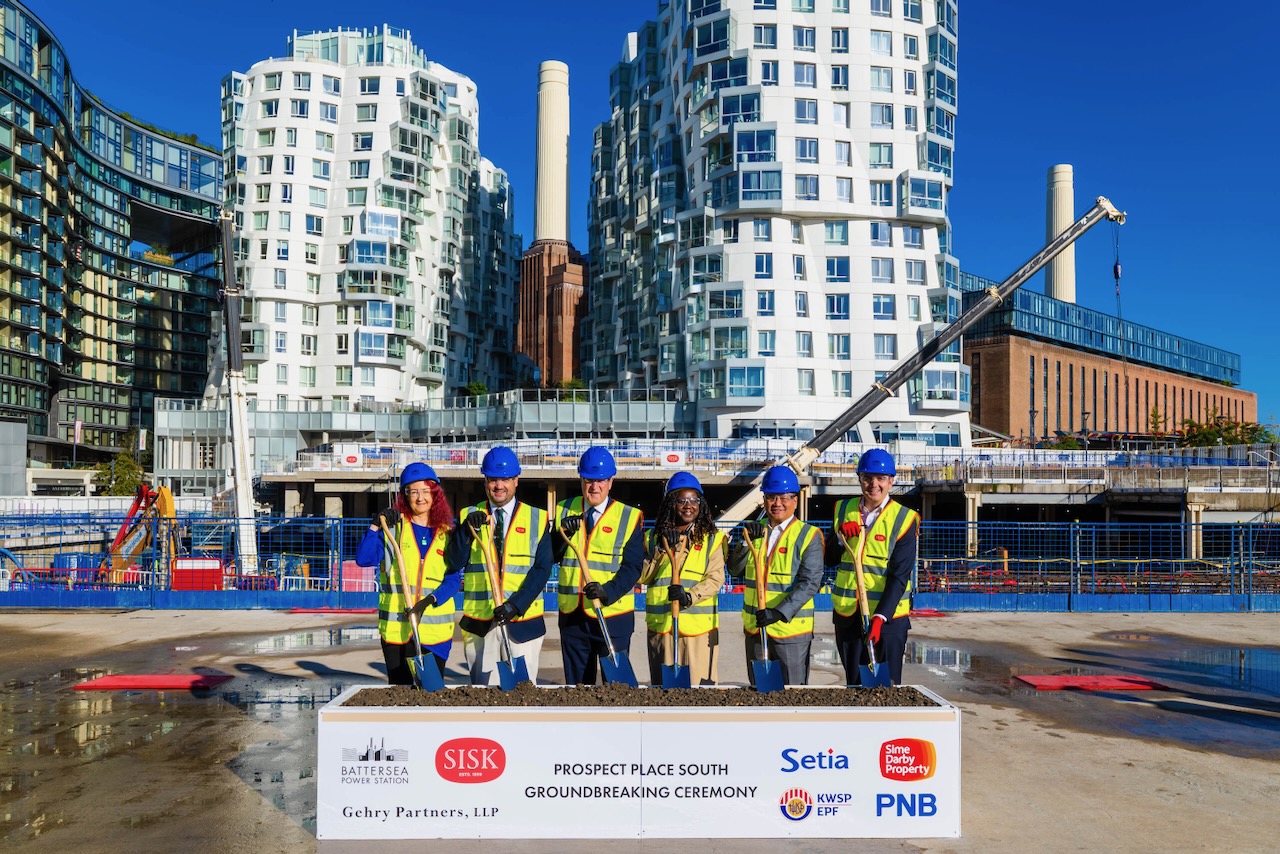
    Sisk has broken ground on Prospect Place South at Battersea Power Station, a brownfield riverside scheme delivering around 300 homes, 65,000 sq ft of commercial space, a 15,000 sq ft community hub and a 600-space cycle hub across two Gehry Partners-designed blocks, Rosewood House and Hayworth House. Gehry’s design targets a reduced carbon footprint with green roofs specified to secure at least a 10% biodiversity net gain, while construction is expected to create 400 jobs, 20% locally sourced, ahead of completion in 2030. Masterplanner Studio Egret West will submit a revised plan this month for the remaining 16 acres, enabling up to 3.2 million sq ft of additional residential, commercial, cultural and leisure floorspace.

    Technical Brief

    • Prospect Place South’s two blocks complete the pedestrianised Electric Boulevard high street frontage and urban grain.
    • Rosewood House and Hayworth House extend the existing Gehry-designed Prospect Place ensemble, maintaining architectural continuity on the riverfront.
    • Battersea Power Station Development Company retains client/developer role, with Sisk appointed as sole main contractor.
    • Green roofs are explicitly tied to delivering at least a 10% biodiversity net gain on-site.
    • Local labour targets build on 7,500 jobs already created across earlier Battersea Power Station phases.
    • Construction is one component of a 42‑acre estate, with roughly half the overall regeneration already delivered.
    • Studio Egret West is reworking Rafael Viñoly’s 15‑year‑old masterplan to reflect changed workspace and lifestyle demand.
    • Remaining 16 acres are masterplanned for up to 3.2 million sq ft of additional mixed-use floorspace.
    • Existing neighbourhood context already includes over 2,200 homes, ~800,000 sq ft offices and 170+ retail/leisure units.

    Our Take

    Studio Egret West’s role on Prospect Place South follows its separate commission to rework Rafael Viñoly’s masterplan for the final 16 acres of the 42-acre Battersea Power Station site, signalling continuity of design intent across the remaining 3.2 million sq ft of planned mixed-use space.

    With a minimum 10% biodiversity net gain target and a 600-space bike hub, Prospect Place South sits at the more ambitious end of London schemes in our infrastructure database, where many brownfield redevelopments reference biodiversity and active travel but rarely quantify them so explicitly.

    The creation of around 400 construction jobs with a 20% local workforce target is notable given the recent employment tribunal claim involving Battersea Power Station Development Company’s former chief executive, and suggests the developer is keen to foreground social value and local hiring commitments as the project enters its next phase.

    Geotechnical Software for Modern Teams

    Centralise site data, logs, and lab results with GEODB-io, CMRR-io, and HYDROGEO-io.

    No credit card required.

    • Save and export unlimited calculations
    • Advanced data visualisation
    • Generate professional PDF reports
    • Cloud storage for all your projects

    Prepared by collating external sources, AI-assisted tools, and Geomechanics.io’s proprietary mining database, then reviewed for technical accuracy & edited by our geotechnical team.

    Related Articles

    Strabag’s Pfaffensteig Tunnel contract: design and delivery notes for rail engineers
    Infrastructure
    4 months ago

    Strabag’s Pfaffensteig Tunnel contract: design and delivery notes for rail engineers

    Strabag and Group company Züblin have secured the design-and-build structural works for the ABS Gäubahn Nord/Pfaffensteig Tunnel in south-west Germany, centred on an 11km twin-bore rail tunnel linking Stuttgart Airport station directly to the Gäubahn line towards Switzerland. About 9.8km will be driven by two TBMs, with conventional tunnelling for the A8 motorway undercrossing and airport connection, plus a 240m cut-and-cover section, retaining structures, railway underpasses and a grade-separated crossing. A 3km surface section will be upgraded and partially realigned for 200km/h operation, delivered under an integrated project delivery model with Ed. Züblin, Wayss & Freytag and Strabag AG sharing tunnelling, structural and earthworks packages.

    National Grid TBM under the Thames: tunnelling design and risk notes for engineers
    Infrastructure
    6 months ago

    National Grid TBM under the Thames: tunnelling design and risk notes for engineers

    A 271.5‑tonne Herrenknecht Mixshield TBM, Caroline, has started driving a 2.2km electricity cable tunnel with a 4m internal diameter beneath the River Thames in Essex for National Grid’s Grain to Tilbury project, delivered by the Ferrovial BEMO joint venture. The drive will pass through variable Thames estuary ground conditions between 35m‑deep launch and reception shafts of 15m and 12m diameter, with tunnelling continuing into 2026 and overall scheme completion targeted for 2029. The new tunnel will replace the 1969 Thames Cable Tunnel and carry new high‑voltage circuits between Grain and Tilbury substations.

    Panama Canal Mixshield undercrossing: design and tunnelling lessons for engineers
    Infrastructure
    7 months ago

    Panama Canal Mixshield undercrossing: design and tunnelling lessons for engineers

    A 13.46m diameter Herrenknecht Mixshield TBM has broken through into the future Balboa station on Panama Metro Line 3 after completing the first-ever TBM undercrossing of the Panama Canal at depths exceeding 60m below sea level. The 5,600kW, 26,616kNm machine, fitted with an accessible cutterhead and more than 4,500 sensors linked via the Herrenknecht.Connected platform, has achieved peak advance of 150 segment rings (about 300m) per month through mixed sandstone, tuff, breccias and basalt. Around 1.5km of the 4.5km twin-track tunnel remains to final breakthrough.

    Related Industries & Products

    Construction

    Quality control software for construction companies with material testing, batch tracking, and compliance management.

    Mining

    Geotechnical software solutions for mining operations including CMRR analysis, hydrogeological testing, and data management.

    QCDB-io

    Comprehensive quality control database for manufacturing, tunnelling, and civil construction with UCS testing, PSD analysis, and grout mix design management.

    AllGeotechnicalInfrastructureHazardsEnvironmental