RWE completes Camster II wind farm: delivery and design notes for engineers
Reviewed by Joe Ashwell
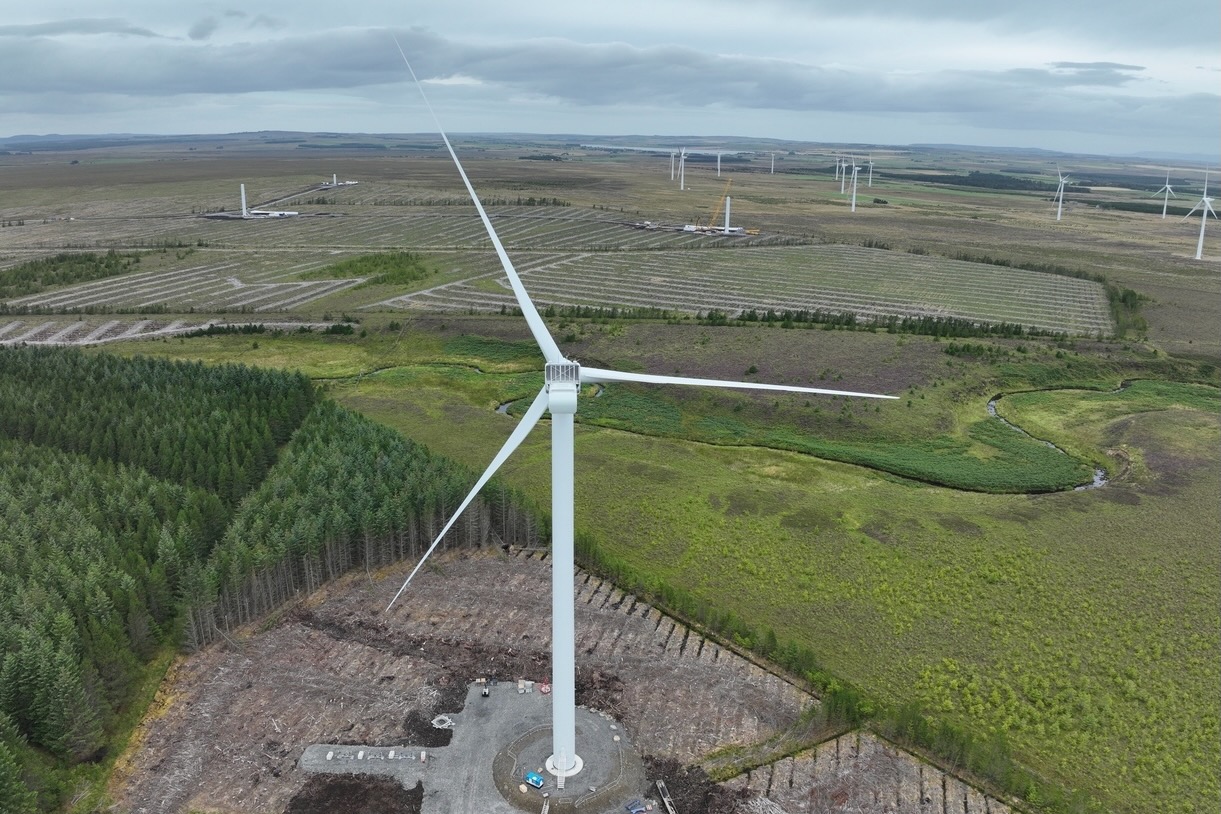
First reported on The Construction Index
30 Second Briefing
RWE has completed the 36 MW Camster II onshore wind farm in Caithness, comprising 10 turbines and enough capacity to supply electricity equivalent to about 51,000 typical homes, as the first of four new Scottish RWE onshore projects totalling up to 232 MW. Principal contractor Farrans supported over 50 construction roles, took on two early careers civil engineering students and an apprentice, and sourced 54% of subcontractors within 20 miles of the site, including Gow Earthworks, GMR Hendersons and John Gunn and Sons. Operations and maintenance will be handled by locally based engineers, consolidating a regional wind cluster that now includes four operational RWE farms in Caithness.
Technical Brief
- Consent for Camster II was granted in July 2021, with physical construction commencing in 2023.
- Grid export began with first power in March 2026, prior to full commissioning.
- Ten-turbine layout implies an average installed capacity of 3.6 MW per unit.
- Camster II is the first of four new Scottish RWE onshore projects totalling up to 232 MW.
- RWE now operates four wind farms in Caithness, forming a concentrated regional generation cluster.
- Farrans’ subcontractor strategy kept 54% of firms within 20 miles, equating to 56% of spend.
- Local O&M resourcing is intended to provide long-term engineering roles tied to asset life.
- Ongoing collaboration between RWE and Farrans continues at the Golticlay wind farm, supporting delivery continuity.
Our Take
RWE’s completion of the 36 MW Camster II in Caithness sits alongside its recent UK power purchase agreement with Network Rail, signalling that RWE is building both generation capacity and long-term offtake in the UK power market rather than relying solely on merchant exposure.
With Camster II contributing to a 232 MW pipeline of four new onshore wind farms in Scotland, RWE is consolidating a material onshore footprint in a region where our infrastructure coverage has more often focused on transport and building projects than grid‑connected renewables.
The fact that 54% of subcontractors on Camster II were sourced within 20 miles of the site, and accounted for 56% of subcontract spend, reinforces a pattern seen in our database where Scottish onshore wind schemes increasingly lean on local civils firms such as Farrans to bolster social licence and planning narratives for future phases.
Prepared by collating external sources, AI-assisted tools, and Geomechanics.io’s proprietary mining database, then reviewed for technical accuracy & edited by our geotechnical team.
Related Articles


Related Industries & Products
Construction
Quality control software for construction companies with material testing, batch tracking, and compliance management.
Mining
Geotechnical software solutions for mining operations including CMRR analysis, hydrogeological testing, and data management.
QCDB-io
Comprehensive quality control database for manufacturing, tunnelling, and civil construction with UCS testing, PSD analysis, and grout mix design management.