Rail Baltica £300M EU bid: construction phasing insights for rail engineers
Reviewed by Tom Sullivan
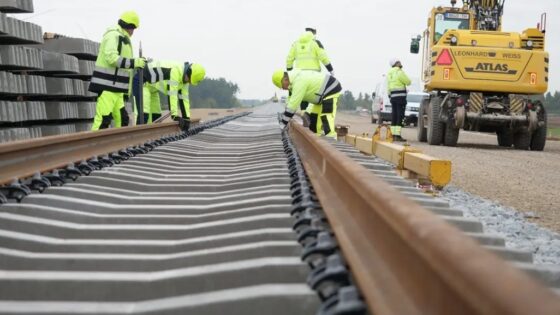
First reported on New Civil Engineer
30 Second Briefing
Rail Baltica has submitted a joint application for about £300M in additional EU funding to accelerate construction and systems installation on the standard‑gauge high‑speed corridor linking Estonia, Latvia and Lithuania with Poland. The request targets core civil works and rail systems needed to integrate the Baltic section into the wider Trans‑European Transport Network, including cross‑border sections and interfaces with existing 1,520mm‑gauge infrastructure. For civil and rail engineers, the funding decision will influence phasing of major earthworks, structures and signalling deployments across all three states.
Technical Brief
- Joint application structure implies coordinated phasing of civil works contracts across Estonia, Latvia and Lithuania.
- Cross‑border sections with Poland require interface design between EU‑standard signalling and legacy Baltic control systems.
- Standard‑gauge alignment must be threaded alongside existing 1,520mm corridors, constraining formation width and structure placement.
- Systems scope includes high‑speed‑capable signalling, telecoms and power supply, not just track and earthworks.
Our Take
Rail Baltica’s reliance on EU funding aligns with the bloc’s broader use of infrastructure as a strategic tool, similar to how the EU is coordinating critical minerals stockpiles and logistics hubs such as the Port of Rotterdam in our other coverage.
Cross-border schemes in Estonia, Latvia, Lithuania and Poland will likely be benchmarked against other large EU-backed initiatives in our 925 Infrastructure stories, where schedule risk often stems from differing national procurement and permitting regimes rather than pure engineering complexity.
Because the European Union features heavily in recent pieces on sanctions and critical raw materials, sustained EU backing for Rail Baltica signals that north–south transport capacity in the Baltics is being treated as part of a wider resilience agenda, not just a regional rail upgrade.
Prepared by collating external sources, AI-assisted tools, and Geomechanics.io’s proprietary mining database, then reviewed for technical accuracy & edited by our geotechnical team.
Related Articles


Related Industries & Products
Construction
Quality control software for construction companies with material testing, batch tracking, and compliance management.
Mining
Geotechnical software solutions for mining operations including CMRR analysis, hydrogeological testing, and data management.
QCDB-io
Comprehensive quality control database for manufacturing, tunnelling, and civil construction with UCS testing, PSD analysis, and grout mix design management.