Post Office tunnel beneath St Giles Quarter: design and risk notes for engineers
Reviewed by Tom Sullivan
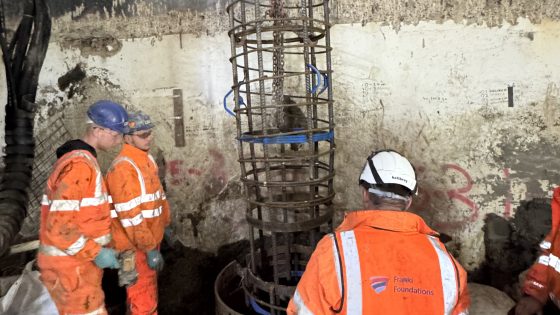
First reported on New Civil Engineer
30 Second Briefing
A-squared Studio has developed a protection strategy for a live Post Office tunnel running beneath the St Giles Quarter redevelopment in London’s Holborn, where an existing tower is being demolished and replaced on the same footprint. The scheme must maintain tunnel integrity and operational access while managing demolition-induced vibration, differential settlement and load transfer from the new high-rise structure. For geotechnical and structural teams, the project centres on temporary works, precise monitoring and foundation design that limits additional stresses on the ageing tunnel lining.
Technical Brief
- Protection concept is described as “novel”, implying departure from standard London tunnel safeguarding details.
- Holborn’s dense utilities and legacy basements likely restrict conventional piling layouts, pushing towards bespoke foundation detailing around the tunnel.
- Age of the Post Office tunnel suggests older lining standards, so safety factors must reflect limited original load allowance.
- Coordination with the asset owner will require formal asset protection agreements and tunnel condition surveys before and after works.
- Continuous structural and geotechnical monitoring is expected to feed into trigger-action response plans for safe working above the tunnel.
- Similar overbuild projects on ageing service tunnels in central London will increasingly need custom protection schemes rather than generic safeguarding envelopes.
Our Take
Underground legacy assets like the Post Office tunnel under Holborn are a recurring challenge in London projects, and in our Infrastructure coverage they often drive bespoke monitoring and settlement-control regimes that can dominate the risk profile even on otherwise routine builds.
New Civil Engineer’s recent focus on BIM, CDEs and digital handover suggests schemes such as St Giles Quarter will be under pressure to capture the tunnel’s condition and protection measures in a structured asset dataset, not just in traditional as-builts.
With 921 Infrastructure stories and many London pieces touching buried utilities and transport tunnels, the Holborn case signals that early 3D utilities/tunnel mapping and legal interface with asset owners are now effectively baseline requirements for central London developments rather than value-adds.
Prepared by collating external sources, AI-assisted tools, and Geomechanics.io’s proprietary mining database, then reviewed for technical accuracy & edited by our geotechnical team.
Related Articles


Related Industries & Products
Construction
Quality control software for construction companies with material testing, batch tracking, and compliance management.
Mining
Geotechnical software solutions for mining operations including CMRR analysis, hydrogeological testing, and data management.
CMRR-io
Streamline coal mine roof stability assessments with our cloud-based CMRR software featuring automated calculations, multi-scenario analysis, and collaborative workflows.
HYDROGEO-io
Comprehensive hydrogeological testing platform for managing, analysing, and reporting on packer tests, lugeon values, and hydraulic conductivity assessments.
GEODB-io
Centralised geotechnical data management solution for storing, accessing, and analysing all your site investigation and material testing data.