Port of Southampton–Vestas deal: port pavement and berth demands for engineers
Reviewed by Tom Sullivan
First reported on New Civil Engineer
30 Second Briefing
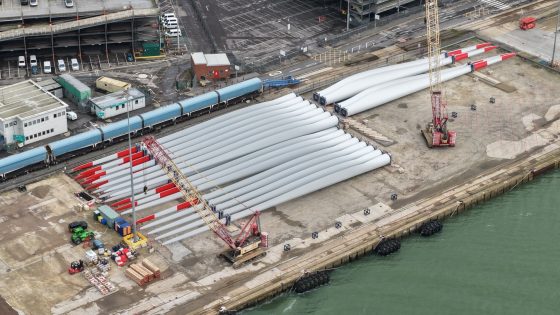
Port of Southampton is expanding its partnership with Vestas to handle larger volumes of offshore wind components, reinforcing its role as a key hub in the UK’s renewable energy logistics. The collaboration focuses on port-side storage, heavy-lift handling and transport of oversized turbine blades, nacelles and towers, requiring specialised quayside cranage and strengthened laydown areas. For civil and port engineers, this signals continued demand for upgraded pavements, marshalling yards and deep-water berths capable of supporting high axle loads and complex heavy-lift operations.
Technical Brief
- Pavements and quaysides designed for repeated SPMT and crawler-crane load cycles.
- Handling full turbine sets concentrates abnormal loads near quay edges, driving stringent bearing capacity checks.
- Storage of long blades demands large unobstructed laydown zones with tight differential settlement limits to avoid distortion.
- Nacelle and tower marshalling requires heavy-duty surfacing with high fatigue resistance to braking and turning stresses.
- Increased offshore wind traffic will intensify interface design between landside haul roads and strengthened quayside slabs.
- Expansion of this hub creates demand for specialist port geotechnical input on ground improvement beneath upgraded hardstandings.
- Similar ports handling offshore wind components will face comparable quay upgrade, ground improvement and cranage integration challenges.
Our Take
Coverage tagged under Projects and Sustainability increasingly shows UK infrastructure owners using long‑term logistics contracts with OEMs such as Vestas to de‑risk future berth and laydown investments, rather than relying solely on public funding cycles.
For the United Kingdom, our recent Infrastructure pieces indicate that ports able to handle oversized renewable components tend to attract parallel investment in grid connections and hinterland road/rail, which can materially shorten programme times for adjacent industrial or storage schemes.
Prepared by collating external sources, AI-assisted tools, and Geomechanics.io’s proprietary mining database, then reviewed for technical accuracy & edited by our geotechnical team.
Related Articles


Related Industries & Products
Construction
Quality control software for construction companies with material testing, batch tracking, and compliance management.
Mining
Geotechnical software solutions for mining operations including CMRR analysis, hydrogeological testing, and data management.
CMRR-io
Streamline coal mine roof stability assessments with our cloud-based CMRR software featuring automated calculations, multi-scenario analysis, and collaborative workflows.
HYDROGEO-io
Comprehensive hydrogeological testing platform for managing, analysing, and reporting on packer tests, lugeon values, and hydraulic conductivity assessments.
GEODB-io
Centralised geotechnical data management solution for storing, accessing, and analysing all your site investigation and material testing data.