Geomechanics.io

  • Free Tools
Sign UpLog In

Geomechanics.io

Geomechanics, Streamlined.

© 2026 Geomechanics.io. All rights reserved.

Geomechanics.io

CMRR-ioGEODB-ioHYDROGEO-ioQCDB-ioFree Tools & CalculatorsBlogLatest Industry News

Industries

MiningConstructionTunnelling

Company

Terms of UsePrivacy PolicyLinkedIn
    Product
    Projects

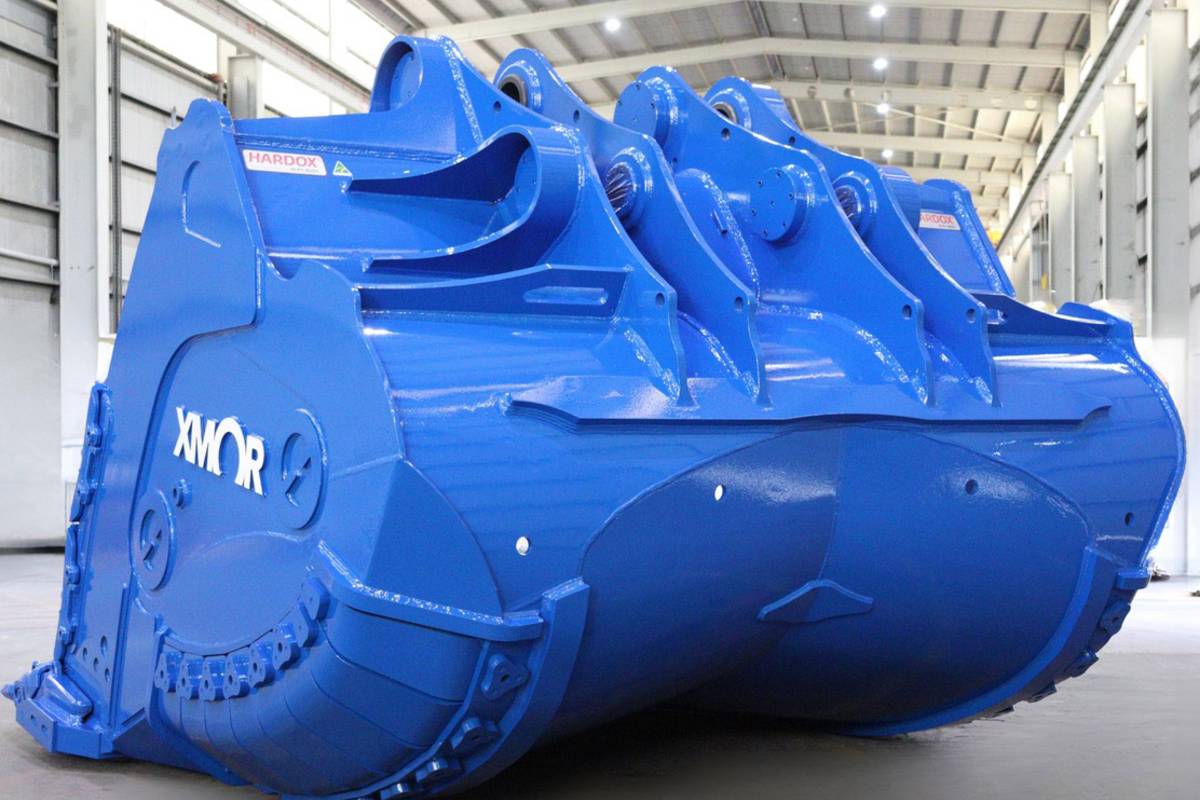
    ONTRAC Group’s XMOR bucket: payload, wear and fuel-efficiency notes for mine engineers

    September 9, 2026|

    Reviewed by Joe Ashwell

    ONTRAC Group’s XMOR bucket: payload, wear and fuel-efficiency notes for mine engineers

    First reported on Australian Mining

    30 Second Briefing

    ONTRAC Group’s XMOR bucket range, manufactured in Australia under licence from SSAB, cuts dead weight so every kilogram of removed steel becomes additional payload. The design uses high-strength, wear-resistant steels and a re‑engineered back and sides with an inverted keel supplied as a plug‑and‑play modular unit, shifting material away from low-stress zones. For mine operators, this allows larger effective payloads per pass without upsizing the excavator, with implications for haulage cycle times, fuel burn and wear on ground‑engaging tools.

    Technical Brief

    • Design work focuses on the back and side plates, where bulk steel is structurally least efficient.
    • An inverted keel module is supplied as a plug‑and‑play unit, simplifying replacement and rebuilds.

    Our Take

    Weight-optimised buckets like ONTRAC Group’s XMOR design directly complement the productivity push seen in recent Australian iron ore coverage, such as Fortescue’s record Pilbara shipments, by turning existing truck and loader fleets into higher effective-capacity assets without new mobile plant purchases.

    In our database of 1278 Mining stories, most Australia-focused ‘Product’ pieces are now framed around incremental efficiency gains rather than greenfield capacity, suggesting that lighter bucket systems will be evaluated not just on payload but on how quickly they pay back through reduced cycle times and fuel burn.

    For Australian operators already investing in digital and autonomous fleets, as highlighted in the recent article on AI and connected data in local mines, lower-mass buckets provide cleaner input parameters for optimisation software, making it easier to model and lock in consistent payload targets across mixed equipment fleets.

    Geotechnical Software for Modern Teams

    Centralise site data, logs, and lab results with GEODB-io, CMRR-io, and HYDROGEO-io.

    No credit card required.

    • Save and export unlimited calculations
    • Advanced data visualisation
    • Generate professional PDF reports
    • Cloud storage for all your projects

    Prepared by collating external sources, AI-assisted tools, and Geomechanics.io’s proprietary mining database, then reviewed for technical accuracy & edited by our geotechnical team.

    Related Articles

    Mining
    about 2 hours ago

    Tru-Trac conveyor belt and thermal scanning: reliability lessons for mine engineers

    Advanced thermal scanning combined with modern belt scanning is being deployed by Tru-Trac to detect hotspots, misalignment and structural defects on high-capacity mining conveyors before they escalate into catastrophic failures. David Pereira, Head of Sales, points to continuous infrared monitoring of idlers, pulleys and drive stations, integrated with belt rip and splice detection systems, to trigger early interventions rather than reactive shutdowns. For engineers, the key shift is moving condition monitoring from periodic manual inspections to automated, full-length conveyor health scans that can be trended and alarmed in real time.

    Mining
    about 2 hours ago

    Weir comminution efficiency gains: design and control lessons for mine engineers

    Technology-led optimisation of comminution circuits can deliver immediate, material efficiency gains when applied with tight process control, argues JD Singleton, Comminution Director for EMEA at Weir. Singleton links precision deployment of tools such as high-pressure grinding rolls, advanced process control and real-time ore characterisation to lower specific energy consumption and reduced CO₂ per tonne milled. He stresses that disciplined implementation and continuous performance tracking are essential if mines are to meet carbon targets without escalating unit operating costs.

    Mining
    about 2 hours ago

    Darma Henwa’s 10 new Liebherr units: pit advance and stability notes for mine teams

    Darma Henwa has expanded its fleet with 10 new Liebherr machines to support increased overburden and coal production at Kaltim Prima Coal’s Bengalon mine in East Kalimantan and Arutmin’s Kintap mine in South Kalimantan. The additional units, likely including large hydraulic excavators and ultra-class mining trucks typical of Liebherr’s Indonesian deployments, are being deployed to a new pit at Bengalon and to meet higher production targets at Kintap. For mine planners and geotechnical teams, the larger fleet implies higher stripping rates, faster pit advance and tighter haul road and dump stability requirements.

    Related Industries & Products

    Mining

    Geotechnical software solutions for mining operations including CMRR analysis, hydrogeological testing, and data management.

    CMRR-io

    Streamline coal mine roof stability assessments with our cloud-based CMRR software featuring automated calculations, multi-scenario analysis, and collaborative workflows.

    HYDROGEO-io

    Comprehensive hydrogeological testing platform for managing, analysing, and reporting on packer tests, lugeon values, and hydraulic conductivity assessments.

    GEODB-io

    Centralised geotechnical data management solution for storing, accessing, and analysing all your site investigation and material testing data.

    AllGeotechnicalInfrastructureHazardsEnvironmental