Network Rail treatment trains: autumn resilience lessons for geotechnical teams
Reviewed by Joe Ashwell
First reported on New Civil Engineer
30 Second Briefing
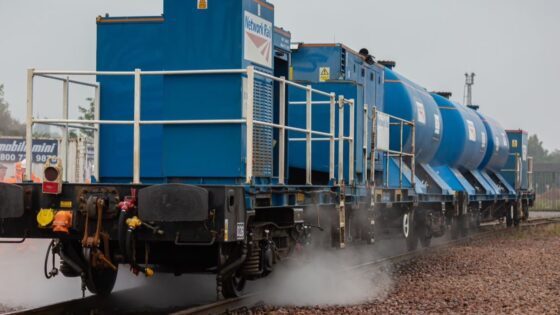
Network Rail is deploying four specialist treatment trains to treat more than 87,000km of track across 224 circuits on key routes in Wales and the Borders ahead of forecast wetter, windier autumn and winter conditions. The trains will apply high-pressure water jets and adhesion modifiers to railheads to remove leaf mulch and improve wheel–rail interface performance, reducing low-adhesion braking distances and signal failures. For geotechnical and drainage teams, the move signals closer integration of vegetation management, runoff control and railhead conditioning on vulnerable cuttings and embankments.
Technical Brief
- Circuits prioritised include leaf‑fall hotspots beneath mature lineside woodland and steep cuttings.
- Operations are scheduled predominantly overnight to avoid conflicting with daytime passenger and freight paths.
- High‑pressure water jets are configured to strip compacted organic contamination without damaging rail steel microstructure.
- Adhesion modifier application is targeted on approach to signals, junctions and known low‑adhesion braking zones.
- Deployment planning is integrated with seasonal vegetation clearance and drainage inspections on embankments and cuttings.
- Safety focus is on reducing SPADs, wheel slide incidents and extended braking distances in wet–leaf conditions.
- Similar integrated railhead–drainage–vegetation regimes are increasingly being adopted on UK routes with heavy tree cover.
Our Take
Network Rail’s use of four specialist treatment trains on 224 circuits in Wales and the Borders sits alongside a run of recent permanent-way renewals in England (e.g. the £1.5M Snelland and £1.4M Hubbert’s Bridge schemes), signalling a strategy that couples seasonal resilience operations with targeted asset replacement rather than relying on renewals alone.
Our database shows Network Rail appearing frequently across the 917 Infrastructure stories, and this autumn–winter deployment in Wales complements larger capital works such as the £41M North West earthworks and the £13M Birmingham New Street overhead line replacement, indicating that weather-related resilience is being tackled both through temporary seasonal measures and long-lived civils upgrades.
For practitioners, the scale of 224 treated circuits suggests that autumn leaf-fall and low-adhesion risk is being managed as a network-wide operational issue in Wales and the Borders, which is likely to influence timetable planning, possession strategies and the prioritisation of future drainage and earthworks schemes on these same corridors.
Prepared by collating external sources, AI-assisted tools, and Geomechanics.io’s proprietary mining database, then reviewed for technical accuracy & edited by our geotechnical team.
Related Articles


Related Industries & Products
Construction
Quality control software for construction companies with material testing, batch tracking, and compliance management.
Mining
Geotechnical software solutions for mining operations including CMRR analysis, hydrogeological testing, and data management.
CMRR-io
Streamline coal mine roof stability assessments with our cloud-based CMRR software featuring automated calculations, multi-scenario analysis, and collaborative workflows.
HYDROGEO-io
Comprehensive hydrogeological testing platform for managing, analysing, and reporting on packer tests, lugeon values, and hydraulic conductivity assessments.
GEODB-io
Centralised geotechnical data management solution for storing, accessing, and analysing all your site investigation and material testing data.