Geomechanics.io

  • Free Tools
Sign UpLog In

    Geomechanics.io

    Geomechanics, Streamlined.

    © 2026 Geomechanics.io. All rights reserved.

    Geomechanics.io

    CMRR-ioGEODB-ioHYDROGEO-ioQCDB-ioFree Tools & CalculatorsBlogLatest Industry News

    Industries

    MiningConstructionTunnelling

    Company

    Terms of UsePrivacy PolicyLinkedIn
    Projects
    Sustainability

    National Highways’ Hertfordshire bridge infill: key asset lessons for engineers

    September 9, 2026|

    Reviewed by Joe Ashwell

    National Highways’ Hertfordshire bridge infill: key asset lessons for engineers

    First reported on New Civil Engineer

    30 Second Briefing

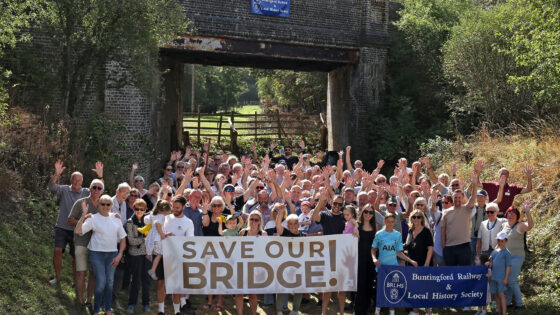
    More than 100 campaigners have protested against National Highways’ plan to infill a historic disused railway overbridge in Hertfordshire, a treatment typically involving mass concrete or foamed fill placed between abutments to avoid structural repairs. Opponents argue that infilling would permanently block the former rail corridor for future active travel or rail reuse and alter the masonry structure’s heritage character. For asset managers and bridge engineers, the dispute signals continuing scrutiny of infill as a low-maintenance option for ageing masonry spans on disused lines.

    Technical Brief

    • Proposed treatment would likely use mass concrete or foamed lightweight fill packed between masonry abutments.
    • Infill solution effectively converts the masonry arch to a buried culvert with soil–structure interaction dominated by the new fill.
    • Load redistribution would shift from arch compression to vertical bearing and lateral earth pressures on abutments and wingwalls.
    • Drainage detailing becomes critical to avoid trapped water behind infill, elevated pore pressures and frost damage in masonry.
    • Once infilled, any future trackbed lowering or utility corridor creation would require bulk excavation of hardened fill.
    • Inspection regime changes from visible masonry defect monitoring to buried-structure surveillance via limited access points, if any.
    • Carbon footprint of large-volume concrete or foamed fill is a growing challenge versus targeted arch strengthening or partial reconstruction.

    Our Take

    National Highways appears in multiple recent pieces in our database for major upgrade works on the A38 and M3, so local resistance in Hertfordshire adds a heritage and community‑acceptance risk dimension to what is otherwise framed as a nationally scaled renewal programme.

    With more than 100 people protesting a single bridge intervention in Hertfordshire, similar asset‑management decisions on ageing structures along England’s Strategic Road Network may now face closer scrutiny from local groups and planning bodies, potentially elongating programme timescales.

    Our infrastructure coverage shows National Highways simultaneously pushing complex capacity schemes and EV‑charging strategy work with WSP and KPMG, so reputational issues around heritage treatment could spill over into stakeholder confidence on these higher‑profile, sustainability‑tagged initiatives.

    Geotechnical Software for Modern Teams

    Centralise site data, logs, and lab results with GEODB-io, CMRR-io, and HYDROGEO-io.

    No credit card required.

    • Save and export unlimited calculations
    • Advanced data visualisation
    • Generate professional PDF reports
    • Cloud storage for all your projects

    Prepared by collating external sources, AI-assisted tools, and Geomechanics.io’s proprietary mining database, then reviewed for technical accuracy & edited by our geotechnical team.

    Related Articles

    Strabag’s Pfaffensteig Tunnel contract: design and delivery notes for rail engineers
    Infrastructure
    4 months ago

    Strabag’s Pfaffensteig Tunnel contract: design and delivery notes for rail engineers

    Strabag and Group company Züblin have secured the design-and-build structural works for the ABS Gäubahn Nord/Pfaffensteig Tunnel in south-west Germany, centred on an 11km twin-bore rail tunnel linking Stuttgart Airport station directly to the Gäubahn line towards Switzerland. About 9.8km will be driven by two TBMs, with conventional tunnelling for the A8 motorway undercrossing and airport connection, plus a 240m cut-and-cover section, retaining structures, railway underpasses and a grade-separated crossing. A 3km surface section will be upgraded and partially realigned for 200km/h operation, delivered under an integrated project delivery model with Ed. Züblin, Wayss & Freytag and Strabag AG sharing tunnelling, structural and earthworks packages.

    National Grid TBM under the Thames: tunnelling design and risk notes for engineers
    Infrastructure
    6 months ago

    National Grid TBM under the Thames: tunnelling design and risk notes for engineers

    A 271.5‑tonne Herrenknecht Mixshield TBM, Caroline, has started driving a 2.2km electricity cable tunnel with a 4m internal diameter beneath the River Thames in Essex for National Grid’s Grain to Tilbury project, delivered by the Ferrovial BEMO joint venture. The drive will pass through variable Thames estuary ground conditions between 35m‑deep launch and reception shafts of 15m and 12m diameter, with tunnelling continuing into 2026 and overall scheme completion targeted for 2029. The new tunnel will replace the 1969 Thames Cable Tunnel and carry new high‑voltage circuits between Grain and Tilbury substations.

    Panama Canal Mixshield undercrossing: design and tunnelling lessons for engineers
    Infrastructure
    7 months ago

    Panama Canal Mixshield undercrossing: design and tunnelling lessons for engineers

    A 13.46m diameter Herrenknecht Mixshield TBM has broken through into the future Balboa station on Panama Metro Line 3 after completing the first-ever TBM undercrossing of the Panama Canal at depths exceeding 60m below sea level. The 5,600kW, 26,616kNm machine, fitted with an accessible cutterhead and more than 4,500 sensors linked via the Herrenknecht.Connected platform, has achieved peak advance of 150 segment rings (about 300m) per month through mixed sandstone, tuff, breccias and basalt. Around 1.5km of the 4.5km twin-track tunnel remains to final breakthrough.

    Related Industries & Products

    Construction

    Quality control software for construction companies with material testing, batch tracking, and compliance management.

    Mining

    Geotechnical software solutions for mining operations including CMRR analysis, hydrogeological testing, and data management.

    QCDB-io

    Comprehensive quality control database for manufacturing, tunnelling, and civil construction with UCS testing, PSD analysis, and grout mix design management.

    AllGeotechnicalInfrastructureHazardsEnvironmental