Geomechanics.io

  • Free Tools
Sign UpLog In
Built byBoxcut Studio

Geomechanics.io

Geomechanics, Streamlined.

© 2026 Geomechanics.io. All rights reserved.

Geomechanics.io

CMRR-ioGEODB-ioHYDROGEO-ioQCDB-ioFree Tools & CalculatorsBlogLatest Industry News

Industries

MiningConstructionTunnelling

Company

Terms of UsePrivacy PolicyLinkedIn
    Safety
    Sustainability

    National Engineering Day: inclusive PPE design and safety lessons for site engineers

    November 4, 2026|

    Reviewed by Joe Ashwell

    National Engineering Day: inclusive PPE design and safety lessons for site engineers

    First reported on New Civil Engineer

    30 Second Briefing

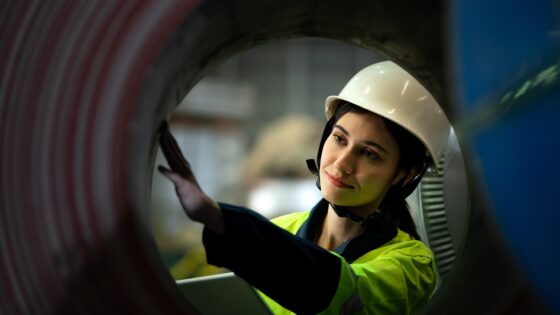
    National Engineering Day uses the simple child’s question “Can you be an engineer and wear a dress?” to challenge stereotypes that still deter many girls from civil and infrastructure careers. Female engineers describe working on site in PPE adapted for smaller frames, maternity needs and religious dress, contrasting this with ill‑fitting hi-vis, harnesses and safety boots that can compromise comfort and even safe movement on scaffolds or in excavations. The piece signals growing pressure on contractors and PPE suppliers to provide gender-inclusive, standards-compliant kit without diluting EN ISO safety requirements.

    Technical Brief

    • PPE must still comply with EN ISO standards for hi-vis, helmets, gloves and safety footwear.
    • Harness and lanyard attachment points need correct positioning on smaller torsos to avoid fall-arrest injury.
    • Poorly sized boots reduce ladder and scaffold grip area, increasing slip risk on wet steel.
    • Oversized hi-vis and jackets can snag on rebar, scaffold fittings or plant, breaching safe systems.
    • Maternity-compatible PPE must maintain impact, penetration and fall-arrest performance across changing body dimensions.
    • Religious dress on sites is typically managed via flame-retardant, close-fitting layers under standard PPE.
    • Wider adoption of gender-specific sizing is framed as a safety-critical control, not a welfare “nice-to-have”.

    Our Take

    New Civil Engineer appears repeatedly in our database as a convenor of early-career initiatives and awards (e.g. the Beyond Design Early Careers Bridges Challenge and Heathrow’s innovation competition), so a National Engineering Day piece on identity and dress likely feeds into its wider effort to reshape what ‘typical’ engineers look like to entrants.

    By linking personal presentation to engineering identity, New Civil Engineer is extending the same platform it uses for awards and conferences into values signalling; for practitioners, that can influence how client-facing organisations frame site dress codes, office policies and mentoring for diverse early-career staff.

    Geotechnical Software for Modern Teams

    Centralise site data, logs, and lab results with GEODB-io, CMRR-io, and HYDROGEO-io.

    No credit card required.

    • Save and export unlimited calculations
    • Advanced data visualisation
    • Generate professional PDF reports
    • Cloud storage for all your projects

    Prepared by collating external sources, AI-assisted tools, and Geomechanics.io’s proprietary mining database, then reviewed for technical accuracy & edited by our geotechnical team.

    Related Articles

    Strabag’s Pfaffensteig Tunnel contract: design and delivery notes for rail engineers
    Infrastructure
    6 months ago

    Strabag’s Pfaffensteig Tunnel contract: design and delivery notes for rail engineers

    Strabag and Group company Züblin have secured the design-and-build structural works for the ABS Gäubahn Nord/Pfaffensteig Tunnel in south-west Germany, centred on an 11km twin-bore rail tunnel linking Stuttgart Airport station directly to the Gäubahn line towards Switzerland. About 9.8km will be driven by two TBMs, with conventional tunnelling for the A8 motorway undercrossing and airport connection, plus a 240m cut-and-cover section, retaining structures, railway underpasses and a grade-separated crossing. A 3km surface section will be upgraded and partially realigned for 200km/h operation, delivered under an integrated project delivery model with Ed. Züblin, Wayss & Freytag and Strabag AG sharing tunnelling, structural and earthworks packages.

    National Grid TBM under the Thames: tunnelling design and risk notes for engineers
    Infrastructure
    8 months ago

    National Grid TBM under the Thames: tunnelling design and risk notes for engineers

    A 271.5‑tonne Herrenknecht Mixshield TBM, Caroline, has started driving a 2.2km electricity cable tunnel with a 4m internal diameter beneath the River Thames in Essex for National Grid’s Grain to Tilbury project, delivered by the Ferrovial BEMO joint venture. The drive will pass through variable Thames estuary ground conditions between 35m‑deep launch and reception shafts of 15m and 12m diameter, with tunnelling continuing into 2026 and overall scheme completion targeted for 2029. The new tunnel will replace the 1969 Thames Cable Tunnel and carry new high‑voltage circuits between Grain and Tilbury substations.

    Panama Canal Mixshield undercrossing: design and tunnelling lessons for engineers
    Infrastructure
    9 months ago

    Panama Canal Mixshield undercrossing: design and tunnelling lessons for engineers

    A 13.46m diameter Herrenknecht Mixshield TBM has broken through into the future Balboa station on Panama Metro Line 3 after completing the first-ever TBM undercrossing of the Panama Canal at depths exceeding 60m below sea level. The 5,600kW, 26,616kNm machine, fitted with an accessible cutterhead and more than 4,500 sensors linked via the Herrenknecht.Connected platform, has achieved peak advance of 150 segment rings (about 300m) per month through mixed sandstone, tuff, breccias and basalt. Around 1.5km of the 4.5km twin-track tunnel remains to final breakthrough.

    Related Industries & Products

    Construction

    Quality control software for construction companies with material testing, batch tracking, and compliance management.

    Mining

    Geotechnical software solutions for mining operations including CMRR analysis, hydrogeological testing, and data management.

    CMRR-io

    Streamline coal mine roof stability assessments with our cloud-based CMRR software featuring automated calculations, multi-scenario analysis, and collaborative workflows.

    HYDROGEO-io

    Comprehensive hydrogeological testing platform for managing, analysing, and reporting on packer tests, lugeon values, and hydraulic conductivity assessments.

    GEODB-io

    Centralised geotechnical data management solution for storing, accessing, and analysing all your site investigation and material testing data.

    AllGeotechnicalInfrastructureHazardsEnvironmental