Mace steel reuse at 30 Duke Street: embodied carbon lessons for designers
Reviewed by Joe Ashwell
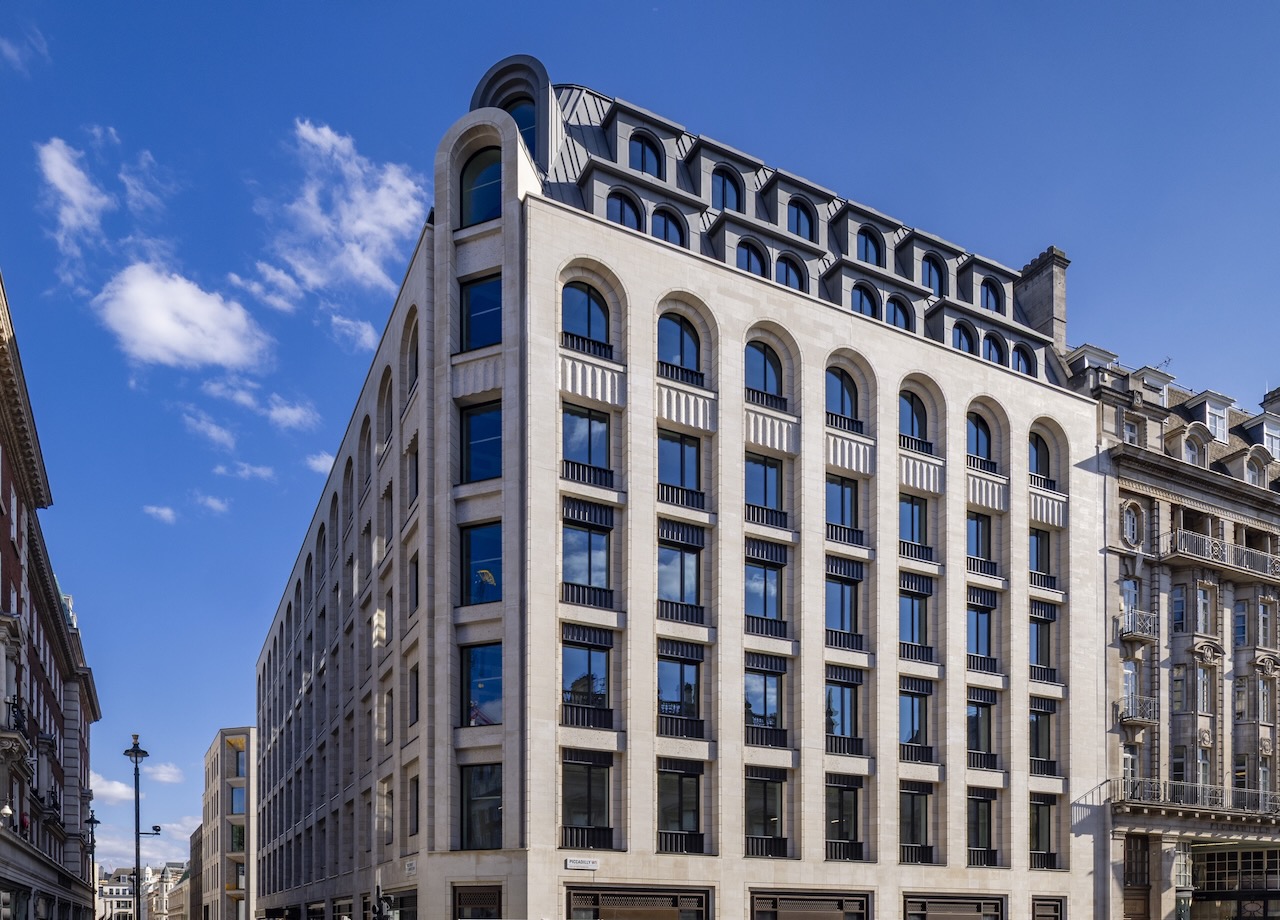
First reported on The Construction Index
30 Second Briefing
Mace Construct has completed the 68,000 sq ft 30 Duke Street St James’s scheme for GPE using a steel frame made from 78% recycled sections, largely reclaimed from other GPE assets, cutting embodied carbon by 744 tonnes. The fully electric office and retail building also incorporates Hydro CIRCAL 100R aluminium and ORAÉ glass, both with 100% recycled content, in what is claimed as the UK’s largest commercial steel reuse project. Portland stone, marble, raised access flooring and the original French Railways House mosaic were retained in situ, reducing demolition waste and new material demand.
Technical Brief
- Structural steel was partly reclaimed from other GPE assets, requiring detailed survey, dismantling and re-certification.
- Fully electric building services eliminate on-site combustion, shifting operational carbon intensity to grid decarbonisation performance.
- Hydro CIRCAL 100R aluminium is deployed as façade/fit-out metalwork, demanding tight traceability of scrap feedstock.
- ORAÉ glass with 100% recycled content introduces façade specification challenges around optical quality and structural performance.
- Portland stone, marble and raised access flooring were reused in situ, reducing demolition, temporary works and disposal logistics.
- Retention of the original French Railways House mosaic imposed protection, vibration and access constraints during structural works.
- Mace and GPE emphasise early-stage circularity targets, requiring supply-chain engagement before structural and façade design freeze.
Our Take
Mace Construct’s use of reclaimed steel and 100% recycled-content ORAÉ glass at 30 Duke Street St James’s aligns with other London schemes in our database where Mace is also fronting low‑carbon envelope and façade upgrades, such as the St Magnus House recladding with Reynaers Aluminium systems.
Across our 924 Infrastructure stories, relatively few UK office redevelopments in the West End explicitly quantify embodied carbon savings as at 30 Duke Street St James’s, which suggests GPE and Mace are positioning this scheme to meet tightening London planning expectations on whole‑life carbon disclosure.
With Mace Construct already engaged on central London office projects like 1 Victoria Street and Red Lion Court, the high recycled steel percentage on this West End job signals that circular steel procurement could become a standard offer in its London commercial portfolio rather than a one‑off pilot.
Prepared by collating external sources, AI-assisted tools, and Geomechanics.io’s proprietary mining database, then reviewed for technical accuracy & edited by our geotechnical team.
Related Articles


Related Industries & Products
Construction
Quality control software for construction companies with material testing, batch tracking, and compliance management.
Mining
Geotechnical software solutions for mining operations including CMRR analysis, hydrogeological testing, and data management.
CMRR-io
Streamline coal mine roof stability assessments with our cloud-based CMRR software featuring automated calculations, multi-scenario analysis, and collaborative workflows.
HYDROGEO-io
Comprehensive hydrogeological testing platform for managing, analysing, and reporting on packer tests, lugeon values, and hydraulic conductivity assessments.
GEODB-io
Centralised geotechnical data management solution for storing, accessing, and analysing all your site investigation and material testing data.