Mabey Weston bridge installation: temporary works and sustainability notes for engineers
Reviewed by Tom Sullivan
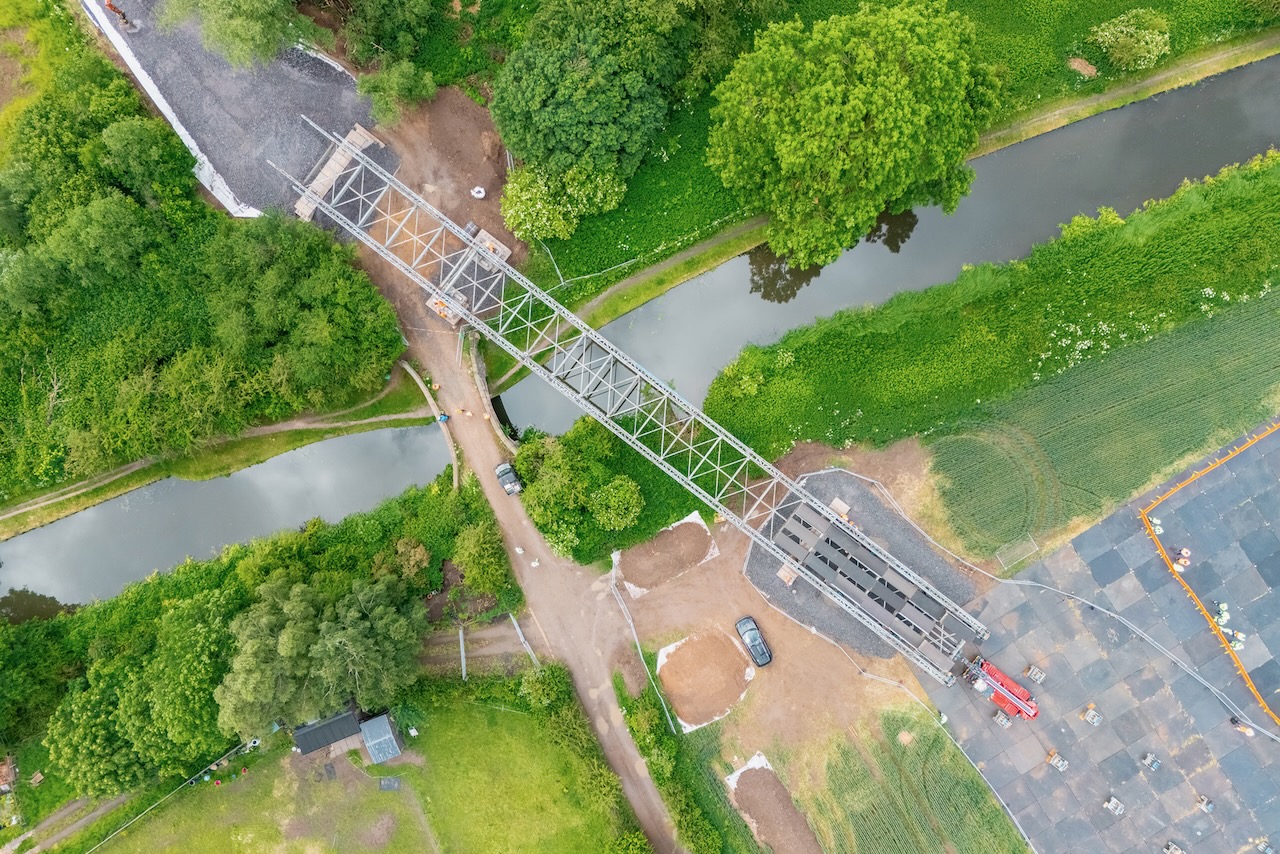
First reported on The Construction Index
30 Second Briefing
Mabey Hire has installed a 39m clear-span temporary bridge at Weston-on-Trent for Balfour Beatty and National Grid, overcoming a 10t weight limit on the Grade II listed Scotch Bridge and access issues for a 500t crane. Using its Compact 200 modular panel system, Mabey tail-launched a 13-bay main span with a 5-bay counterweight and a further 15m of adjacent span/down ramp, pushing the deck across the Trent and Mersey Canal on rollers within a 30-minute navigation stoppage. The bridge nose was jacked down to act as a ramp on a lower foundation, avoiding excavation near a medieval mill and saving about 1,500 tonnes of stone.
Technical Brief
- Flood damage to Weston-on-Trent electrical infrastructure drove the need for rapid temporary access across the canal.
- A 10t weight limit on the Grade II listed Scotch Bridge prevented conventional heavy plant access for repairs.
- Initial methodology using a 500t crane was abandoned because approach roads and structures could not carry crane loads.
- A historic contaminated waste site on the far bank forced the alignment to be skewed rather than parallel to the canal.
- Discovery of a medieval water mill prohibited excavation for conventional temporary abutments on the receiving bank.
- Balfour Beatty’s temporary works team and Mabey Hire iteratively re-designed the scheme as constraints emerged on site.
- The launch on 28 May was scheduled under a Canals & River Trust 30‑minute navigation stoppage window.
- Bridge will remain in place until completion of National Grid electricity repair works, currently programmed to December 2026.
Our Take
Mabey Hire’s role at Weston-on-Trent follows its use of bespoke temporary works and monitoring on the New York Road Flyover in Leeds, signalling that clients such as Balfour Beatty and National Grid are increasingly turning to it for complex, short-duration access and propping solutions on constrained UK sites.
The 30-minute stoppage window for Trent and Mersey Canal traffic implies a launch methodology optimised for navigation-critical assets, which is likely to appeal to asset owners such as the Canal & River Trust facing similar constraints across the UK’s ageing canal and river bridge stock.
With 917 Infrastructure stories and 2,388 tag-matched ‘Projects’/‘Sustainability’ pieces in our coverage, this UK temporary bridge scheme sits within a relatively small subset that explicitly tackles access constraints on existing transport corridors without long-term closures, something that could be instructive for other Balfour Beatty-led programmes like the Edinburgh Airport expansion.
Prepared by collating external sources, AI-assisted tools, and Geomechanics.io’s proprietary mining database, then reviewed for technical accuracy & edited by our geotechnical team.
Related Articles


Related Industries & Products
Construction
Quality control software for construction companies with material testing, batch tracking, and compliance management.
Mining
Geotechnical software solutions for mining operations including CMRR analysis, hydrogeological testing, and data management.
CMRR-io
Streamline coal mine roof stability assessments with our cloud-based CMRR software featuring automated calculations, multi-scenario analysis, and collaborative workflows.
HYDROGEO-io
Comprehensive hydrogeological testing platform for managing, analysing, and reporting on packer tests, lugeon values, and hydraulic conductivity assessments.
GEODB-io
Centralised geotechnical data management solution for storing, accessing, and analysing all your site investigation and material testing data.