M3 Junction 9 upgrade halfway: bridge demolition and traffic staging for engineers
Reviewed by Tom Sullivan
First reported on New Civil Engineer
30 Second Briefing
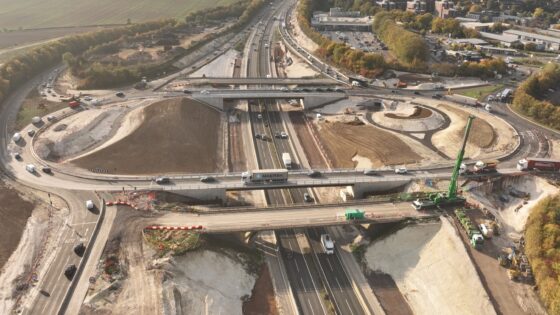
National Highways’ £m-scale upgrade of M3 Junction 9 near Winchester has reached its halfway point, with demolition of the existing A34 and Easton Lane overbridges now being prepared. The scheme will replace the current signalised roundabout with a free-flow, grade-separated interchange linking the M3 and A34, designed to increase capacity for long-distance freight and local traffic between Southampton, the Midlands and the South Coast ports. Upcoming works will require phased weekend closures, complex traffic management and careful sequencing to protect the adjacent River Itchen SSSI and nearby rail infrastructure.
Technical Brief
- Weekend closures will be used as possession windows, limiting worker exposure to live traffic interfaces.
- Traffic management layouts must maintain access for emergency services while isolating demolition plant from public flows.
- Temporary works for bridge removal will need independent category checks under standard UK highways assurance processes.
- Similar grade-separated interchange upgrades on the Strategic Road Network are increasingly bundling ecology and rail-interface risk into early CDM design reviews.
Our Take
National Highways appears frequently in our infrastructure coverage, from the M4 embankment stabilisation in Wiltshire to the M40 resurfacing, signalling a sustained programme of major works on ageing strategic corridors rather than isolated upgrades like this M3 Junction 9 scheme.
The recent criticism of National Highways’ road runoff design rules by nine drainage consultancies suggests that any geometry or drainage changes around M3 Junction 9 will be scrutinised for how they handle water management as much as for traffic capacity and safety.
With National Highways also trialling hydrogen-powered construction on the Lower Thames Crossing, there is a live question as to whether carbon-reduction measures or alternative plant will be adopted on motorway upgrades such as this Hampshire junction, or whether they remain conventional diesel-heavy jobs.
Prepared by collating external sources, AI-assisted tools, and Geomechanics.io’s proprietary mining database, then reviewed for technical accuracy & edited by our geotechnical team.


