Geomechanics.io

  • Free Tools
Sign UpLog In

    Geomechanics.io

    Geomechanics, Streamlined.

    © 2026 Geomechanics.io. All rights reserved.

    Geomechanics.io

    CMRR-ioGEODB-ioHYDROGEO-ioQCDB-ioFree Tools & CalculatorsBlogLatest Industry News

    Industries

    MiningConstructionTunnelling

    Company

    Terms of UsePrivacy PolicyLinkedIn
    Product
    Projects

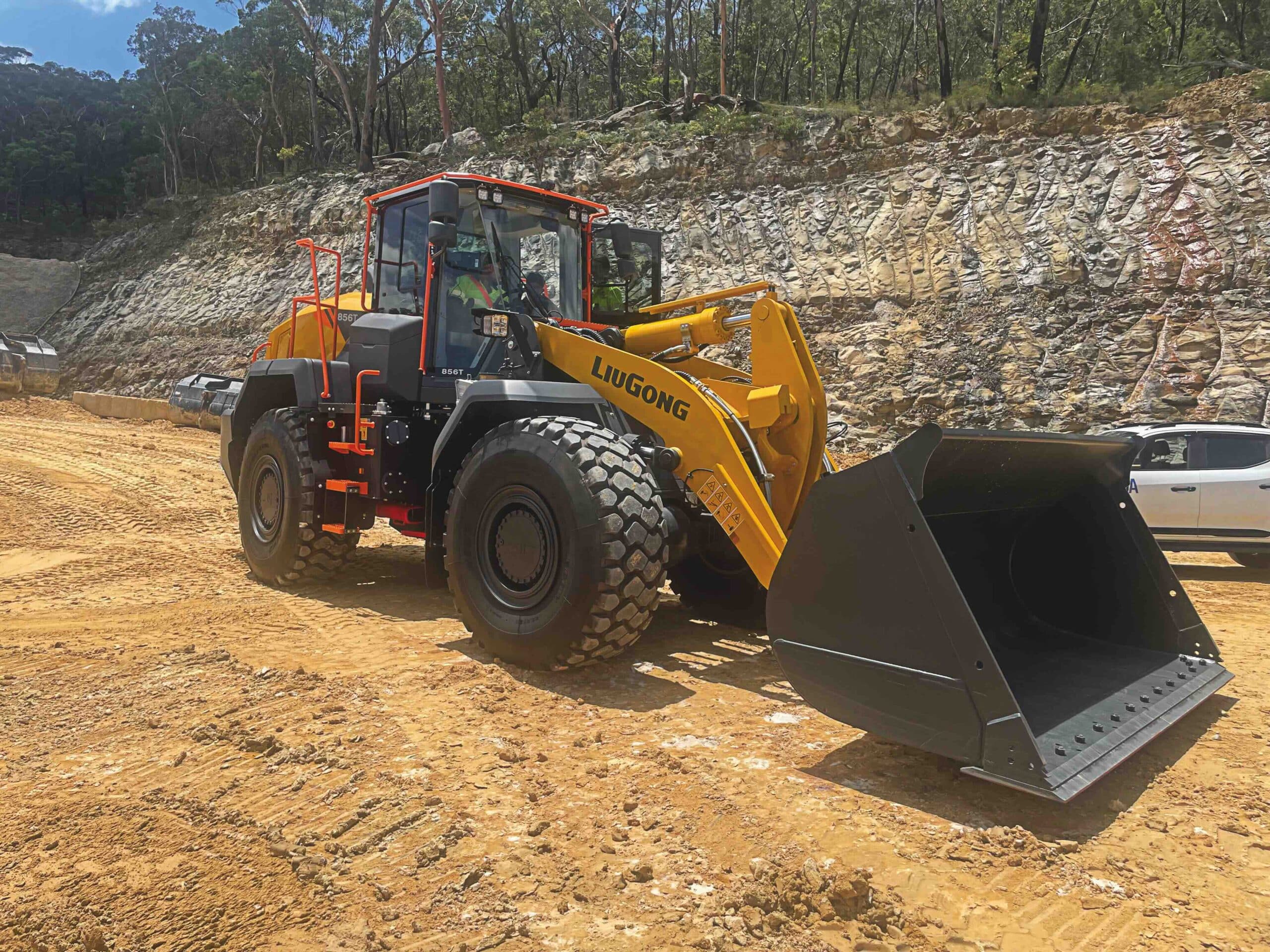
    LiuGong 856T wheel loader at Australian Sandstone: performance notes for quarry engineers

    April 17, 2026|

    Reviewed by Joe Ashwell

    LiuGong 856T wheel loader at Australian Sandstone: performance notes for quarry engineers

    First reported on Roads & Infrastructure (AU)

    30 Second Briefing

    LiuGong’s 856T wheel loader has been selected by Australian Sandstone Merchants in New South Wales as the primary machine for high-duty quarry operations, handling dense sandstone blocks and continuous loading cycles. The 856T, part of LiuGong’s long-running wheel loader line dating back to 1958, is being used for both face loading and stockpile management, where breakout force and stability on uneven quarry floors are critical. For operators, the choice signals growing confidence in Chinese-built loaders for heavy quarry applications traditionally dominated by established Western brands.

    Technical Brief

    • Tyre selection and axle configuration are set up for rough, uneven quarry floors and face work.
    • Cooling package and filtration are tailored for dusty quarry conditions, reducing derating during continuous loading cycles.

    Our Take

    Within our 1224 Mining stories, LiuGong appears more often in equipment and infrastructure contexts than in mine ownership or JV roles, suggesting its competitive angle in Australia is to undercut or out-spec incumbent OEMs on lifecycle cost and serviceability rather than to tie machines to vertically integrated mining investments.

    Geotechnical Software for Modern Teams

    Centralise site data, logs, and lab results with GEODB-io, CMRR-io, and HYDROGEO-io.

    No credit card required.

    • Save and export unlimited calculations
    • Advanced data visualisation
    • Generate professional PDF reports
    • Cloud storage for all your projects

    Prepared by collating external sources, AI-assisted tools, and Geomechanics.io’s proprietary mining database, then reviewed for technical accuracy & edited by our geotechnical team.

    Related Articles

    Trump-linked $1.1B Kazakhstan tungsten project: key metrics for mine planners
    Mining
    about 12 hours ago

    Trump-linked $1.1B Kazakhstan tungsten project: key metrics for mine planners

    A $1.1 billion tungsten project in Kazakhstan’s Karaganda district is being advanced by newly formed Kaz Resources, created via the merger of US construction group Skyline Builders (Nasdaq: SKBL) and Cove Kaz Capital, with Skyline having paid $20 million for a 20% stake. The project covers the Northern Katpar and Upper Kairakty deposits, holds a 2023 JORC resource of 1.4 million tonnes WO₃, and targets output equivalent to about 15% of global tungsten production within three years. Cove/Kaz Resources will own 70% alongside Kazakh state miner Tau-Ken Samruk (30%), with potential debt support of up to $900 million from US Ex-Im Bank and $700 million from the US International Development Finance Corporation.

    Arizona Metals’ negative-value Kay mine PEA: project economics lens for engineers
    Mining
    about 15 hours ago

    Arizona Metals’ negative-value Kay mine PEA: project economics lens for engineers

    Arizona Metals’ Kay polymetallic project in Arizona has delivered a rare negative-value PEA, with a post-tax NPV5 of -$6 million, IRR of 4.9% and upfront capital of $731 million for a 1,918 t/d underground operation, triggering a 46% share price drop to C$0.29. Even a spot-price case at $6.05/lb copper and $4,745/oz gold only lifts the post-tax NPV to $445 million with a modest 14.9% IRR, constrained by limited initial tonnage. The PEA uses just 71% of the 9.28 Mt indicated resource, with no inferred material, so future economics hinge on adding tonnes, higher mining rates and alternative processing routes.

    Royal Canadian Mint cartel-linked gold: due diligence lessons for mine teams
    Mining
    about 16 hours ago

    Royal Canadian Mint cartel-linked gold: due diligence lessons for mine teams

    Gold refined by the Royal Canadian Mint may include material from Colombian mines linked to the Clan del Golfo cartel, after an unidentified Texas supplier mixed Antioquia-sourced gold with US metal that the Mint then classified as “North American”, a New York Times investigation found. About 5% of the Mint’s 2024 feedstock came from this US supplier, which held a valid audit naming Colombia as a source, while the Mint relied on supplier due diligence and said “it’s not our responsibility” to probe further. The Mint has now halted Colombian gold intake, launched an “incident review”, and plans to start disclosing source countries despite already deploying Bullion Genesis traceability software and LBMA-aligned KYC and AML controls.

    Related Industries & Products

    Mining

    Geotechnical software solutions for mining operations including CMRR analysis, hydrogeological testing, and data management.

    Construction

    Quality control software for construction companies with material testing, batch tracking, and compliance management.

    CMRR-io

    Streamline coal mine roof stability assessments with our cloud-based CMRR software featuring automated calculations, multi-scenario analysis, and collaborative workflows.

    HYDROGEO-io

    Comprehensive hydrogeological testing platform for managing, analysing, and reporting on packer tests, lugeon values, and hydraulic conductivity assessments.

    GEODB-io

    Centralised geotechnical data management solution for storing, accessing, and analysing all your site investigation and material testing data.

    AllGeotechnicalInfrastructureHazardsEnvironmental