Lewes–Haywards Heath derailment: rapid recovery lessons for rail engineers
Reviewed by Tom Sullivan
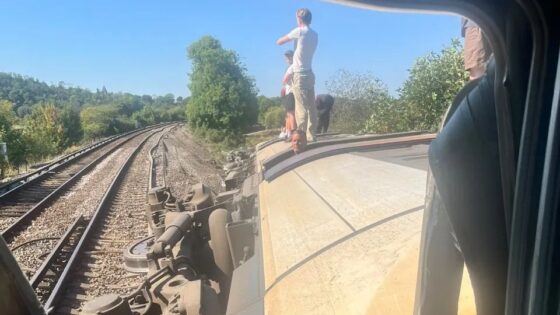
First reported on New Civil Engineer
30 Second Briefing
Passenger services between Lewes and Haywards Heath resumed on 1 September after Network Rail and contractors removed derailed carriages and renewed 500m of damaged track. The rapid reinstatement required full clearance of rolling stock, ballast and contaminated materials before installing new rail, sleepers and fixings to restore line geometry and signalling integrity. For civil and permanent-way engineers, the incident underlines the need for robust derailment response plans, modular track replacement capability and close coordination with operators to minimise corridor downtime.
Technical Brief
- Derailed rolling stock was fully removed before any track renewal to avoid residual structural or geometric damage.
- Ballast and sub-ballast were excavated where contaminated, preventing long-term fouling and drainage impairment beneath the new formation.
- Track renewal included new rail, sleepers and fastenings installed as a complete system to maintain design stiffness.
- Signalling assets in the affected section required verification and revalidation to ensure route integrity post-derailment.
- Recovery and reinstatement were delivered under emergency possession conditions, compressing planning, access and verification windows.
- Incident reinforces the value of pre-planned derailment playbooks, including modular track replacement and contamination protocols.
Our Take
The 500 m of renewed track on the Lewes–Haywards Heath section sits alongside other near-term Network Rail interventions in our database, such as the Weaver line overhead line renewals, indicating a period of concentrated asset replacement rather than purely reactive maintenance.
With this derailment tagged as a ‘Failure’ incident in the United Kingdom, it will likely feed into the geotechnical and civil engineering framework procurement for Wales and Western, where Network Rail is explicitly seeking contractors to manage earthworks and structural risk across a wider portfolio.
Recent coverage of Network Rail includes adoption of CFD-based scour assessment on bridges, suggesting that lessons from the derailment and associated 500 m track renewal may be coupled with more advanced analytical tools for route-wide risk modelling rather than treated as an isolated repair job.
Prepared by collating external sources, AI-assisted tools, and Geomechanics.io’s proprietary mining database, then reviewed for technical accuracy & edited by our geotechnical team.
Related Articles


Related Industries & Products
Construction
Quality control software for construction companies with material testing, batch tracking, and compliance management.
Mining
Geotechnical software solutions for mining operations including CMRR analysis, hydrogeological testing, and data management.
CMRR-io
Streamline coal mine roof stability assessments with our cloud-based CMRR software featuring automated calculations, multi-scenario analysis, and collaborative workflows.
HYDROGEO-io
Comprehensive hydrogeological testing platform for managing, analysing, and reporting on packer tests, lugeon values, and hydraulic conductivity assessments.
GEODB-io
Centralised geotechnical data management solution for storing, accessing, and analysing all your site investigation and material testing data.