Geomechanics.io

  • Free Tools
Sign UpLog In

Geomechanics.io

Geomechanics, Streamlined.

© 2026 Geomechanics.io. All rights reserved.

Geomechanics.io

CMRR-ioGEODB-ioHYDROGEO-ioQCDB-ioFree Tools & CalculatorsBlogLatest Industry News

Industries

MiningConstructionTunnelling

Company

Terms of UsePrivacy PolicyLinkedIn
    Standard/Guideline
    Projects

    Julie Wood to lead Institution of Civil Engineers: continuity signals for project teams

    December 18, 2025|

    Reviewed by Joe Ashwell

    Julie Wood to lead Institution of Civil Engineers: continuity signals for project teams

    First reported on New Civil Engineer

    30 Second Briefing

    Julie Wood has been confirmed by the ICE Council to succeed David Porter as President of the Institution of Civil Engineers in November 2026, setting the leadership line-up two years in advance. The early confirmation gives continuity for ongoing work on infrastructure resilience, decarbonisation and digital delivery across ICE’s 95,000-strong global membership. Civil engineering firms can expect policy and guidance stability through at least 2027 as Porter’s term transitions to Wood’s, aiding long-term planning for major UK and international projects.

    Technical Brief

    • Confirmation date fixes a hard leadership changeover point for ICE governance calendars and committee terms.
    • Succession from David Porter to Julie Wood is now formally mandated by ICE Council decision.
    • Firms can map major project gateways to expected ICE policy positions during procurement and early design.
    • Early clarity reduces risk of mid-programme shifts in ICE positions on standards, contracts or procurement models.
    • Similar professional bodies may adopt comparable long-range presidential appointments to stabilise policy influence.

    Our Take

    Within the 48 Policy stories in our database, the Institution of Civil Engineers appears frequently as a standard‑setter rather than a project promoter, so Julie Wood’s 2026 presidency is likely to influence how future guidance lands with contractors and consultants on the ground.

    The combination of the Standard/Guideline and Projects tags here matches a subset of our coverage where ICE interventions have preceded updates to procurement and design practices, suggesting her term could be important for embedding emerging themes such as carbon measurement and digital delivery into everyday project governance.

    New Civil Engineer’s role alongside ICE in our records is typically as a channel for disseminating technical and policy shifts, so this early confirmation for November 2026 gives a long runway for shaping the narrative around Wood’s priorities before they translate into formal guidance or client expectations.

    Geotechnical Software for Modern Teams

    Centralise site data, logs, and lab results with GEODB-io, CMRR-io, and HYDROGEO-io.

    No credit card required.

    • Save and export unlimited calculations
    • Advanced data visualisation
    • Generate professional PDF reports
    • Cloud storage for all your projects

    Prepared by collating external sources, AI-assisted tools, and Geomechanics.io’s proprietary mining database, then reviewed for technical accuracy & edited by our geotechnical team.

    Related Articles

    OECD critical minerals traceability report: risk-based lessons for project teams
    Policy
    about 14 hours ago

    OECD critical minerals traceability report: risk-based lessons for project teams

    Better traceability of critical minerals such as lithium and nickel is needed to manage operational and governance risks in complex supply chains, with the OECD report flagging fragmented company-level systems, low adoption by miners, and opaque transnational ownership structures in Indonesian and Philippine nickel. Case studies of lithium from Argentina and Chile show heavy dependence on Chinese processing and major data gaps, limiting visibility on foreign upstream ownership despite existing tools like SIMBARA, LME responsible-sourcing rules and local audits. The OECD proposes a phased, risk-based approach: short-term use of current supplier mapping and bilateral mineral agreements, medium-term closure of data gaps via traders, exchanges and smelters, and long-term cross-border data sharing and aligned battery standards through platforms such as the G7 Critical Minerals Action Plan, FORGE and RESourceEU.

    Chile bill targets foreign cash: exploration incentives unpacked for mine planners
    Policy
    about 14 hours ago

    Chile bill targets foreign cash: exploration incentives unpacked for mine planners

    Chile is moving to open its capital markets to junior explorers with a Senate-approved bill that creates a dedicated investment framework for early-stage mining and innovation companies, including a simplified regime that avoids full Securities Registry registration and uses sponsoring agents for compliance. The package offers capital gains tax exemptions on share sales, greenfield exploration write-offs and reworked reduced-fee rules for exploration and exploitation concessions, addressing long-standing issues flagged by Agrumin and Sonami over fee-related auctions. With exploration budgets at about $874 million in 2025, 76% in copper and only $206 million in initial exploration, the reform aims to push more private capital into grassroots projects rather than major-led brownfield programmes.

    Global mineral race and 2026 IMARC: policy and funding takeaways for projects
    Policy
    1 day ago

    Global mineral race and 2026 IMARC: policy and funding takeaways for projects

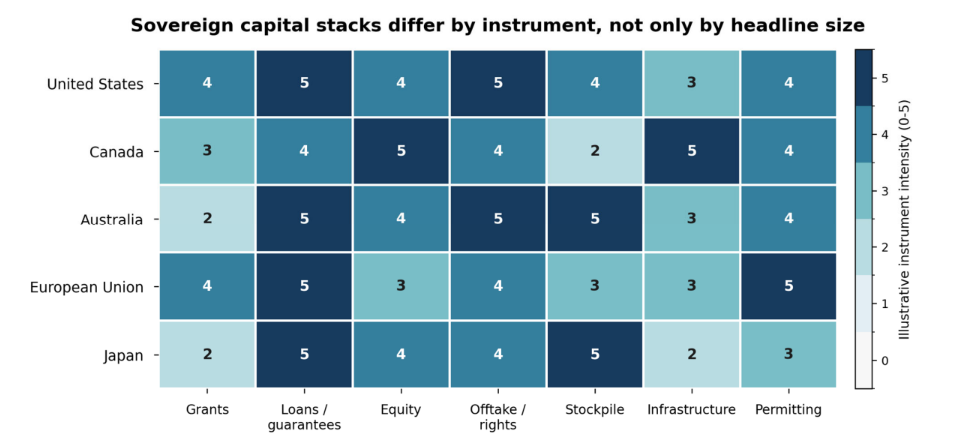
    A looming “space race” for critical minerals is set to accelerate state-backed mining investment, with International Council on Mining and Metals chief executive Rohitesh Dhawan arguing that geopolitical competition could rapidly expand permitting, infrastructure funding and offtake guarantees. The 2026 International Mining and Resources Conference (IMARC) in Melbourne is being framed as a test of whether governments will move beyond rhetoric to concrete policy support, including streamlined approvals and public–private financing for new copper, nickel and rare earths projects.

    Related Industries & Products

    Construction

    Quality control software for construction companies with material testing, batch tracking, and compliance management.

    Mining

    Geotechnical software solutions for mining operations including CMRR analysis, hydrogeological testing, and data management.

    CMRR-io

    Streamline coal mine roof stability assessments with our cloud-based CMRR software featuring automated calculations, multi-scenario analysis, and collaborative workflows.

    HYDROGEO-io

    Comprehensive hydrogeological testing platform for managing, analysing, and reporting on packer tests, lugeon values, and hydraulic conductivity assessments.

    GEODB-io

    Centralised geotechnical data management solution for storing, accessing, and analysing all your site investigation and material testing data.

    AllGeotechnicalInfrastructureHazardsEnvironmental