Interface 5600 2-Axis Axial Torsion Load Cell: test rig gains for engineers
Reviewed by Joe Ashwell
First reported on Australian Mining
30 Second Briefing
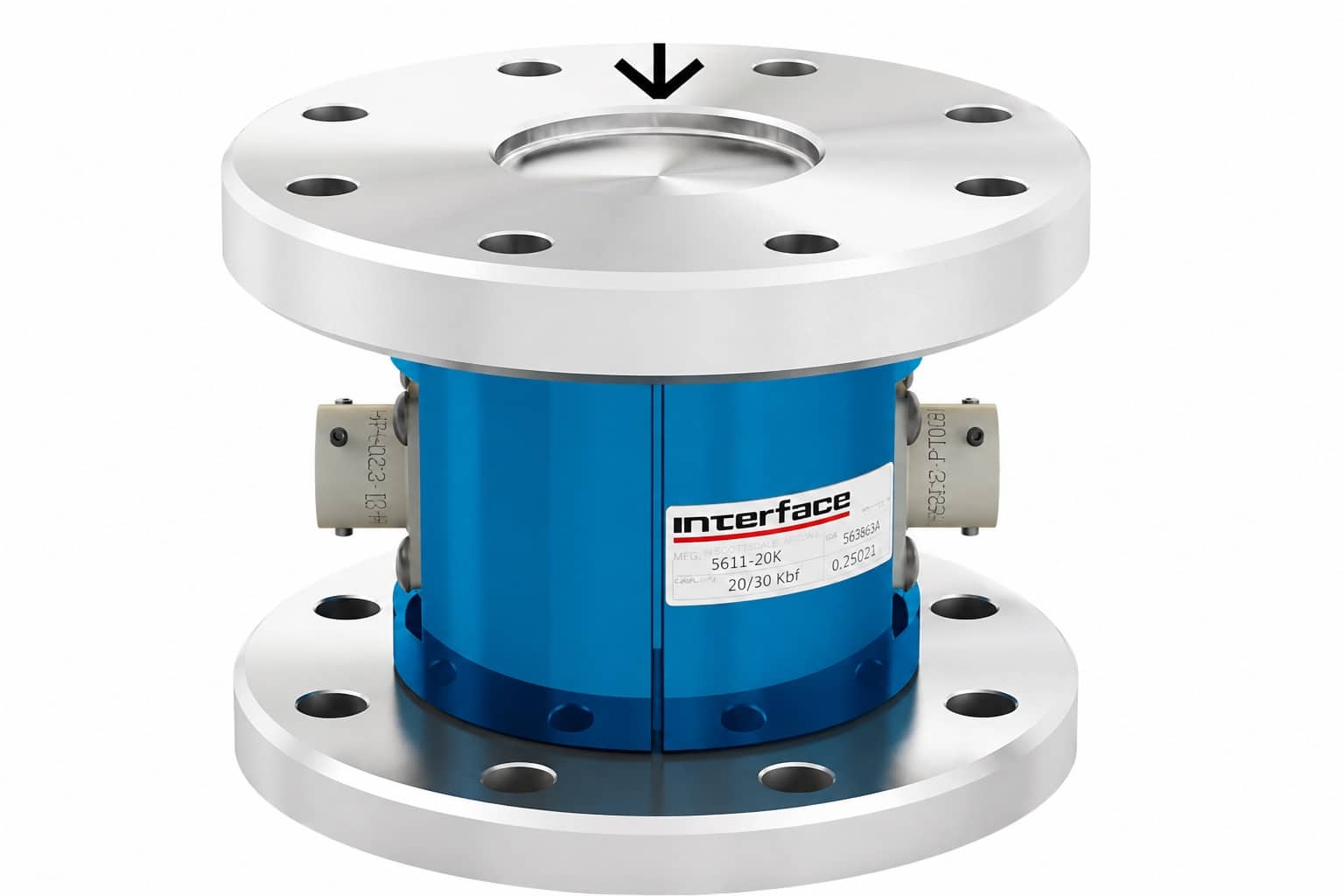
The Interface 5600 2-Axis Axial Torsion Load Cell combines compressive force and torsional moment measurement in a single flange-mount transducer, capturing both at the same point for demanding test and measurement rigs. Its compact, multi-axis design reduces fixture complexity compared with separate axial and torque sensors, freeing space around test specimens and simplifying alignment. For mining equipment OEMs and materials labs, the unit supports more accurate characterisation of drill strings, couplings and rotating components under combined loading.
Technical Brief
- 5600 Series uses a flange-mount configuration suited to rigid integration in test rigs.
- Multi-axis strain-gauged design allows simultaneous resolution of axial and torsional components in one sensor body.
- Co-located measurement point reduces spatial separation errors common with discrete force and torque transducers.
- Compact housing geometry enables closer placement to couplings, drill collars or rotating joints under test.
- Single wiring harness and amplifier chain simplifies signal conditioning versus parallel axial and torque channels.
- Interface targets demanding cyclic and fatigue test programmes where combined loading paths must be tightly controlled.
- Particularly relevant for mining OEM durability rigs validating drivetrain, drill-string and coupling performance envelopes.
- Similar multi-axis cells are increasingly specified in high-fidelity FEA correlation and digital twin validation test setups.
Our Take
Interface’s 5600-series instrumentation sits in the same ‘Product’ and ‘Projects’ stream as Nederman MikroPul’s dust-control systems, signalling that Australian Mining is increasingly profiling niche hardware that underpins project commissioning and performance verification rather than just headline plant and fleet.
Across the 48 Materials stories in our database, Australia-focused pieces like this one often highlight measurement and control equipment, which suggests operators are putting more emphasis on high-fidelity load and torque data to de-risk complex mechanical systems before they reach full production.
Because Australian Mining also covers large-volume operators such as Fortescue in iron ore, specialised load cells marketed through this channel are likely targeting OEMs and contractors working on high-duty assets (conveyors, crushers, drill rigs) where combined axial and torsional loading is a design and maintenance concern.
Prepared by collating external sources, AI-assisted tools, and Geomechanics.io’s proprietary mining database, then reviewed for technical accuracy & edited by our geotechnical team.
Related Articles



Related Industries & Products
Mining
Geotechnical software solutions for mining operations including CMRR analysis, hydrogeological testing, and data management.
CMRR-io
Streamline coal mine roof stability assessments with our cloud-based CMRR software featuring automated calculations, multi-scenario analysis, and collaborative workflows.
HYDROGEO-io
Comprehensive hydrogeological testing platform for managing, analysing, and reporting on packer tests, lugeon values, and hydraulic conductivity assessments.
GEODB-io
Centralised geotechnical data management solution for storing, accessing, and analysing all your site investigation and material testing data.