Geomechanics.io

  • Free Tools
Sign UpLog In
Built byBoxcut Studio

Geomechanics.io

Geomechanics, Streamlined.

© 2026 Geomechanics.io. All rights reserved.

Geomechanics.io

CMRR-ioGEODB-ioHYDROGEO-ioQCDB-ioFree Tools & CalculatorsBlogLatest Industry News

Industries

MiningConstructionTunnelling

Company

Terms of UsePrivacy PolicyLinkedIn
    Projects
    Sustainability

    IET Faraday Challenge 2026–27: flexible format and skills focus for educators

    September 29, 2026|

    Reviewed by Tom Sullivan

    IET Faraday Challenge 2026–27: flexible format and skills focus for educators

    First reported on New Civil Engineer

    30 Second Briefing

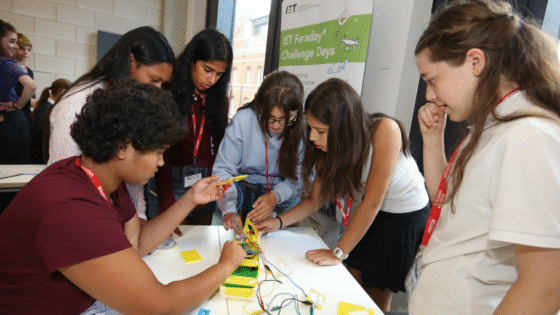
    The Institution of Engineering and Technology has launched the 2026–27 IET Faraday Challenge with a new flexible format allowing schools, youth groups and home-educating families to run engineering design challenges on their own timetable rather than fixed competition days. Teams of 6–8 students aged 12–13 will work on a real-world brief from an industry partner, using standardised kits of electronic components and structural materials supplied by the IET. The format is intended to widen access beyond well-resourced schools and give more pupils early exposure to structured engineering problem-solving.

    Technical Brief

    • IET schedules the new Faraday Challenge cycle for the 2026–27 academic year window.
    • Format is explicitly framed around engineering, technology and innovation rather than pure science or coding tasks.
    • Challenge branding is carried by the Institution of Engineering and Technology, reinforcing professional body alignment.

    Our Take

    The Institution of Engineering and Technology also appears in our database in a June 2026 safety warning on domestic plug‑in solar kits, signalling that the IET Faraday Challenge is being promoted by a body already active in real‑world electrical safety debates rather than purely academic outreach.

    Because this initiative sits under both ‘Projects’ and ‘Sustainability’ tags, it is likely to expose young participants to live issues such as safe integration of small‑scale renewables and grid‑connected devices, echoing the IET’s recent involvement in guidance on plug‑in solar equipment.

    Geotechnical Software for Modern Teams

    Centralise site data, logs, and lab results with GEODB-io, CMRR-io, and HYDROGEO-io.

    No credit card required.

    • Save and export unlimited calculations
    • Advanced data visualisation
    • Generate professional PDF reports
    • Cloud storage for all your projects

    Prepared by collating external sources, AI-assisted tools, and Geomechanics.io’s proprietary mining database, then reviewed for technical accuracy & edited by our geotechnical team.

    Related Articles

    MPs’ infrastructure procurement inquiry: delivery and risk lessons for project teams
    Policy
    about 3 hours ago

    MPs’ infrastructure procurement inquiry: delivery and risk lessons for project teams

    MPs on the Public Administration and Constitutional Affairs Committee have opened an inquiry into how effectively the UK state delivers major infrastructure, with a focus on procurement models and governance. The review will examine how current contracting approaches, such as design-and-build and alliancing, affect cost overruns, programme slippage and risk transfer on large schemes like HS2 and major road upgrades. Outcomes could influence future Treasury Green Book guidance, Cabinet Office procurement rules and how client bodies structure frameworks and long-term delivery partnerships.

    Critical minerals boom’s ‘second funding gap’: licence-to-operate risks for engineers
    Policy
    3 days ago

    Critical minerals boom’s ‘second funding gap’: licence-to-operate risks for engineers

    Development finance for critical minerals mines, processing plants and supporting infrastructure is expanding, while funding for transparency tools, civil society oversight and community participation is being cut, according to a Washington-based donor network. The group warns of a “second funding gap” in governance support as multilateral banks and state-backed lenders prioritise capital-intensive extraction and refining projects. For miners and engineers, this signals rising scrutiny risks around licence-to-operate, community consent processes and ESG reporting, even where project finance appears readily available.

    Smarter risk-sharing for UK ageing infrastructure: key lessons for project engineers
    Policy
    5 days ago

    Smarter risk-sharing for UK ageing infrastructure: key lessons for project engineers

    Improved public–private collaboration, “smarter” financial risk sharing and better asset data are being urged by a new Lloyds Banking Group report to upgrade the UK’s ageing, climate-exposed infrastructure. The report calls for clearer allocation of construction, demand and climate risks between government, institutional investors and asset owners, moving beyond traditional PFI-style models. For engineers, this points to stronger requirements for whole-life performance data, climate stress testing of assets and more transparent condition information to unlock private capital for renewals and resilience upgrades.

    Related Industries & Products

    Mining

    Geotechnical software solutions for mining operations including CMRR analysis, hydrogeological testing, and data management.

    CMRR-io

    Streamline coal mine roof stability assessments with our cloud-based CMRR software featuring automated calculations, multi-scenario analysis, and collaborative workflows.

    HYDROGEO-io

    Comprehensive hydrogeological testing platform for managing, analysing, and reporting on packer tests, lugeon values, and hydraulic conductivity assessments.

    GEODB-io

    Centralised geotechnical data management solution for storing, accessing, and analysing all your site investigation and material testing data.

    AllGeotechnicalInfrastructureHazardsEnvironmental