HS2 ‘green’ tunnel at Copthall: reuse and backfill lessons for rail engineers
Reviewed by Joe Ashwell
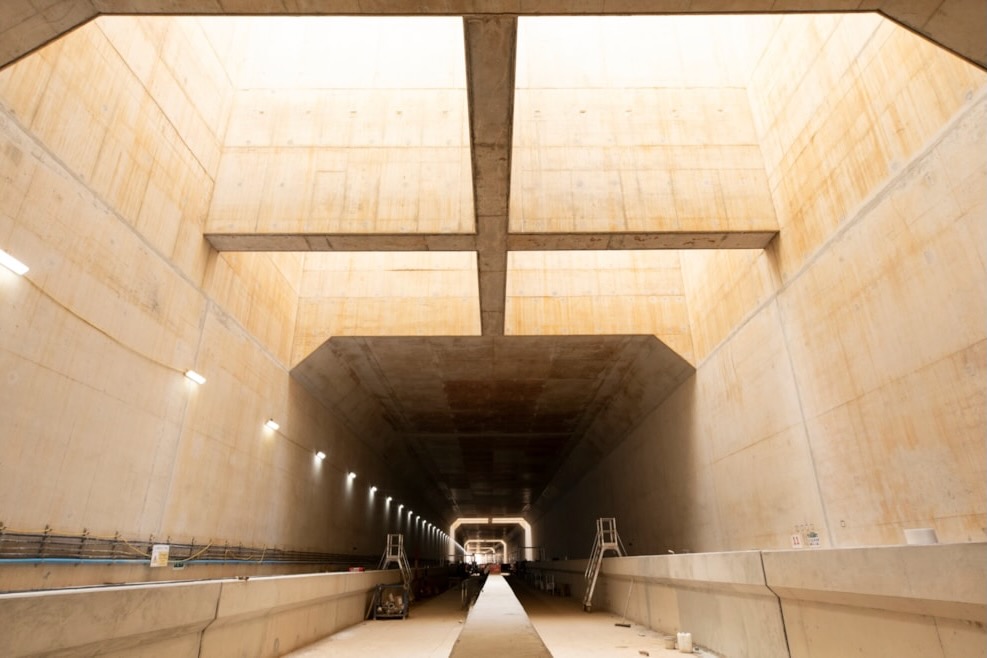
First reported on The Construction Index
30 Second Briefing
HS2 has completed its first ‘green’ tunnel, an 880m cut-and-cover structure at Copthall constructed by the SCS joint venture of Skanska, Costain and Strabag. The tunnel was built using 1.2m cubic metres of material excavated from the nearby Northolt tunnel, reducing imported fill and heavy lorry movements. For designers and contractors, the scheme illustrates large-scale reuse of tunnel spoil for structural backfill and landscape integration on a major high-speed rail corridor.
Technical Brief
- Cut-and-cover box constructed first, then buried to form a fully integrated land bridge structure.
- Tunnel alignment designed to carry HS2 trains at high speed while maintaining shallow cover.
- Structural design had to accommodate long-term settlement behaviour of re-used Northolt tunnel arisings.
- Drainage and waterproofing systems installed before backfilling to protect the reinforced concrete roof slab.
- Landscape restoration above the tunnel reconnects severed habitats and public rights of way.
- Reuse of tunnel spoil at Copthall reduces demand on off-site waste processing and disposal capacity.
- Approach provides a reference model for integrating tunnelling arisings into linear infrastructure earthworks.
Our Take
The Copthall cut-and-cover tunnel sits alongside the Chipping Warden ‘green tunnel’ in our recent HS2 coverage, signalling that the Skanska–Costain–Strabag (SCS) JV is standardising buried, landscaped structures as a core mitigation tool on visually and acoustically sensitive sections of the route.
Using 1.2M m³ of material from the nearby Northholt tunnel points to a deliberate mass-haul strategy on HS2, reducing imported fill and truck movements, which contractors on other large UK infrastructure schemes can expect planning authorities to view increasingly as a baseline sustainability practice.
Prepared by collating external sources, AI-assisted tools, and Geomechanics.io’s proprietary mining database, then reviewed for technical accuracy & edited by our geotechnical team.
Related Articles


Related Industries & Products
Tunnelling
Specialised solutions for tunnelling projects including grout mix design, hydrogeological analysis, and quality control.
Construction
Quality control software for construction companies with material testing, batch tracking, and compliance management.
QCDB-io
Comprehensive quality control database for manufacturing, tunnelling, and civil construction with UCS testing, PSD analysis, and grout mix design management.
HYDROGEO-io
Comprehensive hydrogeological testing platform for managing, analysing, and reporting on packer tests, lugeon values, and hydraulic conductivity assessments.