Holcim’s 100,000t Sunderland rail route: supply-chain and carbon notes for engineers
Reviewed by Joe Ashwell
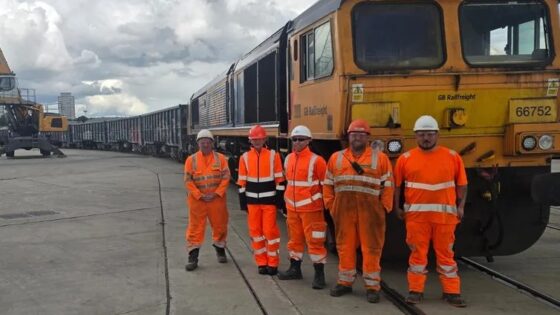
First reported on New Civil Engineer
30 Second Briefing
Holcim UK has launched a new rail freight service into the Port of Sunderland, aiming to move around 100,000t of aggregate in its first year. The service shifts material that would otherwise move by road HGVs onto existing rail corridors, cutting heavy traffic on regional routes into the port. For contractors and materials suppliers in the North East, the route offers a higher-volume, lower-emission supply chain option for bulk aggregate deliveries to marine export or coastal construction projects.
Technical Brief
- Port rail access enables direct ship loading of bulk aggregate, reducing double-handling at inland depots.
- Concentrated rail deliveries support stockpile formation for large, continuous pour or reclamation programmes.
- Rail-served port storage allows blending of different aggregate grades before barge or coaster loading.
- Reduced HGV dependence can ease highway abnormal-load permitting where aggregate is paired with oversized components.
- Port-based aggregate reception simplifies quality control, with single-point sampling and certification for export consignments.
Our Take
Holcim UK’s plan to move about 100,000t of aggregate via the Port of Sunderland in the first year sits alongside its 35,000t aggregate supply to London Luton Airport, signalling a push to lock in higher-volume, multi-node logistics corridors for UK infrastructure clients.
Across our infrastructure coverage, Holcim UK increasingly appears in sustainability-tagged pieces, from battery-electric loaders in its quarry fleet to on-site concrete recycling at Ford Airfield, so shifting aggregate by rail or sea to Sunderland is likely part of a broader decarbonisation narrative it can present to public-sector and Tier 1 contractors.
Using a dedicated freight route into a regional hub like the Port of Sunderland positions Holcim UK to compete more aggressively on delivered aggregate cost in northern England, where our database shows fewer large-scale aggregate logistics stories than around southern airports and major regeneration schemes such as Birmingham’s Smithfield.
Prepared by collating external sources, AI-assisted tools, and Geomechanics.io’s proprietary mining database, then reviewed for technical accuracy & edited by our geotechnical team.
Related Articles


Related Industries & Products
Construction
Quality control software for construction companies with material testing, batch tracking, and compliance management.
Mining
Geotechnical software solutions for mining operations including CMRR analysis, hydrogeological testing, and data management.
QCDB-io
Comprehensive quality control database for manufacturing, tunnelling, and civil construction with UCS testing, PSD analysis, and grout mix design management.