Glencar’s Sidney Sussex life sciences centre: design and low‑carbon notes for engineers
Reviewed by Tom Sullivan
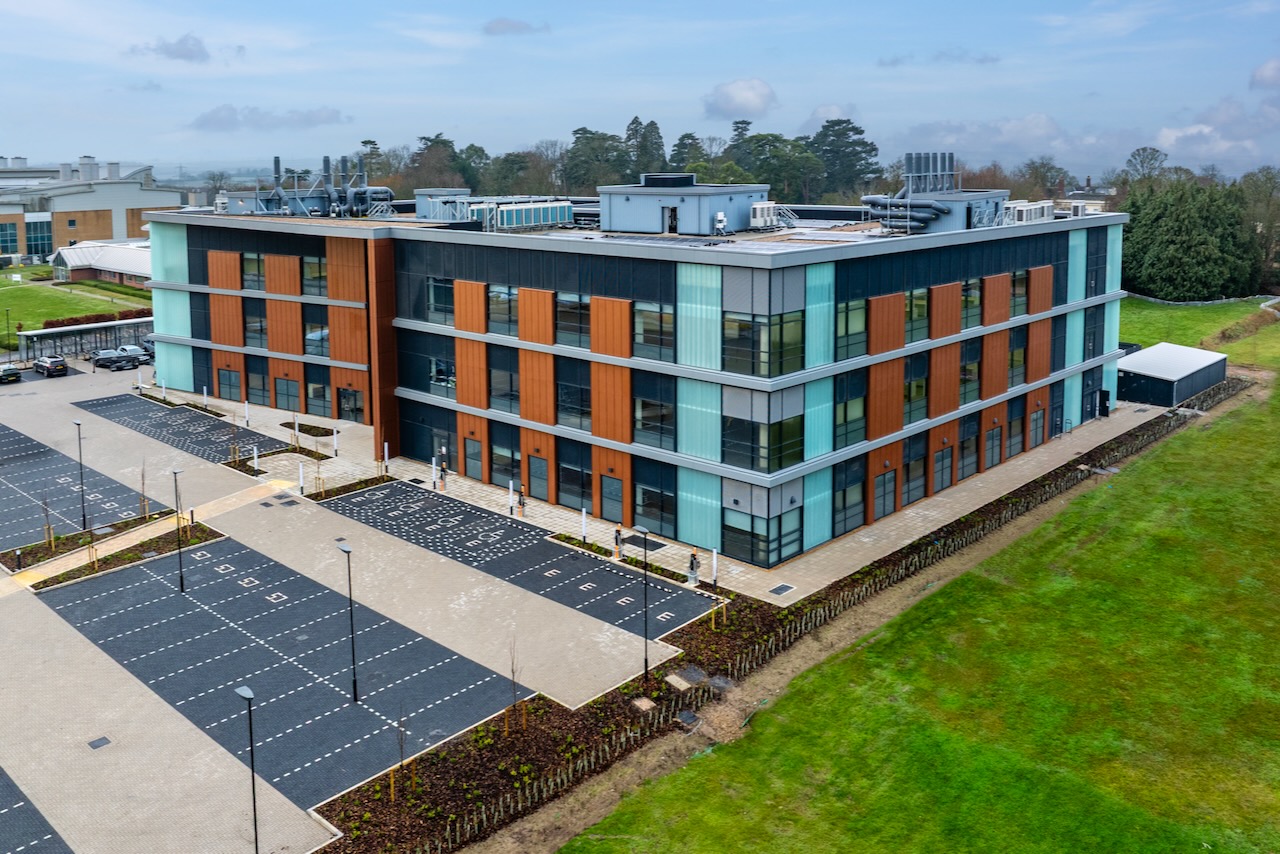
First reported on The Construction Index
30 Second Briefing
Glencar has completed the 56,000 sq ft, three-storey Sidney Sussex Building at Chesterford Research Park, a reinforced-concrete framed life sciences facility engineered for vibration control to support precision laboratory equipment. The multi-occupancy block delivers ten fully fitted wet-lab R&D suites (c.2,200–8,300 sq ft) with fume hoods, specialist flooring, Cat A write-up space, high-performance HVAC, new HV substation and EV charging, plus modular façades, lightweight steel framing and demountable partitions for future reconfiguration. The scheme achieves BREEAM Excellent, EPC A, 659kgCO₂e/m² upfront embodied carbon using 50% GGBS concrete, and a 24% biodiversity net gain.
Technical Brief
- Structural layout uses two wings linked by a central atrium and full-height reception.
- External envelope combines rainscreen cladding, curtain walling, structural glazing and a high-performance cold roof.
- Ten R&D suites are pre-fitted with benching, sinks, fume hoods and specialist laboratory flooring.
- Dedicated plant rooms and surplus MEP capacity allow future increase in HVAC and process loads.
- Vertical circulation includes separate passenger and goods lifts to segregate people and materials flows.
- External works add HV substation, waste compound, overflow parking, EV and cycle parking, and loading areas.
- Biodiversity net gain (24%) delivered via wildflower meadows, new planting, bird/bat boxes and habitat creation.
Our Take
Using 50% ground granulated blast furnace slag in the UK context is at the upper end of mixes seen in our infrastructure coverage, signalling that Glencar is comfortable pushing cement replacement levels while still meeting structural and programme constraints for a three‑storey research facility.
The 659 kgCO2e/m² upfront embodied carbon reported for the Sidney Sussex Building sits below many conventional UK commercial builds in our database, which typically cluster higher when GGBS content is not aggressively optimised, suggesting this scheme could become a benchmark for regional life‑sciences projects.
Across recent Glencar projects in the UK, including the Grandidges Quay warehouse and Hillwood Park Luton scheme, the firm is moving from pure logistics delivery into more specialised, sustainability‑tagged assets, which is likely to strengthen its position in bids for research parks and other technically demanding campuses like Chesterford Research Park.
Prepared by collating external sources, AI-assisted tools, and Geomechanics.io’s proprietary mining database, then reviewed for technical accuracy & edited by our geotechnical team.
Related Articles


Related Industries & Products
Construction
Quality control software for construction companies with material testing, batch tracking, and compliance management.
Mining
Geotechnical software solutions for mining operations including CMRR analysis, hydrogeological testing, and data management.
CMRR-io
Streamline coal mine roof stability assessments with our cloud-based CMRR software featuring automated calculations, multi-scenario analysis, and collaborative workflows.
HYDROGEO-io
Comprehensive hydrogeological testing platform for managing, analysing, and reporting on packer tests, lugeon values, and hydraulic conductivity assessments.
GEODB-io
Centralised geotechnical data management solution for storing, accessing, and analysing all your site investigation and material testing data.