Geomechanics.io

  • Free Tools
Sign UpLog In
Built byBoxcut Studio

Geomechanics.io

Geomechanics, Streamlined.

© 2026 Geomechanics.io. All rights reserved.

Geomechanics.io

CMRR-ioGEODB-ioHYDROGEO-ioQCDB-ioFree Tools & CalculatorsBlogLatest Industry News

Industries

MiningConstructionTunnelling

Company

Terms of UsePrivacy PolicyLinkedIn
    Research
    Projects

    General Fusion LM26 magnetised heating: design implications for fusion civil works

    October 13, 2026|

    Reviewed by Joe Ashwell

    General Fusion LM26 magnetised heating: design implications for fusion civil works

    First reported on New Civil Engineer

    30 Second Briefing

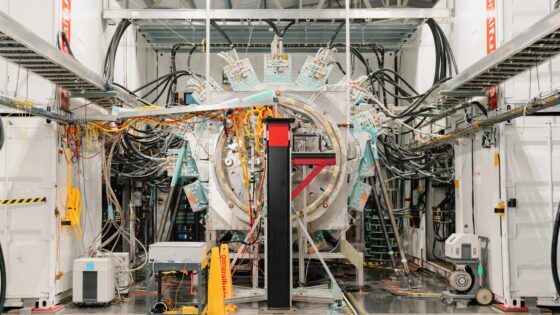
    General Fusion’s Lawson Machine 26 (LM26) experiment has achieved electron temperatures above 12M°C in a large-scale magnetised target fusion set‑up, with measurements co‑authored and independently verified by the UK Atomic Energy Authority (UKAEA). The LM26 platform is designed to validate plasma heating and confinement physics at reactor‑relevant scale ahead of General Fusion’s planned commercial demonstration plant at the UKAEA Culham Campus. For infrastructure planners, the result signals progress towards grid‑scale fusion facilities that will demand high‑integrity civil structures, advanced shielding and complex thermal management systems.

    Technical Brief

    • Measurements focused on electron temperature profiles, a key input for confinement and heating scaling laws.
    • Result is physics-only; no net energy gain or integrated power-plant performance is claimed at this stage.
    • Operationally, validated magnetised heating informs sizing of future plant cooling circuits and heat-rejection structures.
    • For infrastructure planning, MTF’s pulsed operation suggests distinct dynamic loading and fatigue regimes versus steady-state fission.

    Our Take

    UKAEA’s verification role on General Fusion’s LM26 work aligns with its broader 2025–2030 strategy to shift UK fusion from pure experimentation towards commercial power, signalling that magnetised target concepts are being assessed alongside tokamak-based routes rather than outside them.

    With UKAEA simultaneously collaborating with Commonwealth Fusion Systems on the Librti tritium-breeding programme and with Japan’s QST, General Fusion’s UK-based LM26 results position the company within a growing, UK-centred fusion ecosystem that is already thinking about fuel-cycle and regulatory integration, not just physics milestones.

    Among Infrastructure–Research items in our database, UK fusion coverage is increasingly concentrated around Culham-linked initiatives, so UKAEA’s endorsement of LM26 data is likely to carry disproportionate weight with UK government and grid-planning stakeholders compared with validation from a purely private lab.

    Geotechnical Software for Modern Teams

    Centralise site data, logs, and lab results with GEODB-io, CMRR-io, and HYDROGEO-io.

    No credit card required.

    • Save and export unlimited calculations
    • Advanced data visualisation
    • Generate professional PDF reports
    • Cloud storage for all your projects

    Prepared by collating external sources, AI-assisted tools, and Geomechanics.io’s proprietary mining database, then reviewed for technical accuracy & edited by our geotechnical team.

    Related Articles

    Strabag’s Pfaffensteig Tunnel contract: design and delivery notes for rail engineers
    Infrastructure
    5 months ago

    Strabag’s Pfaffensteig Tunnel contract: design and delivery notes for rail engineers

    Strabag and Group company Züblin have secured the design-and-build structural works for the ABS Gäubahn Nord/Pfaffensteig Tunnel in south-west Germany, centred on an 11km twin-bore rail tunnel linking Stuttgart Airport station directly to the Gäubahn line towards Switzerland. About 9.8km will be driven by two TBMs, with conventional tunnelling for the A8 motorway undercrossing and airport connection, plus a 240m cut-and-cover section, retaining structures, railway underpasses and a grade-separated crossing. A 3km surface section will be upgraded and partially realigned for 200km/h operation, delivered under an integrated project delivery model with Ed. Züblin, Wayss & Freytag and Strabag AG sharing tunnelling, structural and earthworks packages.

    National Grid TBM under the Thames: tunnelling design and risk notes for engineers
    Infrastructure
    7 months ago

    National Grid TBM under the Thames: tunnelling design and risk notes for engineers

    A 271.5‑tonne Herrenknecht Mixshield TBM, Caroline, has started driving a 2.2km electricity cable tunnel with a 4m internal diameter beneath the River Thames in Essex for National Grid’s Grain to Tilbury project, delivered by the Ferrovial BEMO joint venture. The drive will pass through variable Thames estuary ground conditions between 35m‑deep launch and reception shafts of 15m and 12m diameter, with tunnelling continuing into 2026 and overall scheme completion targeted for 2029. The new tunnel will replace the 1969 Thames Cable Tunnel and carry new high‑voltage circuits between Grain and Tilbury substations.

    Panama Canal Mixshield undercrossing: design and tunnelling lessons for engineers
    Infrastructure
    8 months ago

    Panama Canal Mixshield undercrossing: design and tunnelling lessons for engineers

    A 13.46m diameter Herrenknecht Mixshield TBM has broken through into the future Balboa station on Panama Metro Line 3 after completing the first-ever TBM undercrossing of the Panama Canal at depths exceeding 60m below sea level. The 5,600kW, 26,616kNm machine, fitted with an accessible cutterhead and more than 4,500 sensors linked via the Herrenknecht.Connected platform, has achieved peak advance of 150 segment rings (about 300m) per month through mixed sandstone, tuff, breccias and basalt. Around 1.5km of the 4.5km twin-track tunnel remains to final breakthrough.

    Related Industries & Products

    Construction

    Quality control software for construction companies with material testing, batch tracking, and compliance management.

    Mining

    Geotechnical software solutions for mining operations including CMRR analysis, hydrogeological testing, and data management.

    CMRR-io

    Streamline coal mine roof stability assessments with our cloud-based CMRR software featuring automated calculations, multi-scenario analysis, and collaborative workflows.

    HYDROGEO-io

    Comprehensive hydrogeological testing platform for managing, analysing, and reporting on packer tests, lugeon values, and hydraulic conductivity assessments.

    GEODB-io

    Centralised geotechnical data management solution for storing, accessing, and analysing all your site investigation and material testing data.

    AllGeotechnicalInfrastructureHazardsEnvironmental