Fortescue’s China stance and Pilbara electrification: key signals for mine planners
Reviewed by Tom Sullivan
First reported on Australian Mining
30 Second Briefing
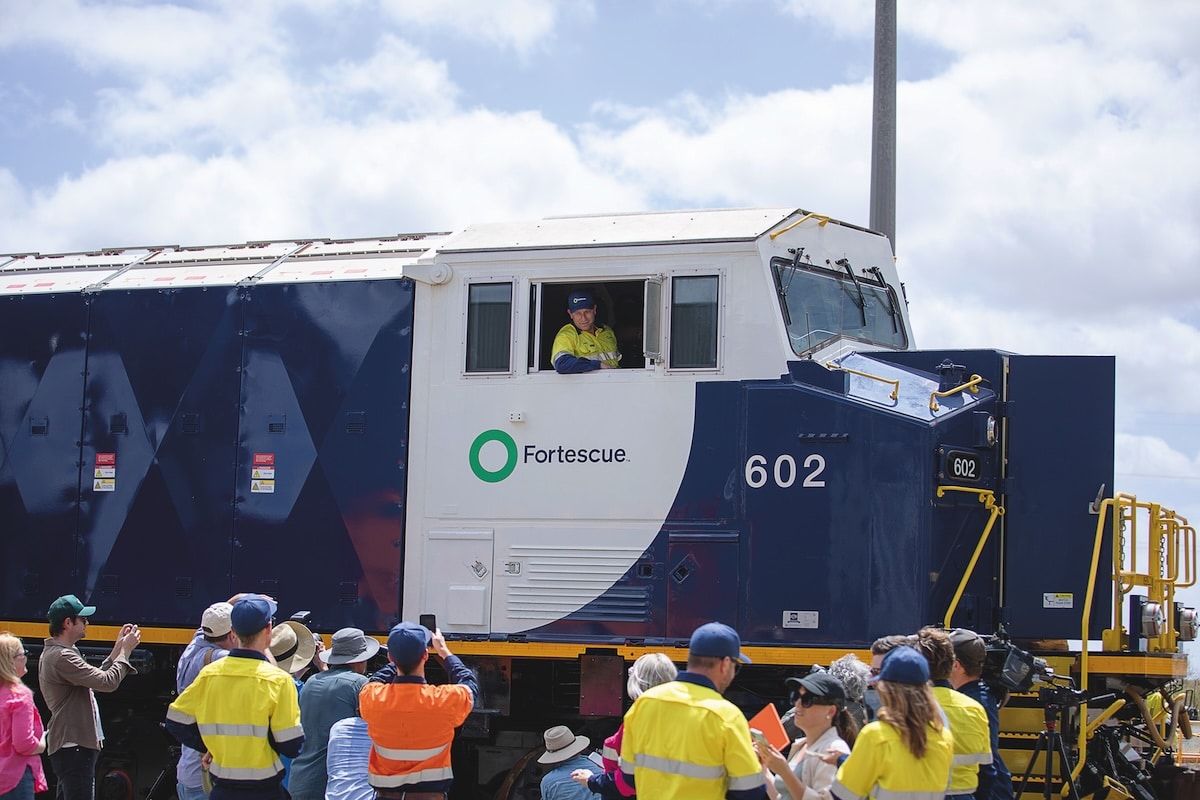
Fortescue is resisting pricing pressure from China’s centralised iron ore buyer, China Mineral Resources Group (CMRG), while accelerating large-scale electrification of its Pilbara operations, including battery-electric locomotives. Executive chair Andrew Forrest used the AGM to reaffirm long-term iron ore supply to China but rejected CMRG’s attempts to dictate benchmark discounts and contract terms. He also detailed plans to grow non-iron ore revenue via green energy technologies developed at Fortescue’s Pilbara sites, signalling future diversification of capital allocation and project pipelines.
Technical Brief
- Battery-electric locomotive trials are being run in the Pilbara heavy-haul environment under full consist loads.
- Regenerative braking on downhill ore hauls is targeted to recharge onboard battery packs.
- Pilbara electrification planning must contend with long haul distances, high ambient temperatures and iron ore dust.
- Onsite green energy technology development is being co-located with existing mine, rail and port infrastructure.
- Non-iron ore technologies proven at Pilbara sites are intended for export as standalone revenue-generating products.
- For other miners, large-scale rail electrification in remote regions could materially alter mine-to-port operating cost structures.
Our Take
The stalled iron ore pricing and offtake talks with China Mineral Resources Group flagged in the 23 Oct piece suggest Fortescue’s decision to ‘stand firm’ on China is being made despite near‑term revenue friction, not because those issues are resolved.
In our database of Mining–Sustainability items, Fortescue increasingly appears not just as an iron ore exporter from the Pilbara but as a power and technology provider, illustrated by FMG Clean Energy’s 20‑year PPA to supply 325 GWh/year to Pilgangoora.
Recent coverage of Fortescue’s copper processing technologies and Peru acquisition indicates that while China remains central for its Pilbara iron ore, the group is simultaneously building optionality in other commodities and jurisdictions, which can soften strategic dependence on a single steelmaking market.
Prepared by collating external sources, AI-assisted tools, and Geomechanics.io’s proprietary mining database, then reviewed for technical accuracy & edited by our geotechnical team.
Related Articles

Related Industries & Products
Mining
Geotechnical software solutions for mining operations including CMRR analysis, hydrogeological testing, and data management.
Construction
Quality control software for construction companies with material testing, batch tracking, and compliance management.
CMRR-io
Streamline coal mine roof stability assessments with our cloud-based CMRR software featuring automated calculations, multi-scenario analysis, and collaborative workflows.
HYDROGEO-io
Comprehensive hydrogeological testing platform for managing, analysing, and reporting on packer tests, lugeon values, and hydraulic conductivity assessments.
GEODB-io
Centralised geotechnical data management solution for storing, accessing, and analysing all your site investigation and material testing data.