Fortescue’s 690MW Pilbara solar farm: power system lessons for mine operators
Reviewed by Joe Ashwell
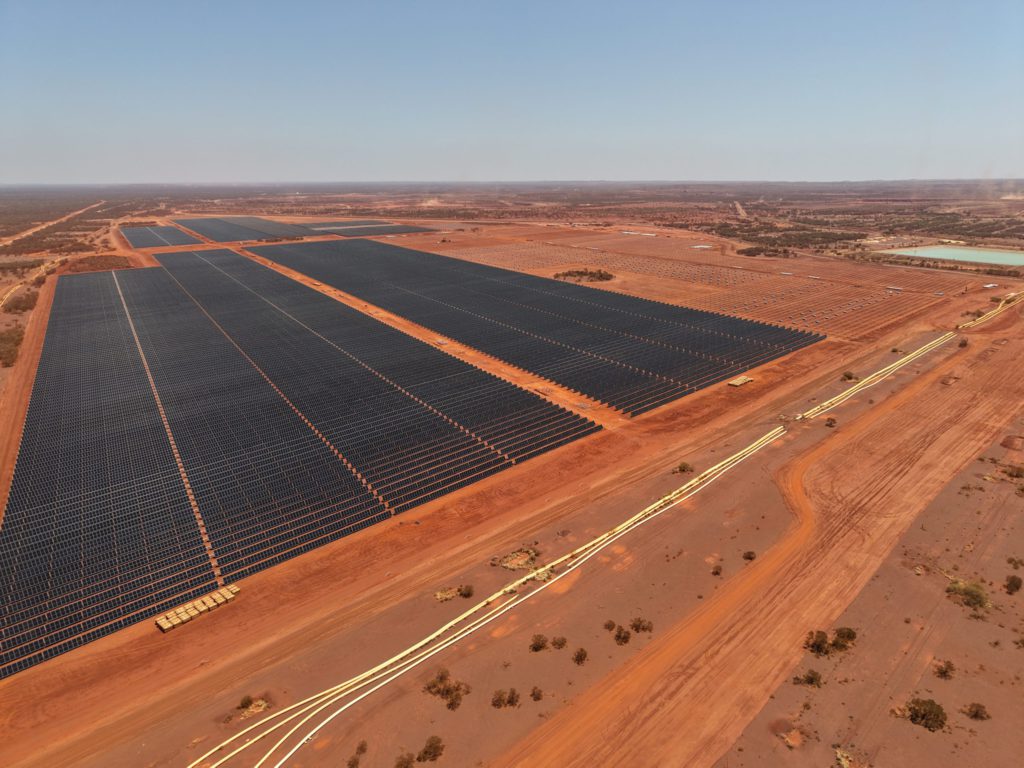
First reported on MINING.com
30 Second Briefing
Fortescue has started building the 690MW Turner River solar farm in the Pilbara and a 650MWh BESS at its Cloudbreak mine, completing the solar component of its Real Zero plan alongside existing 440MW Solomon Airport, 190MW Cloudbreak and 100MW North Star Junction plants for a combined 1.4GW. Turner River will install over 1 million panels by 2028, while the Cloudbreak BESS will deliver 74MW for about eight hours via 124 battery units, backed by a 133MW Nullagine wind farm and more than 480 km of high‑voltage transmission, extending to 620 km. For mine operators, Fortescue’s parallel fleet electrification—16 electric excavators in service, a 6MW fast charger capable of fully charging a haul truck in ~30 minutes, and incoming battery electric haul trucks and ancillary XCMG equipment—signals rapid scaling of high‑power electrical infrastructure at remote iron ore sites.
Technical Brief
- Cloudbreak BESS will use 124 containerised battery units directly integrated with the existing solar farm.
- Turner River solar build is scheduled to run through to completion in 2028.
- Cloudbreak BESS is targeted for commissioning in Fortescue’s 2027 financial year, aligning with mine schedules.
- Nullagine wind farm under construction adds 133MW of wind capacity into the Pilbara renewables portfolio.
- High-voltage transmission already exceeds 480 km, planned to extend beyond 620 km across mines, rail and port.
- Around 50% of Fortescue’s excavator fleet is planned to be electric by end‑2026.
- Prototype XCMG battery-electric wheel loader, dozer, grader and water cart are completing facility tests before Pilbara trials.
Our Take
Across the 1184 Mining stories in our database, very few iron ore operators are committing to a renewables build-out on the order of Fortescue’s 1.4 GW Pilbara package, which signals a move to treat power infrastructure as a core mining asset rather than a supporting utility.
The recent International Mining coverage of Fortescue’s Liebherr T 264 battery-electric haul truck and XCMG’s large BE prototypes suggests the 6 MW fast-charging and 650 MWh Cloudbreak BESS are being sized not just for fixed plant loads but to support a future high-duty-cycle electric mobile fleet at Cloudbreak, Eliwana and related iron ore hubs.
With 480 km of high-voltage transmission already built towards a 620 km network, Fortescue’s Pilbara grid effectively creates a private backbone that could, over time, lower the marginal cost of adding further wind or solar near sites like North Star Junction or Nullagine compared with standalone, mine-by-mine power solutions common in other Australian iron ore operations in our coverage.
Prepared by collating external sources, AI-assisted tools, and Geomechanics.io’s proprietary mining database, then reviewed for technical accuracy & edited by our geotechnical team.
Related Articles

Related Industries & Products
Mining
Geotechnical software solutions for mining operations including CMRR analysis, hydrogeological testing, and data management.
Construction
Quality control software for construction companies with material testing, batch tracking, and compliance management.
CMRR-io
Streamline coal mine roof stability assessments with our cloud-based CMRR software featuring automated calculations, multi-scenario analysis, and collaborative workflows.
HYDROGEO-io
Comprehensive hydrogeological testing platform for managing, analysing, and reporting on packer tests, lugeon values, and hydraulic conductivity assessments.
GEODB-io
Centralised geotechnical data management solution for storing, accessing, and analysing all your site investigation and material testing data.