Forgemasters flood relief tunnelling: design and hydraulic notes for engineers
Reviewed by Tom Sullivan
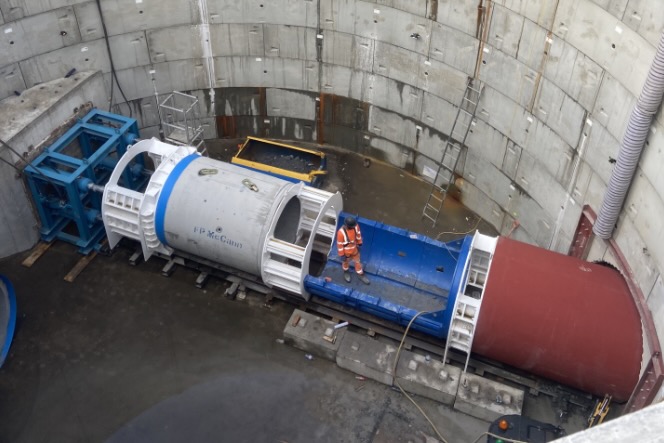
First reported on The Construction Index
30 Second Briefing
Tunnelling has begun on a 1,050ft, 1.8m-diameter storm-water tunnel beneath Brightside Lane to link two storage shafts more than 35ft deep and up to 40ft wide at Sheffield Forgemasters’ flood-prone site on the Lower Don Valley. JBA Bentley will intercept the Victorian Bagley Brook culvert with a new weir chamber, diverting excess flows to a pumping station beside the River Don and discharging up to 8,000 litres per second via a new outfall and modified flood wall. The scheme is a planning requirement for Forgemasters’ new 13,000-tonne forging line adjacent to the Midland Mainline.
Technical Brief
- Tunnel boring machine is launched from the River Don shaft, driving beneath live Brightside Lane traffic.
- One storm-water shaft exceeds 40ft diameter; the second is more than 15ft, both >35ft deep.
- Bagley Brook’s Victorian culvert is intercepted via a new weir chamber integrated into the existing masonry.
- Flood wall on Sheffield Forgemasters’ river boundary is being repositioned to accommodate the new high‑capacity outfall.
- Storage shafts, transfer tunnel and pumping station form a closed system to manage backflow when the Don is in flood.
- Construction sequencing keeps motorists and pedestrians unaware of tunnelling operations, reducing surface-level safety interfaces.
- Scheme directly mitigates a known flood pathway at the northern Brightside Lane frontage, previously inundated under abnormal storms.
- Similar brownfield industrial sites with legacy culverts and rail adjacency can adopt comparable underground storage–pumping arrangements.
Our Take
The involvement of JBA Bentley on both the flood relief tunnelling and earlier site works around the new 13,000‑tonne forging line suggests the client is favouring continuity of contractors for complex ground and water management, which typically shortens learning curves on constrained industrial sites beside live rail (here, the Midland Mainline).
Prepared by collating external sources, AI-assisted tools, and Geomechanics.io’s proprietary mining database, then reviewed for technical accuracy & edited by our geotechnical team.
Related Articles


Related Industries & Products
Tunnelling
Specialised solutions for tunnelling projects including grout mix design, hydrogeological analysis, and quality control.
Construction
Quality control software for construction companies with material testing, batch tracking, and compliance management.
QCDB-io
Comprehensive quality control database for manufacturing, tunnelling, and civil construction with UCS testing, PSD analysis, and grout mix design management.