Farrans’ Stansted skylinks: construction method and capacity notes for engineers
Reviewed by Joe Ashwell
First reported on The Construction Index
30 Second Briefing
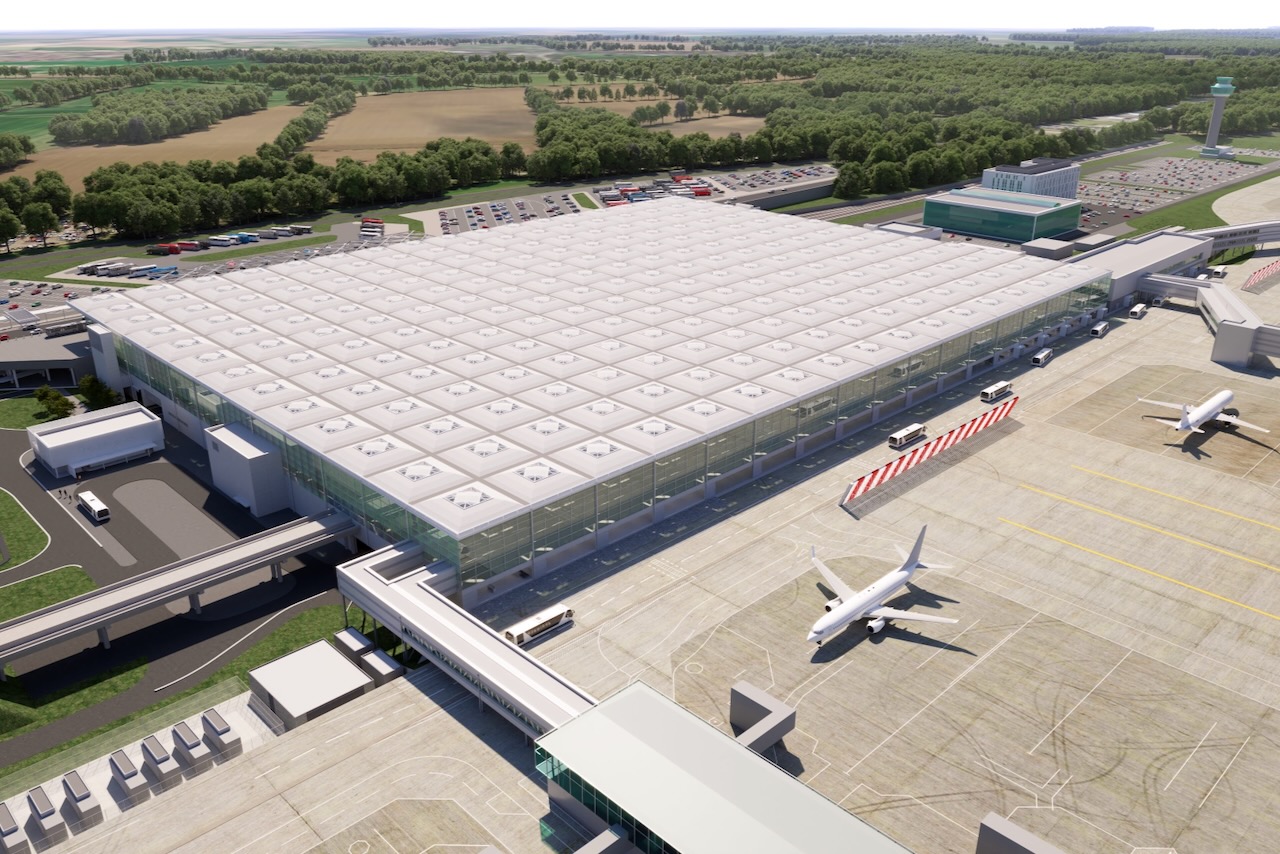
London Stansted has appointed Farrans to build new skylink walkways linking the main terminal to the existing satellite gate building, enabling the ageing people mover tracked transit system to be decommissioned and freeing space for a terminal extension adding three bays and 16,500 m² of floor area. The expansion is intended to make Stansted the largest single-terminal airport in Europe, with additional retail and F&B capacity. Skylink sections will be pre-assembled in a vacant northside hangar and moved overnight into position on SPMTs, with travelators and buggy access designed for full PRM coverage.
Technical Brief
- Skylink modules will be pre-assembled in a vacant northside hangar, effectively functioning as an offsite factory.
- Sequencing must coordinate with decommissioning of the tracked transit system to maintain continuous gate access.
- PRM buggies using the skylinks require gradients, turning radii and lift interfaces compliant with accessibility standards.
- Pre-assembly under cover allows tighter dimensional control of steelwork interfaces with existing terminal and satellite structures.
- Similar airside walkway projects increasingly favour modular offsite assembly to compress possession windows and reduce operational risk.
Our Take
Farrans’ selection at London Stansted follows its £30m terminal infill contract at Bristol Airport, signalling that UK regional airports are repeatedly turning to the same contractor for airside and terminal interface works.
In our database of 924 Infrastructure stories, Farrans appears both in aviation (Bristol Airport, London Stansted) and utilities (Scottish Water’s six‑year framework), indicating it is positioning as a multi‑sector delivery partner for complex, operational brownfield sites in the UK.
The combination of works around a main terminal building, satellite building and a vacant airport hangar at London Stansted plays to Farrans’ recent experience of phasing construction in live terminals, which is likely to reduce interface risk with airfield operations compared with a contractor new to the airport environment.
Prepared by collating external sources, AI-assisted tools, and Geomechanics.io’s proprietary mining database, then reviewed for technical accuracy & edited by our geotechnical team.


