Duddeston Junction Viaduct launch on HS2: staging, tolerances and lessons for engineers
Reviewed by Joe Ashwell
First reported on New Civil Engineer
30 Second Briefing
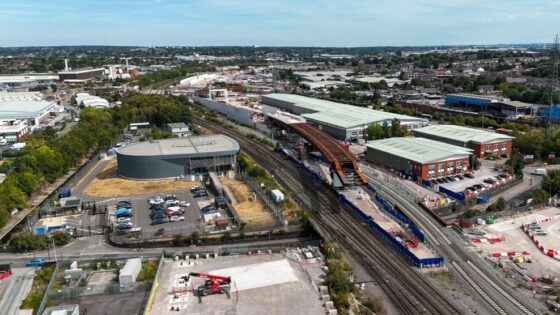
HS2 engineers have completed the first major launch of the Duddeston Junction Viaduct, pushing the steel and concrete structure over the live Birmingham–Derby main lines on the approach to Curzon Street station. The incremental launch was carried out during tightly timed possessions above multiple tracks, using temporary piers and sliding bearings to control alignment and minimise disruption to existing services. The viaduct will carry high-speed trains into the new city-centre terminus, imposing stringent tolerances on deck geometry, dynamic behaviour and clearances over the classic network.
Technical Brief
- Incremental launch method reduces need for extensive working at height over energised main lines.
- Temporary piers and sliding bearings provide controlled load paths, limiting accidental horizontal forces into live track formation.
- Possession planning around services demands tightly sequenced lifts, stressing contingency for overrun scenarios.
- Geometry tolerances drive stringent survey control of pier heads and bearing seats before each launch stage.
- Live-line working requires strict isolation, earthing and exclusion zones, with rail-approved plant and operators only.
- Construction staging must manage unbalanced cantilever moments in the partially launched deck to avoid instability.
- Vibration and deflection limits over the classic network constrain launch speeds and temporary bearing friction allowances.
Our Take
HS2’s Duddeston Junction Viaduct work sits alongside other major approach-structure milestones such as the three viaducts near Interchange station, signalling that the West Midlands approaches are now structurally knitting together rather than progressing as isolated elements.
Recent coverage of HS2 in North Warwickshire over odour issues from excavated material underlines that earthworks and spoil management on urban approaches like Curzon Street will be under close community and regulatory scrutiny, with knock-on implications for construction sequencing and temporary works.
With Old Oak Common’s 450 m platforms already in place and HS2 now advancing approach structures into Birmingham’s Curzon Street station, our database suggests the programme is pivoting from greenfield mainline civils towards complex interface zones where rail systems, urban constraints and safety regimes converge.
Prepared by collating external sources, AI-assisted tools, and Geomechanics.io’s proprietary mining database, then reviewed for technical accuracy & edited by our geotechnical team.
Related Articles


Related Industries & Products
Construction
Quality control software for construction companies with material testing, batch tracking, and compliance management.
Mining
Geotechnical software solutions for mining operations including CMRR analysis, hydrogeological testing, and data management.
QCDB-io
Comprehensive quality control database for manufacturing, tunnelling, and civil construction with UCS testing, PSD analysis, and grout mix design management.