Devon A379 coastal erosion failure: funding and design lessons for engineers
Reviewed by Tom Sullivan
First reported on New Civil Engineer
30 Second Briefing
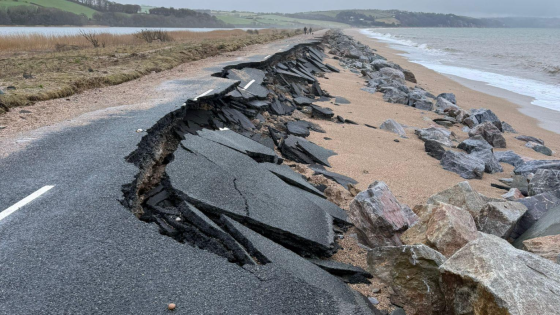
Coastal erosion has destroyed a section of the A379 Slapton line in Devon, severing a key coastal route, but central government has offered only sympathy and no funding or technical commitment to reinstate it. The community, which depends on the road as the primary link between Kingsbridge and Dartmouth, now faces long diversion routes on minor inland roads not designed for current traffic volumes or heavy vehicles. For geotechnical and coastal engineers, the situation signals continued uncertainty over who funds long-term adaptation of low-lying coastal highways exposed to accelerating shoreline retreat.
Technical Brief
- Failure mechanism involves marine undercutting and beach drawdown leading to loss of toe support beneath the carriageway.
- Geotechnical investigation would typically combine LiDAR change detection, beach profile surveys and boreholes through the former road alignment.
- Continuous monitoring should prioritise real-time GNSS prisms, inclinometer arrays in remaining embankments and wave-buoy linked early-warning thresholds.
- Any reinstatement would need coastal defence options appraisal (set-back realignment, rock armour revetment, sea wall) with life-cycle costing.
- Design would be governed by wave loading, storm return periods and accelerated sea-level rise allowances under current UK guidance.
- Temporary traffic management on diversionary minor roads requires structural assessment of pavements, weak bridges and constrained junction geometry.
- Risk assessments must address emergency response access times, school transport and abnormal load routing under highway authority safety duties.
- Similar low-lying coastal links will increasingly require pre-agreed managed realignment corridors and safeguarded inland route corridors in local plans.
Our Take
The lack of central government support in this Devon case suggests that UK local authorities will increasingly need to justify higher upfront resilience spend in their own budgets, rather than relying on post-failure funding, which has been a recurring tension in other UK Safety- and Failure-tagged items.
Because New Civil Engineer also fronts awards and innovation programmes such as the British Construction & Infrastructure Awards and TechFest, this kind of Devon erosion failure is likely to feed into future calls for entries around low-cost coastal protection, managed retreat design, and lifecycle risk management for secondary roads.
Prepared by collating external sources, AI-assisted tools, and Geomechanics.io’s proprietary mining database, then reviewed for technical accuracy & edited by our geotechnical team.
Related Articles

Related Industries & Products
Construction
Quality control software for construction companies with material testing, batch tracking, and compliance management.
Mining
Geotechnical software solutions for mining operations including CMRR analysis, hydrogeological testing, and data management.
QCDB-io
Comprehensive quality control database for manufacturing, tunnelling, and civil construction with UCS testing, PSD analysis, and grout mix design management.