CSIRO road line marking tests: durability and safety insights for engineers
Reviewed by Joe Ashwell
First reported on Roads & Infrastructure (AU)
30 Second Briefing
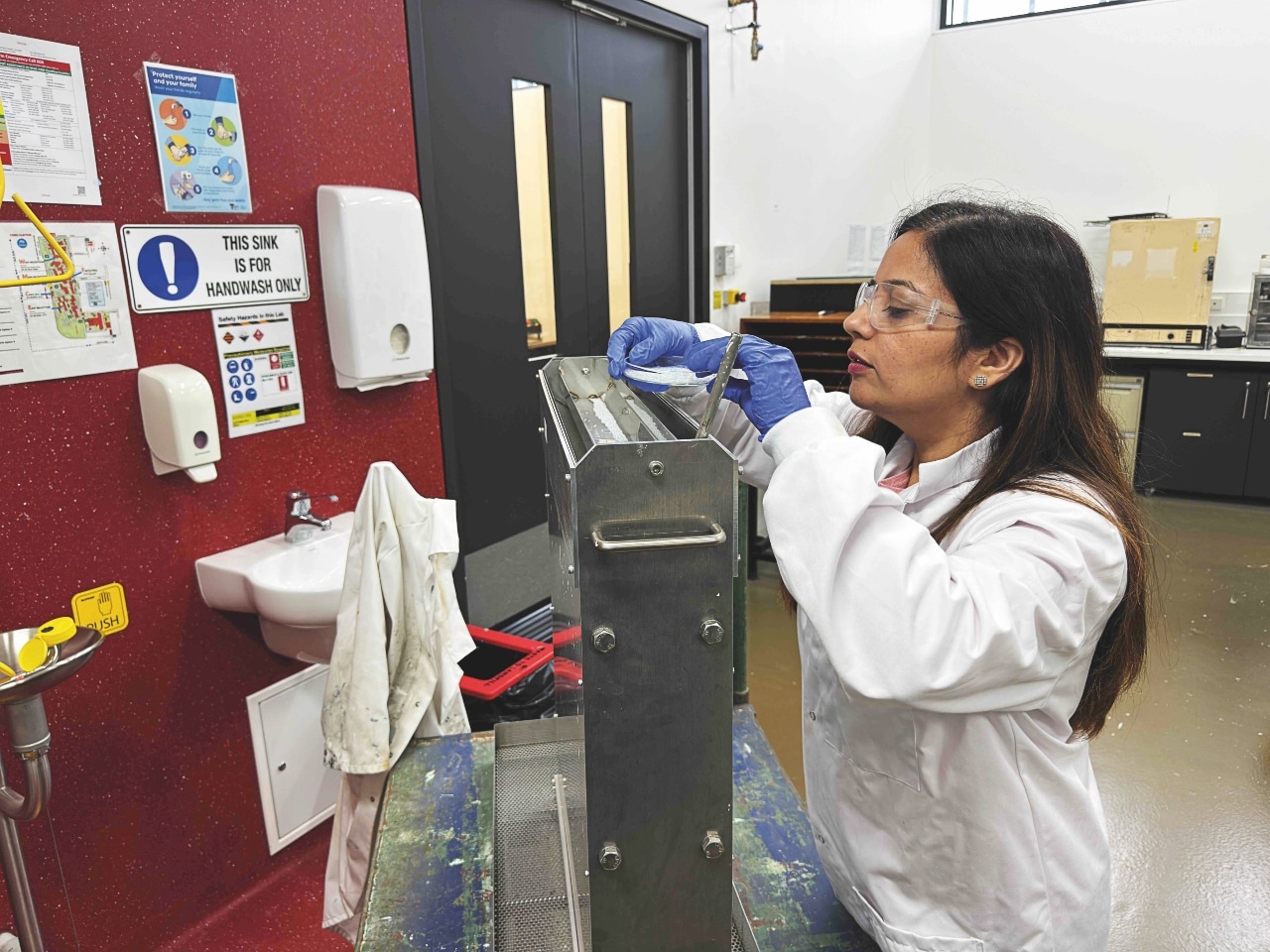
CSIRO is running independent testing and verification of materials used in Australian road line markings, focusing on retroreflective glass beads and binder systems to maintain night-time visibility and durability on high-speed motorways. Materials Performance team leader Money Arora oversees laboratory assessment of bead size distribution, refractive index and coating adhesion against strict specification criteria before products are approved for use. The work directly affects pavement marking design life, maintenance intervals and performance under heavy traffic loading and UV exposure, especially on multilane arterial and freight routes.
Technical Brief
- CSIRO’s Materials Performance laboratory uses controlled wet and dry test rigs to simulate in‑service road conditions.
- Retroreflective performance is measured with calibrated retroreflectometers at specified entrance and observation angles for compliance.
- Glass bead samples undergo sieve analysis and microscopy to quantify gradation uniformity and surface defects.
- Binder–bead systems are subjected to accelerated weathering cabinets to assess UV, moisture and temperature cycling durability.
- Skid resistance and texture depth of marked pavements are checked to ensure visibility does not compromise friction.
- Testing follows state road authority specifications and Austroads guidance for pavement marking performance and safety.
- Results feed directly into road agency approval lists, constraining which proprietary marking systems can be specified.
- Research scope is limited to pre‑deployment verification; in‑service performance monitoring remains the responsibility of road owners.
Our Take
CSIRO’s appearance here in a safety‑tagged piece sits alongside recent coverage of its ventilation air methane abatement trial at South32’s Appin coal mine, signalling that its research is increasingly being applied directly to operational risk reduction in Australian underground environments.
With the Federal Government committing an extra $387.4 million to CSIRO for mining‑related R&D, as noted in our other coverage, safety‑oriented work such as this article describes is likely to be better resourced and pushed towards commercial deployment rather than remaining at lab or pilot scale.
Prepared by collating external sources, AI-assisted tools, and Geomechanics.io’s proprietary mining database, then reviewed for technical accuracy & edited by our geotechnical team.
Related Articles



Related Industries & Products
Mining
Geotechnical software solutions for mining operations including CMRR analysis, hydrogeological testing, and data management.
Tunnelling
Specialised solutions for tunnelling projects including grout mix design, hydrogeological analysis, and quality control.
CMRR-io
Streamline coal mine roof stability assessments with our cloud-based CMRR software featuring automated calculations, multi-scenario analysis, and collaborative workflows.
HYDROGEO-io
Comprehensive hydrogeological testing platform for managing, analysing, and reporting on packer tests, lugeon values, and hydraulic conductivity assessments.
GEODB-io
Centralised geotechnical data management solution for storing, accessing, and analysing all your site investigation and material testing data.