Cockcrow Bridge heathland green bridge: design and ecology notes for engineers
Reviewed by Joe Ashwell
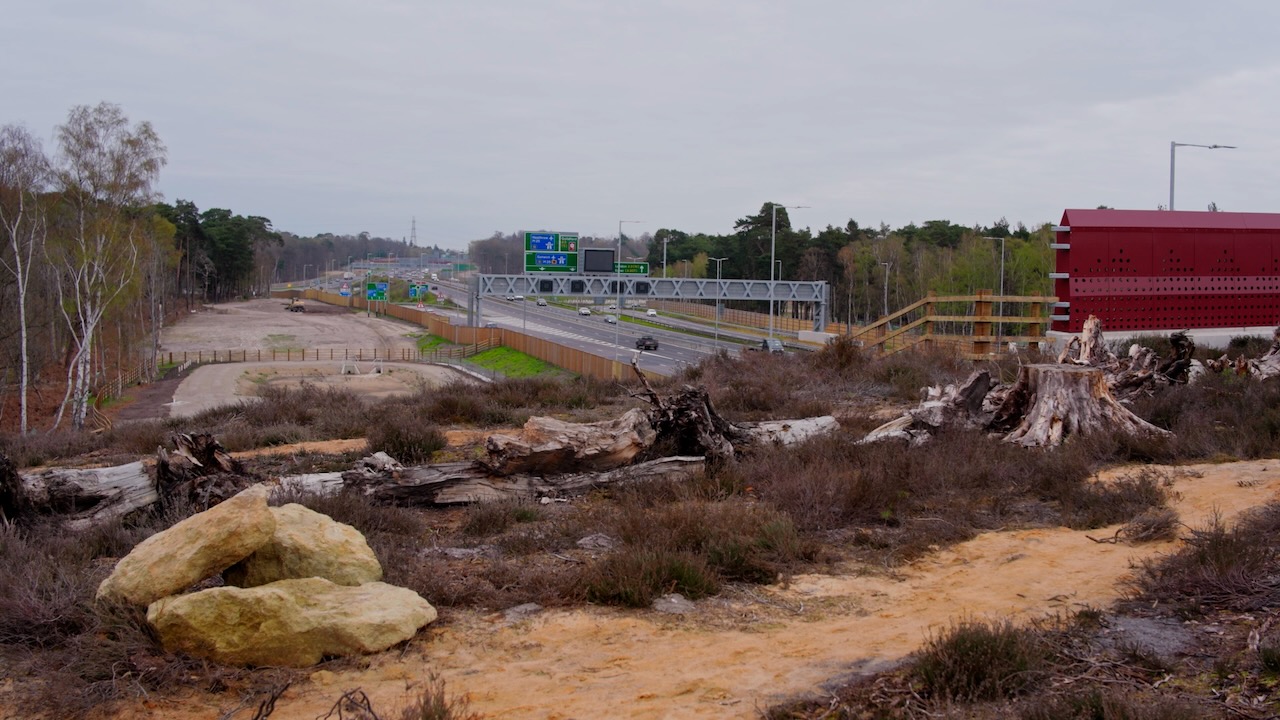
First reported on The Construction Index
30 Second Briefing
The Cockcrow Bridge, delivered by Balfour Beatty and AtkinsRéalis for National Highways, has opened as the UK’s first heathland green bridge, carrying restored lowland heath across the A3 between Ockham and Wisley Commons as part of the M25 junction 10/A3 Wisley Interchange upgrade. Around 10,000 m² of heathland turf has been translocated from nearby donor sites using specialist handling equipment, with the vegetation allowed to re‑establish gradually to support species including deer, badgers, voles and sand lizards. By reconnecting fragmented habitats in an area where heathland has declined by 85% over 200 years, the structure functions as both a multi‑user crossing and a critical ecological corridor.
Technical Brief
- Around 10,000 m² of existing lowland heath turf was lifted and re‑laid using specialist plant.
- Turf was sourced from nearby donor sites, maintaining local seed bank and soil microbial communities.
- Translocation intentionally created bare ground patches, engineered to favour species such as sand lizards.
- Habitat design departs from typical UK green bridges, prioritising heathland over hedgerows and tree planting.
- The structure forms part of the M25 junction 10/A3 Wisley Interchange upgrade led by National Highways.
- Ecological objectives include enabling wildlife migration, feeding and breeding across previously severed commons.
Our Take
Balfour Beatty’s role at Cockcrow Bridge sits alongside a busy UK infrastructure pipeline in our database, including the £83m Forres Academy and major power works for National Grid, signalling that ecological design is now being embedded in mainstream, high-volume delivery rather than niche projects.
With National Highways and Surrey County Council both involved at the A3/M25 Wisley Interchange, this scheme illustrates how local authorities and the strategic roads authority are starting to use major junction upgrades as vehicles for habitat restoration, which could become a template for other congested nodes in the UK network.
The 85% loss of lowland heathland in Surrey over 200 years makes Ockham and Wisley Commons one of the more stressed habitats in our infrastructure coverage, so the Cockcrow Bridge will likely be watched closely by ecologists as a test case for whether green bridges can materially reverse fragmentation rather than just mitigate it on paper.
Prepared by collating external sources, AI-assisted tools, and Geomechanics.io’s proprietary mining database, then reviewed for technical accuracy & edited by our geotechnical team.
Related Articles


Related Industries & Products
Mining
Geotechnical software solutions for mining operations including CMRR analysis, hydrogeological testing, and data management.
Construction
Quality control software for construction companies with material testing, batch tracking, and compliance management.
CMRR-io
Streamline coal mine roof stability assessments with our cloud-based CMRR software featuring automated calculations, multi-scenario analysis, and collaborative workflows.
HYDROGEO-io
Comprehensive hydrogeological testing platform for managing, analysing, and reporting on packer tests, lugeon values, and hydraulic conductivity assessments.
GEODB-io
Centralised geotechnical data management solution for storing, accessing, and analysing all your site investigation and material testing data.