Geomechanics.io

  • Free Tools
Sign UpLog In

Geomechanics.io

Geomechanics, Streamlined.

© 2026 Geomechanics.io. All rights reserved.

Geomechanics.io

CMRR-ioGEODB-ioHYDROGEO-ioQCDB-ioFree Tools & CalculatorsBlogLatest Industry News

Industries

MiningConstructionTunnelling

Company

Terms of UsePrivacy PolicyLinkedIn
    Projects

    Cobre Panamá mine closure: economic and project lessons for mining teams

    April 23, 2026|

    Reviewed by Joe Ashwell

    Cobre Panamá mine closure: economic and project lessons for mining teams

    First reported on MINING.com

    30 Second Briefing

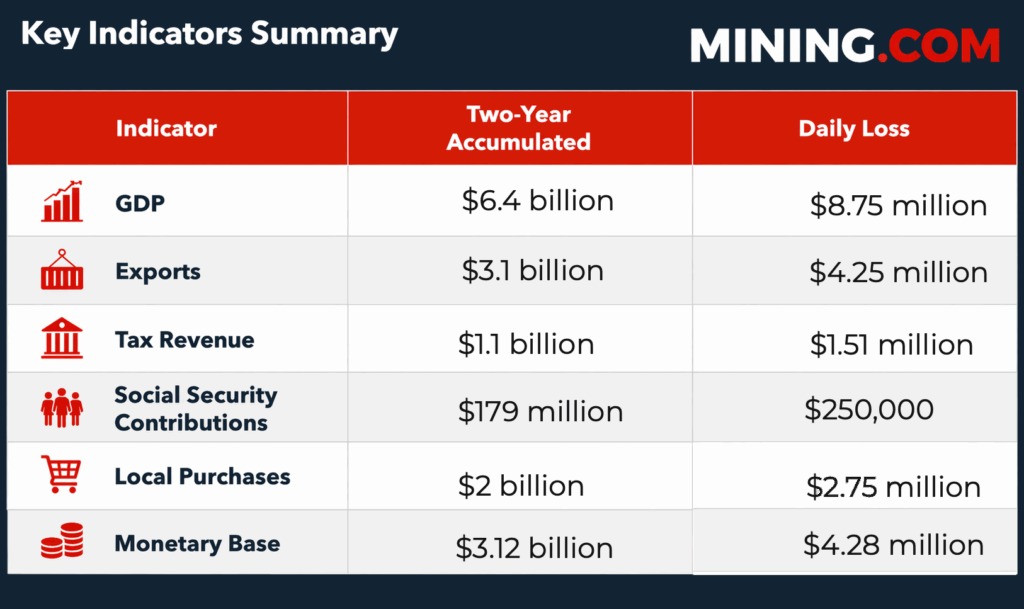
    Panama’s 2023 shutdown of First Quantum Minerals’ Cobre Panamá open-pit copper mine has removed roughly 5% of national GDP and 7% of export earnings, with CONEP estimating about $2 billion in lost exports and more than 40,000 direct and indirect jobs affected across contractors, logistics and services. Government income from corporate tax, royalties and related payments has dropped, constraining infrastructure and social spending and exposing dependence on a few high-impact sectors. The government has now approved processing of on-site ore stockpiles to produce about 70,000 tonnes of copper over a year, but the loss of a mine that once supplied nearly 2% of global copper continues to weigh on long-term growth, FDI and industrial capability.

    Technical Brief

    • First Quantum’s government-approved plan targets ~70,000 t copper over 12 months from existing ore stockpiles.
    • Cobre Panamá previously delivered nearly 2% of global copper supply, indicating substantial latent capacity now idle.
    • National GDP growth dropped from 7.4% (2023) to 2.9% (2024) after the mine shutdown.
    • Export losses tied to the closure are quantified by CONEP at roughly $2 billion.
    • More than 40,000 direct and indirect positions linked to Cobre Panamá’s value chain have been affected.
    • Loss of copper exports has widened Panama’s trade imbalance and reduced hard-currency inflows for capital projects.
    • CONEP flags that large-scale mines like Cobre Panamá typically anchor FDI, regional infrastructure build-out and technical skills transfer.
    • Without a comparable replacement project, Panama’s long-term exposure to critical-mineral demand growth is structurally reduced.

    Our Take

    With Cobre Panamá having supplied nearly 2% of global copper before the 2023 shutdown, the modest 0.5% rise in Comex copper warehouse stocks in our database suggests that other producers and inventories have so far cushioned the physical market impact, even as Panama’s macro hit is severe.

    Our wider Mining coverage shows First Quantum Minerals simultaneously advancing new copper capacity at Taca Taca in Argentina and divesting Çayeli in Türkiye, signalling a portfolio reshaping that could partially offset the loss of Cobre Panamá exposure while shifting more weight to Latin American porphyry assets.

    Geotechnical Software for Modern Teams

    Centralise site data, logs, and lab results with GEODB-io, CMRR-io, and HYDROGEO-io.

    No credit card required.

    • Save and export unlimited calculations
    • Advanced data visualisation
    • Generate professional PDF reports
    • Cloud storage for all your projects

    Prepared by collating external sources, AI-assisted tools, and Geomechanics.io’s proprietary mining database, then reviewed for technical accuracy & edited by our geotechnical team.

    Related Articles

    Silver stockpile drawdown risk: supply–demand lens for mining project teams
    Mining
    about 13 hours ago

    Silver stockpile drawdown risk: supply–demand lens for mining project teams

    Silver inventories at COMEX and London have fallen sharply from pandemic-era peaks – COMEX registered stocks are down more than 75% to about 79.9 million oz., while LBMA vaults hold 27,454 tonnes (≈883 million oz.), 20% below their 2021 record – yet analysts argue this does not prove a structural shortage. The World Silver Survey 2026 projects a 46.3 million oz. deficit and estimates 762 million oz. drawn from above-ground stocks since 2021, but CPM Group stresses that investment flows, working inventories and scrap – including “billions of ounces” in jewellery and electronics – can rapidly re-enter the market.

    Mining’s next boom off the map: frontier project risks and design notes for engineers
    Mining
    about 13 hours ago

    Mining’s next boom off the map: frontier project risks and design notes for engineers

    Depletion of high-grade deposits, declining ore grades and sustained high commodity prices are pushing miners towards frontier resources in the Arctic, on abyssal plains and eventually in space. Capital is already moving into Arctic projects targeting onshore and offshore deposits in ice-affected conditions, while proposed deep-sea mining of polymetallic nodules on abyssal plains faces an intensifying regulatory battle at the International Seabed Authority. Asteroid mining remains a long-dated, largely conceptual option, but is shaping early research into in-situ resource utilisation, autonomous extraction systems and ultra-remote operations.

    Hertha Metals’ Texas high‑purity iron plant: supply, process and capex notes for engineers
    Mining
    about 13 hours ago

    Hertha Metals’ Texas high‑purity iron plant: supply, process and capex notes for engineers

    Hertha Metals will break ground this summer on a Conroe, Texas plant to produce 10,000 tonnes per year of high-purity iron for neodymium-iron-boron magnets, using its FLEXHERS (Flexible Fuel Hydrogen Electric Reduction Smelting) process that couples an electric arc furnace with natural gas or hydrogen. The startup already runs a one-tonne-per-day pilot using Minnesota ore and plans to scale to roughly 500,000 tonnes per year within four to five years, targeting both magnet and electrical steel markets. With 90% of current high-purity iron output in China and a US DoD ban on Chinese-origin rare earth magnets taking effect on 1 January 2027, the project directly targets a looming supply-chain gap.

    Related Industries & Products

    Mining

    Geotechnical software solutions for mining operations including CMRR analysis, hydrogeological testing, and data management.

    Construction

    Quality control software for construction companies with material testing, batch tracking, and compliance management.

    CMRR-io

    Streamline coal mine roof stability assessments with our cloud-based CMRR software featuring automated calculations, multi-scenario analysis, and collaborative workflows.

    HYDROGEO-io

    Comprehensive hydrogeological testing platform for managing, analysing, and reporting on packer tests, lugeon values, and hydraulic conductivity assessments.

    GEODB-io

    Centralised geotechnical data management solution for storing, accessing, and analysing all your site investigation and material testing data.

    AllGeotechnicalMiningInfrastructureMaterialsHazardsEnvironmentalSoftwarePolicy