Bouygues’ timber, offsite St John’s CE Academy: design and carbon notes for engineers
Reviewed by Tom Sullivan
First reported on The Construction Index
30 Second Briefing
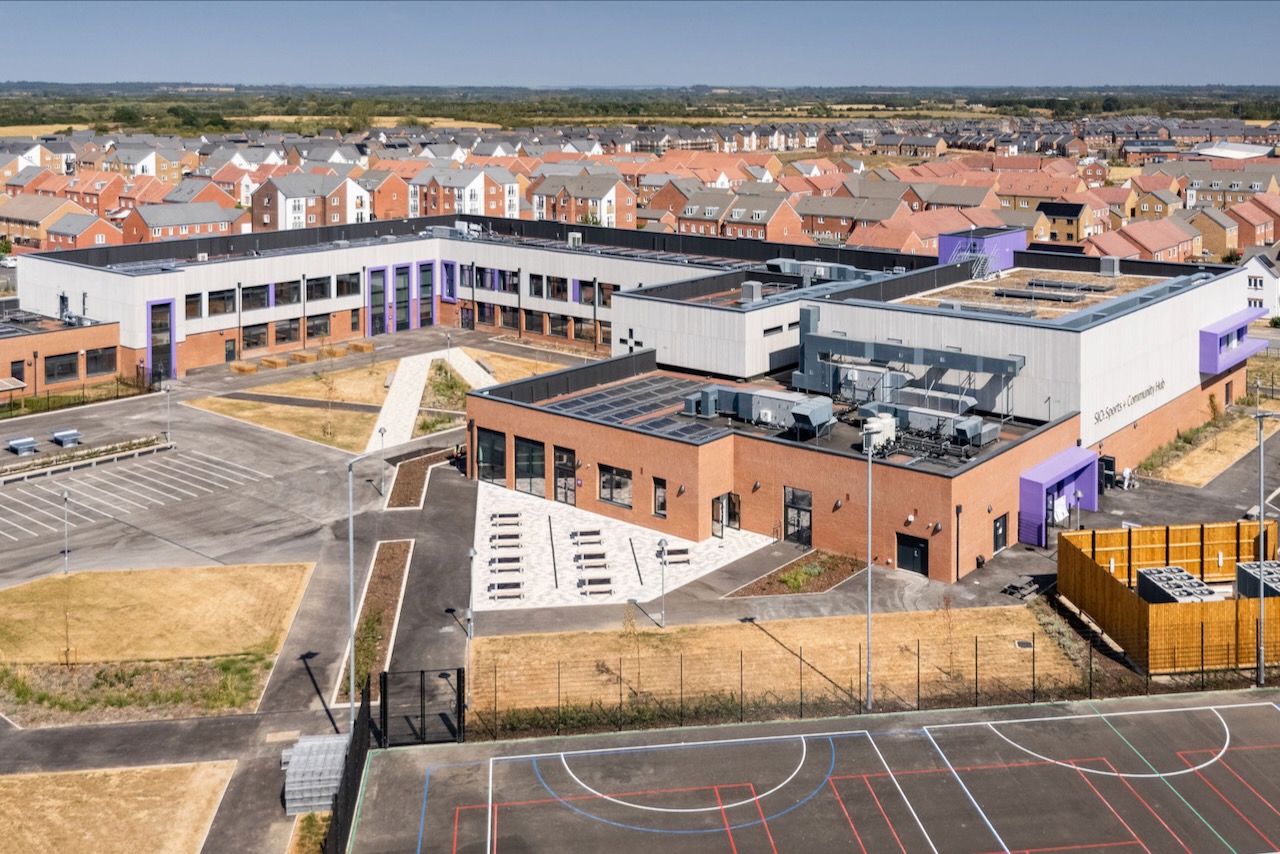
Bouygues UK has completed the new St John’s CE Academy in Grove, Wantage, delivering a 600-place secondary school for Cambrian Learning Trust and the Department for Education using a cross-laminated timber (CLT) structure and offsite manufacturing to cut embodied carbon and site waste. The CLT frame and consistent prefabricated components aim to reduce defects while exposing natural timber internally for occupant comfort. A green roof with photovoltaic panels, grass pitches, a multi-use games area and SuDS with attenuation, swales and porous parking target improved energy performance and surface-water management.
Technical Brief
- Cross-laminated timber panels were factory-produced and standardised, enabling a repeatable, consistent erection sequence.
- Offsite manufacturing reduced on-site cutting and handling of timber, limiting dust, noise and temporary works.
- Green roof build-up is structurally designed to support both photovoltaic arrays and biodiverse planting loads.
- Porous parking areas act as source-control SuDS, reducing reliance on deep piped drainage and large outfalls.
- Swales and attenuation features provide surface-water storage and controlled discharge, mitigating runoff from new hardstanding and pitches.
- Multi-use games area and grass playing fields required coordinated subgrade preparation to manage differential settlement and drainage performance.
Our Take
Bouygues UK’s use of timber and offsite delivery for a 600-place school sits alongside its large healthcare and higher-education schemes in our database, suggesting the contractor is standardising low-carbon and industrialised methods across very different building typologies.
With the Department for Education as client here and NHS and university clients in the recent Overdale Hospital and LSE Bankside House items, Bouygues UK is consolidating a strong position in UK public and quasi-public social infrastructure, which typically favours repeatable design and offsite platforms.
Prepared by collating external sources, AI-assisted tools, and Geomechanics.io’s proprietary mining database, then reviewed for technical accuracy & edited by our geotechnical team.


