Geomechanics.io

  • Free Tools
Sign UpLog In
Built byBoxcut Studio

Geomechanics.io

Geomechanics, Streamlined.

© 2026 Geomechanics.io. All rights reserved.

Geomechanics.io

CMRR-ioGEODB-ioHYDROGEO-ioQCDB-ioFree Tools & CalculatorsBlogLatest Industry News

Industries

MiningConstructionTunnelling

Company

Terms of UsePrivacy PolicyLinkedIn
    Product
    Projects

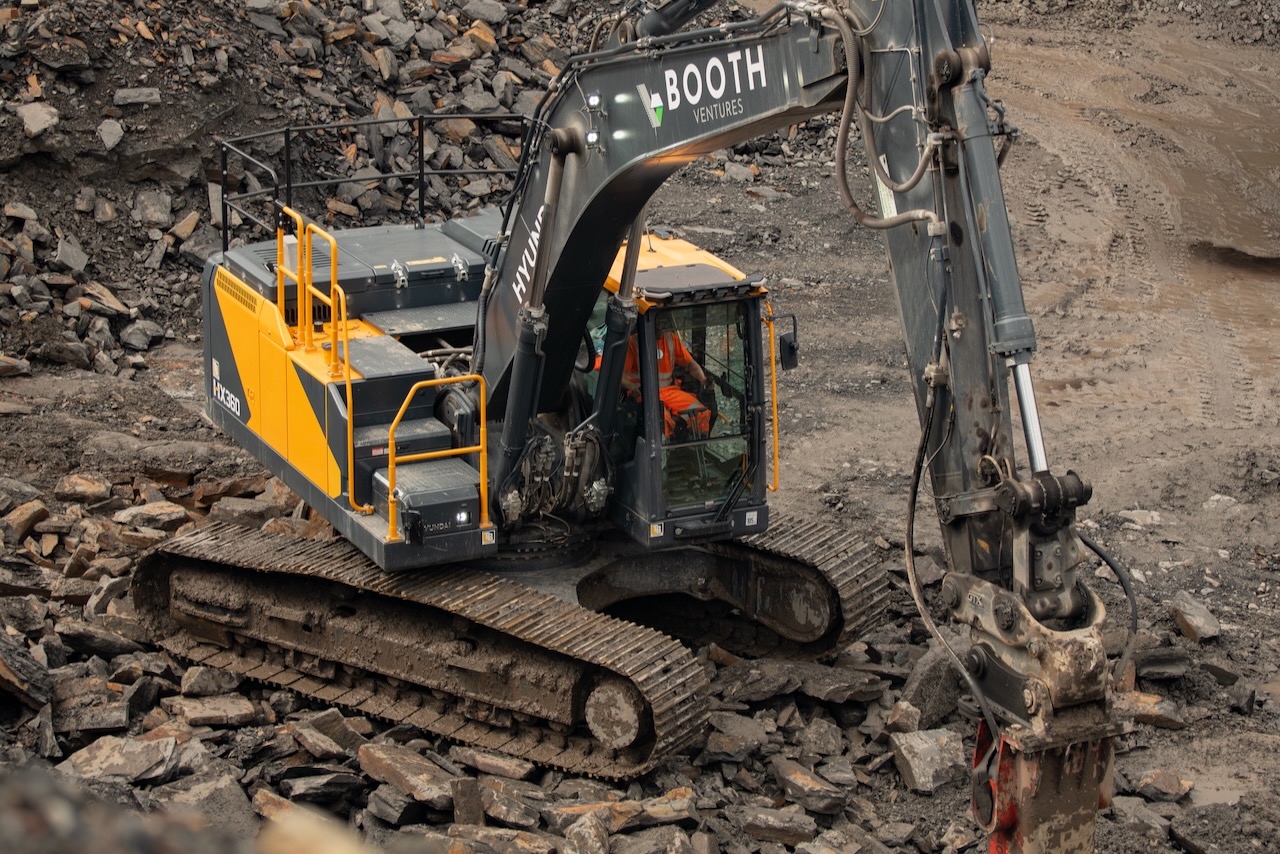
    Booth Ventures’ fuel‑cut HX360L at Ravenhead Quarry: productivity notes for engineers

    October 6, 2026|

    Reviewed by Joe Ashwell

    Booth Ventures’ fuel‑cut HX360L at Ravenhead Quarry: productivity notes for engineers

    First reported on The Construction Index

    30 Second Briefing

    Booth Ventures has deployed a 36‑tonne Hyundai HX360L Next Generation crawler excavator at Ravenhead Quarry, supplied by Taylor & Braithwaite, matching the output of a larger predecessor while cutting fuel consumption. The HX360L is being used for primary quarry duties, including overburden removal and loading, where its reduced operating weight and newer engine platform deliver lower fuel cost per tonne moved. For quarry operators, the case points to potential savings from downsizing to more efficient 30–40‑tonne class excavators without sacrificing production rates.

    Technical Brief

    • HX360L’s reduced 36‑tonne operating weight lowers ground bearing pressure on quarry haul roads and benches.
    • Next Generation Hyundai platform provides updated hydraulics, improving cycle times for digging and truck loading.
    • Machine is deployed on primary quarrying tasks at Ravenhead, including overburden stripping and face loading.

    Our Take

    Hyundai’s 36 t HX360L sits in the same size class as many primary face and load-and-carry units covered in our mining equipment stories, so any verified fuel savings at Ravenhead Quarry are likely to be directly comparable for other UK quarry operators benchmarking fleet renewals.

    In our database, most ‘Product’ pieces for excavators in the 30–40 t range emphasise telematics and cycle-time gains rather than fuel burn, so Booth Ventures’ focus on reduced fuel for the HX360L signals that operating-cost per tonne is becoming a more prominent decision driver in this class.

    With Warrington-area quarrying increasingly constrained on planning and haul distances, a higher-efficiency 36 t excavator at Ravenhead Quarry gives Booth Ventures more headroom on diesel use and emissions, which can strengthen the case for future permit variations or extended operating hours.

    Geotechnical Software for Modern Teams

    Centralise site data, logs, and lab results with GEODB-io, CMRR-io, and HYDROGEO-io.

    No credit card required.

    • Save and export unlimited calculations
    • Advanced data visualisation
    • Generate professional PDF reports
    • Cloud storage for all your projects

    Prepared by collating external sources, AI-assisted tools, and Geomechanics.io’s proprietary mining database, then reviewed for technical accuracy & edited by our geotechnical team.

    Related Articles

    Mining
    about 2 hours ago

    Atlantic Nickel record output at Santa Rita: process and UG transition notes for planners

    Atlantic Nickel’s Santa Rita nickel sulphide mine in Bahia, Brazil, delivered a record 12,464 t of nickel concentrate in August, with metallurgical recovery reaching 86.72%, the highest since operations restarted under Appian Capital ownership. The performance comes as the operation advances its transition from open pit to underground mining, signalling stable plant performance and effective ore blending during a complex changeover. For process and mine planners, the numbers suggest current comminution and flotation circuits are coping well with evolving underground feed characteristics.

    Mining
    about 2 hours ago

    Advanced Navigation US plant: GPS-denied mine positioning insights for engineers

    Advanced Navigation America has opened a US manufacturing facility to scale production of its inertial navigation and robotics systems for GPS-denied underground and surface mines, reducing reliance on vulnerable, legacy GPS-based infrastructure. The plant will build mining-grade INS/IMU units and navigation systems designed to maintain centimetre-level positioning in dust, blast-induced shock and long-haul drifts where satellite signals are unavailable or intermittent. For mine operators, this supports more reliable autonomous haulage, drilling guidance and fleet tracking without installing extensive fixed beacons or repeaters.

    Mining
    about 2 hours ago

    Multotec Zambia expansion: supply chain and uptime takeaways for mine engineers

    Multotec Zambia is marking its 25th anniversary in 2026 by opening a new Central Africa Regional Head Office that will expand local manufacturing, assembly and service support for the Zambian and regional mining sector. The facility is intended to bring Multotec’s process equipment expertise and technology—such as wear linings, screening media and cyclones—closer to copper and cobalt operations that currently rely heavily on imported or South African-supplied components. For mine operators, increased in-country capacity should shorten lead times for critical spares and enable more responsive on-site technical support.

    Related Industries & Products

    Mining

    Geotechnical software solutions for mining operations including CMRR analysis, hydrogeological testing, and data management.

    CMRR-io

    Streamline coal mine roof stability assessments with our cloud-based CMRR software featuring automated calculations, multi-scenario analysis, and collaborative workflows.

    HYDROGEO-io

    Comprehensive hydrogeological testing platform for managing, analysing, and reporting on packer tests, lugeon values, and hydraulic conductivity assessments.

    GEODB-io

    Centralised geotechnical data management solution for storing, accessing, and analysing all your site investigation and material testing data.

    AllGeotechnicalInfrastructureHazardsEnvironmental