Blyth Marble fatal slab incident: key HSE safety lessons for engineers
Reviewed by Joe Ashwell
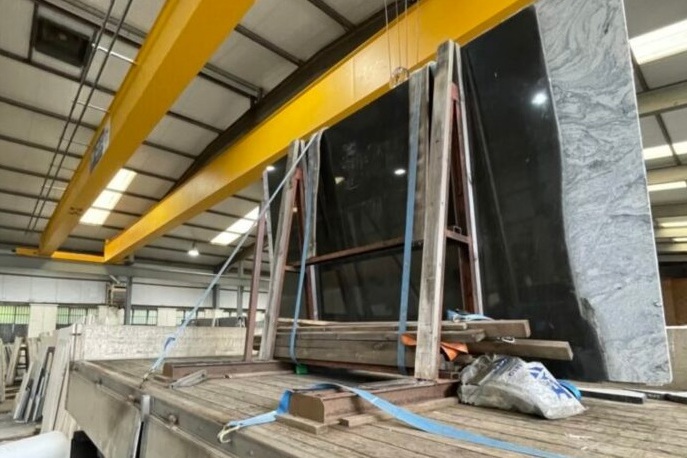
First reported on The Construction Index
30 Second Briefing
Blyth Marble Limited has been fined £50,000 plus a £3,750 victim surcharge after 61-year-old worker Steven White was fatally struck by two granite slabs with a combined weight of more than 900 kg during offloading from a lorry loader at its Larkhall, Lanarkshire premises on 4th September 2024. HSE investigators found vertical safety posts, intended as a physical barrier to prevent slab toppling, had been removed despite custom and practice to leave them in place and no explicit requirement in the safe working manual. The Safe System of Work also failed to distinguish between single and multiple slab lifting and was breached when White worked alone despite a two-person offloading requirement.
Technical Brief
- Vertical safety posts, designed as anti-topple barriers for slab stacks, had been physically removed.
- Combined slab mass exceeded 900 kg, generating high impact energy on a worker standing on the flatbed.
- HSE identified regular practice of lifting two slabs simultaneously without distinct procedural controls for multi-slab lifts.
- Safe System of Work omitted explicit instruction that safety posts must remain fitted throughout offloading operations.
- Company pleaded guilty to breaching Section 2(1) of the Health and Safety at Work etc. Act 1974.
- Hamilton Sheriff Court imposed a £50,000 fine plus £3,750 victim surcharge on 28 January 2026.
- For similar slab-handling operations, monitoring should verify barrier devices remain in place and two-person teams are enforced.
- Typical post-incident investigations would review lifting accessories, slab restraint geometry, and stability under foreseeable handling scenarios.
Our Take
In our hazards coverage for the United Kingdom, incidents involving stone and slab handling are relatively infrequent compared with mobile plant and underground events, which suggests HSE is likely to treat repeat or systemic failures in this niche with particular scrutiny.
The combined slab weight of more than 900 kg puts this event into the same risk band as small vehicle or loader impacts, reinforcing that UK fabricators and yards handling dimensional stone should be applying lifting, racking and exclusion-zone standards closer to those used in heavy manufacturing rather than light workshops.
With 38 Hazards stories and many tagged as Failure and Safety, enforcement actions like this against Blyth Marble Limited signal that regulators are increasingly using post-fatality prosecutions to drive procedural controls (storage, securing, and manual handling limits) into smaller, dispersed industrial estates rather than just large mines or quarries.
Prepared by collating external sources, AI-assisted tools, and Geomechanics.io’s proprietary mining database, then reviewed for technical accuracy & edited by our geotechnical team.
Related Articles



Related Industries & Products
Mining
Geotechnical software solutions for mining operations including CMRR analysis, hydrogeological testing, and data management.
Construction
Quality control software for construction companies with material testing, batch tracking, and compliance management.
QCDB-io
Comprehensive quality control database for manufacturing, tunnelling, and civil construction with UCS testing, PSD analysis, and grout mix design management.