Geomechanics.io

  • Free Tools
Sign UpLog In

Geomechanics.io

Geomechanics, Streamlined.

© 2026 Geomechanics.io. All rights reserved.

Geomechanics.io

CMRR-ioGEODB-ioHYDROGEO-ioQCDB-ioFree Tools & CalculatorsBlogLatest Industry News

Industries

MiningConstructionTunnelling

Company

Terms of UsePrivacy PolicyLinkedIn
    AllGeotechnicalMiningInfrastructureMaterialsHazardsEnvironmentalSoftwarePolicy
    Projects
    Safety

    Blow‑up tents at Royal Bolton: phasing, safety and access lessons for engineers

    March 16, 2026|

    Reviewed by Joe Ashwell

    Blow‑up tents at Royal Bolton: phasing, safety and access lessons for engineers

    First reported on The Construction Index

    30 Second Briefing

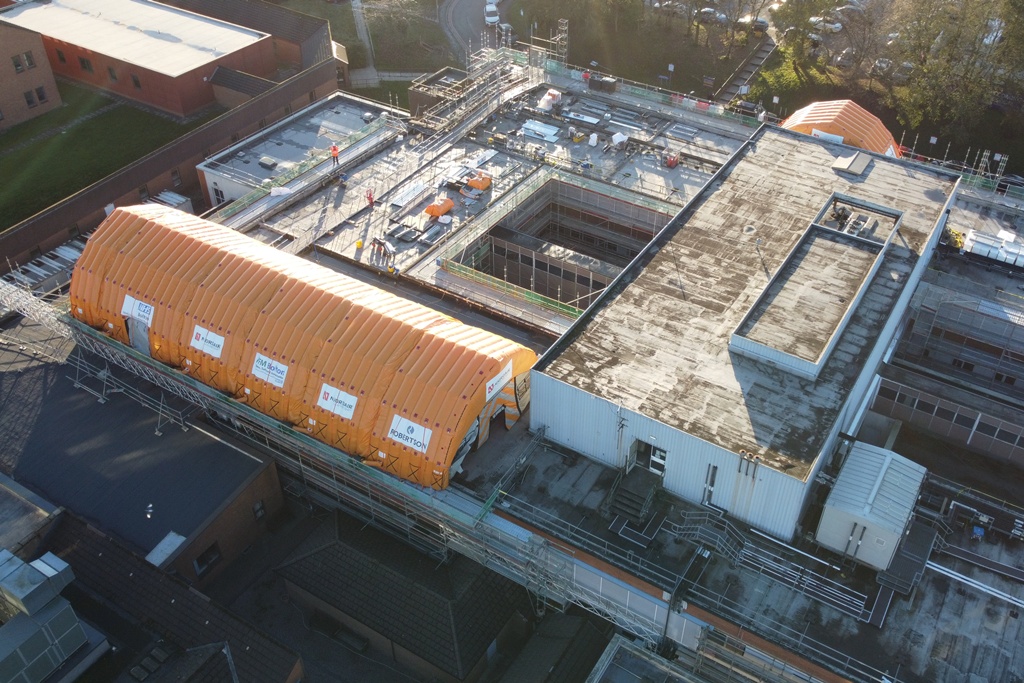
    Robertson Construction is using a 35‑metre Njordair Fast Tent inflatable roofing system on the £38m Royal Bolton Hospital redevelopment to replace life‑expired RAAC roof panels on the maternity unit while keeping clinical services running 24/7. Thirteen modular PVC, flame‑retardant tents, each deployable in about seven minutes and designed to withstand high winds, are being moved across the roof over a 40‑week programme, powered from the hospital mains. The lightweight scaffold–tent combination avoids large traditional scaffold runs that would obstruct complex roof geometries and critical areas such as the oxygen store.

    Technical Brief

    • Tents are engineered for long-term reuse, reducing waste compared with conventional sacrificial weather sheeting.

    Our Take

    Among recent UK Infrastructure pieces in our database, relatively few sub-£50m hospital schemes feature this level of temporary works innovation, suggesting Robertson Construction is using the Royal Bolton job as a proving ground for rapid-deploy weather and safety controls on live healthcare estates.

    The 40‑week roof programme and modular Njordair/Fast Tent set‑up imply a methodology that could be replicated across other NHS ProCure23 and Crown Commercial Service framework projects, where minimising ward decant and maintaining clinical operations are often bigger constraints than pure construction productivity.

    For UK hospital work, air‑supported enclosures of this 35 m scale are more commonly seen in industrial reroofing than in acute healthcare settings in our coverage, signalling that contractors are starting to import logistics and safety practices from commercial and industrial sectors into NHS refurbishment portfolios.

    Geotechnical Software for Modern Teams

    Centralise site data, logs, and lab results with GEODB-io, CMRR-io, and HYDROGEO-io.

    No credit card required.

    • Save and export unlimited calculations
    • Advanced data visualisation
    • Generate professional PDF reports
    • Cloud storage for all your projects

    Prepared by collating external sources, AI-assisted tools, and Geomechanics.io’s proprietary mining database, then reviewed for technical accuracy & edited by our geotechnical team.

    Related Articles

    National Grid TBM under the Thames: tunnelling design and risk notes for engineers
    Infrastructure
    in 9 months

    National Grid TBM under the Thames: tunnelling design and risk notes for engineers

    A 271.5‑tonne Herrenknecht Mixshield TBM, Caroline, has started driving a 2.2km electricity cable tunnel with a 4m internal diameter beneath the River Thames in Essex for National Grid’s Grain to Tilbury project, delivered by the Ferrovial BEMO joint venture. The drive will pass through variable Thames estuary ground conditions between 35m‑deep launch and reception shafts of 15m and 12m diameter, with tunnelling continuing into 2026 and overall scheme completion targeted for 2029. The new tunnel will replace the 1969 Thames Cable Tunnel and carry new high‑voltage circuits between Grain and Tilbury substations.

    Panama Canal Mixshield undercrossing: design and tunnelling lessons for engineers
    Infrastructure
    in 9 months

    Panama Canal Mixshield undercrossing: design and tunnelling lessons for engineers

    A 13.46m diameter Herrenknecht Mixshield TBM has broken through into the future Balboa station on Panama Metro Line 3 after completing the first-ever TBM undercrossing of the Panama Canal at depths exceeding 60m below sea level. The 5,600kW, 26,616kNm machine, fitted with an accessible cutterhead and more than 4,500 sensors linked via the Herrenknecht.Connected platform, has achieved peak advance of 150 segment rings (about 300m) per month through mixed sandstone, tuff, breccias and basalt. Around 1.5km of the 4.5km twin-track tunnel remains to final breakthrough.

    Hudson Tunnel funding deadline: schedule and risk takeaways for project teams
    Infrastructure
    in 8 months

    Hudson Tunnel funding deadline: schedule and risk takeaways for project teams

    Federal funding for New York’s US$16bn Hudson Tunnel Project has been frozen, forcing the Gateway Development Commission to suspend works from 6 February after spending over US$1bn and employing about 1,000 site workers. A Manhattan federal judge has issued a temporary restraining order, giving the administration until 5 p.m. on 12 February to restore reimbursements or appeal, while contractors warn that demobilisation, resequencing and remobilisation will add cost and delay. Sites are now in “safe-pause” mode, with dewatering, ground support and environmental monitoring maintained, and assembly of two Herrenknecht TBMs in New Jersey likely to slip beyond the planned spring 2026 launch without funding certainty.

    Related Industries & Products

    Construction

    Quality control software for construction companies with material testing, batch tracking, and compliance management.

    Mining

    Geotechnical software solutions for mining operations including CMRR analysis, hydrogeological testing, and data management.

    QCDB-io

    Comprehensive quality control database for manufacturing, tunnelling, and civil construction with UCS testing, PSD analysis, and grout mix design management.