Bedford train crash recovery: reinstatement methods and safety notes for engineers
Reviewed by Joe Ashwell
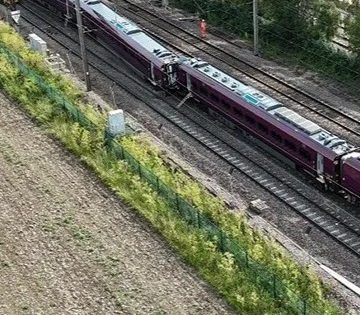
First reported on New Civil Engineer
30 Second Briefing
Passenger services have resumed on the Midland Main Line near Bedford after Network Rail completed complex recovery and structural assessment works following a collision between two East Midlands Railway trains. Engineers used rail-mounted cranes and specialist lifting frames to remove the damaged rolling stock, then carried out detailed track geometry checks, ballast replacement and ultrasonic rail inspections over the affected section. The line’s reinstatement required verification of overhead line equipment alignment and signalling integrity, with temporary speed restrictions expected until full track behaviour under traffic is confirmed.
Technical Brief
- Network Rail’s recovery and assessment operation was described as complex, indicating multi-disciplinary structural and systems checks.
- Site works had to be sequenced around damaged rolling stock, constraining access for heavy plant and inspection teams.
- Incident location on a key intercity corridor added timetable and possession pressure to engineering decision-making.
- Coordination between Network Rail and East Midlands Railway will inform future emergency response playbooks and training.
- Event provides a live reference case for UK rail crash recovery under current safety management systems.
Our Take
Network Rail features heavily across recent Infrastructure and Safety coverage in our database, with items on near-miss incidents and geotechnical defects (e.g. the Purley sinkholes), signalling that operational risk management is under intense scrutiny alongside recovery works like those at Bedford.
The recent £23M Severn Tunnel upgrade and the Eastern Region Assessment Contracts awarded to Amey show Network Rail pairing incident response with planned resilience upgrades, which likely means lessons from the Bedford crash will feed quickly into asset assessment and renewal strategies on comparable routes.
With Ramboll and Amey both recently securing framework roles that include work for Network Rail, the Bedford recovery sits in a context where external consultants are increasingly embedded in structural and geotechnical risk assessment, potentially accelerating independent review of crash-related failure modes.
Prepared by collating external sources, AI-assisted tools, and Geomechanics.io’s proprietary mining database, then reviewed for technical accuracy & edited by our geotechnical team.
Related Articles


Related Industries & Products
Construction
Quality control software for construction companies with material testing, batch tracking, and compliance management.
Tunnelling
Specialised solutions for tunnelling projects including grout mix design, hydrogeological analysis, and quality control.
CMRR-io
Streamline coal mine roof stability assessments with our cloud-based CMRR software featuring automated calculations, multi-scenario analysis, and collaborative workflows.
HYDROGEO-io
Comprehensive hydrogeological testing platform for managing, analysing, and reporting on packer tests, lugeon values, and hydraulic conductivity assessments.
GEODB-io
Centralised geotechnical data management solution for storing, accessing, and analysing all your site investigation and material testing data.