Bedford train collision recovery: access, lifting and stability notes for engineers
Reviewed by Joe Ashwell
First reported on New Civil Engineer
30 Second Briefing
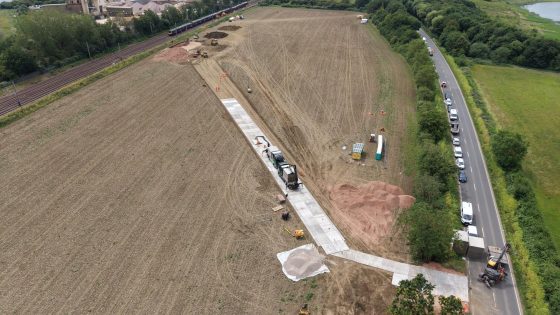
Engineers have started a complex recovery operation after the 19 June collision between two East Midlands Railway trains near Bedford, constructing a temporary access road over the weekend to bring in heavy lifting plant to the otherwise landlocked site. The road, built across adjacent farmland and drainage ditches, is designed to carry multi-axle cranes and ballast wagons needed to remove derailed rolling stock and damaged track panels. Network Rail and specialist contractors are sequencing works to maintain embankment stability and protect buried services while minimising disruption to the Midland Main Line.
Technical Brief
- Recovery sequencing must preserve evidence for RAIB, limiting early disturbance of rolling stock and trackbed.
- Network Rail’s contractors must coordinate with utility owners to avoid damaging undocumented buried services during works.
- Embankment stability assessments are required before imposing crane outrigger loads and ballast stockpiles on the formation.
- Temporary works and lifting plans will be subject to CDM Regulations and Network Rail standard safety approvals.
- Lessons on access planning and embankment loading from this incident will inform future derailment response protocols.
Prepared by collating external sources, AI-assisted tools, and Geomechanics.io’s proprietary mining database, then reviewed for technical accuracy & edited by our geotechnical team.
Related Articles


Related Industries & Products
Mining
Geotechnical software solutions for mining operations including CMRR analysis, hydrogeological testing, and data management.
Construction
Quality control software for construction companies with material testing, batch tracking, and compliance management.
CMRR-io
Streamline coal mine roof stability assessments with our cloud-based CMRR software featuring automated calculations, multi-scenario analysis, and collaborative workflows.
HYDROGEO-io
Comprehensive hydrogeological testing platform for managing, analysing, and reporting on packer tests, lugeon values, and hydraulic conductivity assessments.
GEODB-io
Centralised geotechnical data management solution for storing, accessing, and analysing all your site investigation and material testing data.