Geomechanics.io

  • Free Tools
Sign UpLog In
Built byBoxcut Studio

Geomechanics.io

Geomechanics, Streamlined.

© 2026 Geomechanics.io. All rights reserved.

Geomechanics.io

CMRR-ioGEODB-ioHYDROGEO-ioQCDB-ioFree Tools & CalculatorsBlogLatest Industry News

Industries

MiningConstructionTunnelling

Company

Terms of UsePrivacy PolicyLinkedIn
    Projects

    Barton Gold’s Tunkillia assays: starter pit design and grade insights for engineers

    October 8, 2026|

    Reviewed by Joe Ashwell

    Barton Gold’s Tunkillia assays: starter pit design and grade insights for engineers

    First reported on Australian Mining

    30 Second Briefing

    Barton Gold has completed assays for its Tunkillia resource‑upgrade campaign in South Australia, returning broad, high‑grade gold intersections within the proposed starter pits. Final results include 53m at 2.51g/t Au from 60m in hole TKB0745, with higher‑grade zones of 2m at 18.25g/t from 72m and 1m at 26.3g/t, plus several similarly mineralised intervals. The data support potential early pit designs focused on thicker, near‑surface mineralisation, improving options for initial strip ratios and mill feed grade scheduling.

    Technical Brief

    • Assay phase for Tunkillia’s current resource‑upgrade drilling is now fully complete, enabling updated block modelling.
    • Final batch of results all sit within the footprint of planned starter open pits.
    • Concentration of high‑grade hits in these zones tightens confidence for early mine scheduling assumptions.
    • Data density in the starter‑pit area should allow refinement of geometallurgical domains and recovery assumptions.
    • Near‑surface thickness continuity supports optimisation of bench heights, drill‑and‑blast patterns and haul profiles.
    • Updated resource model will directly inform cut‑off grade selection for first‑phase pit shells.
    • Results de‑risk early cashflow scenarios by constraining variability in grade distribution within initial mining panels.

    Our Take

    With a pre-feasibility study for Tunkillia already under way led by GR Engineering Services (reported June 2026), these new South Australian intersections are likely to be fed directly into pit shell optimisation and reserve conversion, potentially allowing Barton Gold to tighten cut-off assumptions rather than chase additional satellite ounces in the near term.

    Geotechnical Software for Modern Teams

    Centralise site data, logs, and lab results with GEODB-io, CMRR-io, and HYDROGEO-io.

    No credit card required.

    • Save and export unlimited calculations
    • Advanced data visualisation
    • Generate professional PDF reports
    • Cloud storage for all your projects

    Prepared by collating external sources, AI-assisted tools, and Geomechanics.io’s proprietary mining database, then reviewed for technical accuracy & edited by our geotechnical team.

    Related Articles
    Chile copper mines disruptions: production-at-risk insights for planners
    Mining
    about 2 hours ago

    Chile copper mines disruptions: production-at-risk insights for planners

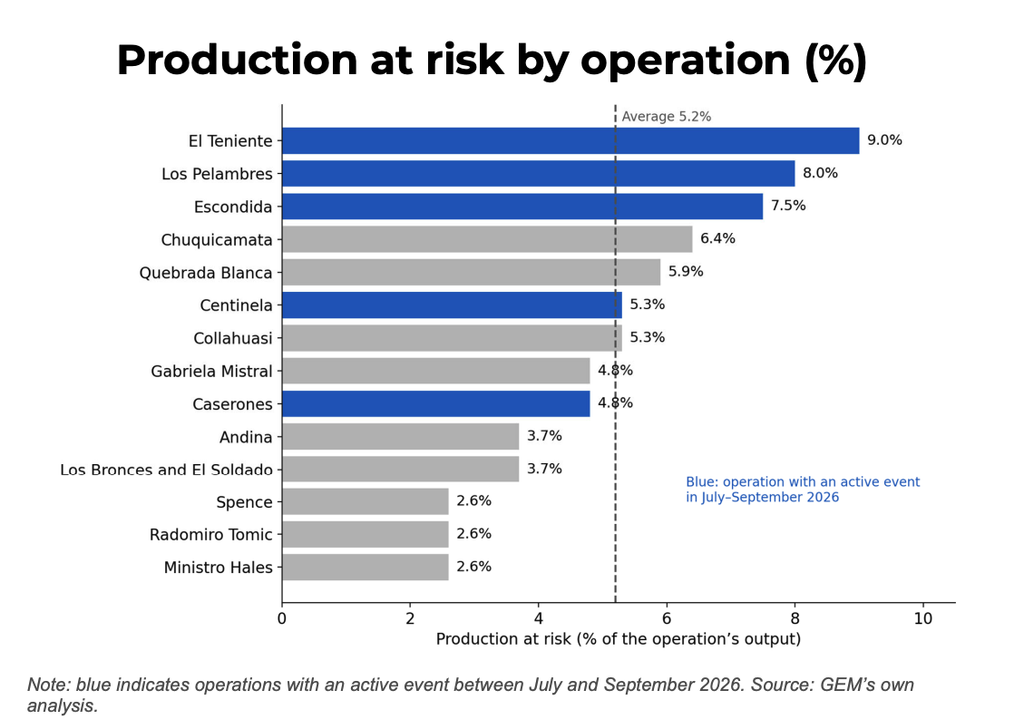
    Strikes, severe weather, accidents and geotechnical issues are putting an average 5.2% of output at Chile’s 14 largest copper mines at risk, with GEM Mining Consulting’s new Production-at-Risk Index scoring El Teniente at 9%, Los Pelambres at 8% and Escondida at 7.5%. The model compounds eight disruption categories—labour, water, weather, geotechnical, metallurgy/grades, ramp-up, safety and permitting—where a single high rating equates to an expected 3% annual loss, or about 11 days of production. Current events validate the exposure, with over 700 workers on strike at Centinela, Escondida halted after a fatal accident, and storms disrupting Los Pelambres and Caserones.

    MACH Energy court ruling: implications for Mount Pleasant mine planning and rehab
    Mining
    about 1 hour ago

    MACH Energy court ruling: implications for Mount Pleasant mine planning and rehab

    MACH Energy has pledged to continue operating its Mount Pleasant thermal coal mine in the NSW Hunter Valley in line with the legal framework set by the High Court’s ruling on its proposed expansion and any subsequent NSW Parliament decisions. The company is signalling ongoing engagement with state regulators, government and local stakeholders as it reassesses plans to increase production and extend mine life. Geotechnical and mine planning teams can expect permitting, design envelopes and progressive rehabilitation schedules to remain contingent on evolving court and legislative constraints.

    Heemskirk tin zone extension: design and stope implications for mine engineers
    Mining
    about 1 hour ago

    Heemskirk tin zone extension: design and stope implications for mine engineers

    Stellar Resources has extended high-grade tin mineralisation at the Heemskirk project in western Tasmania, with step-out drilling north of the Severn deposit intersecting 3.9m at 0.82 per cent Sn from 206.1m, including 2.1m at 1.40 per cent Sn. Additional mineralised intervals in hole ZM194 include 3.7m at 0.41 per cent Sn, supporting a larger, structurally continuous tin system. For mine planning and geotechnical teams, the deeper, high-grade intercepts point to potential expansion of underground resource envelopes and revised stope designs.

    Related Industries & Products

    Mining

    Geotechnical software solutions for mining operations including CMRR analysis, hydrogeological testing, and data management.

    CMRR-io

    Streamline coal mine roof stability assessments with our cloud-based CMRR software featuring automated calculations, multi-scenario analysis, and collaborative workflows.

    HYDROGEO-io

    Comprehensive hydrogeological testing platform for managing, analysing, and reporting on packer tests, lugeon values, and hydraulic conductivity assessments.

    GEODB-io

    Centralised geotechnical data management solution for storing, accessing, and analysing all your site investigation and material testing data.

    AllGeotechnicalInfrastructureHazardsEnvironmental