Atlas Copco mobile charging station: deployment and sizing notes for site engineers
Reviewed by Tom Sullivan
First reported on The Construction Index
30 Second Briefing
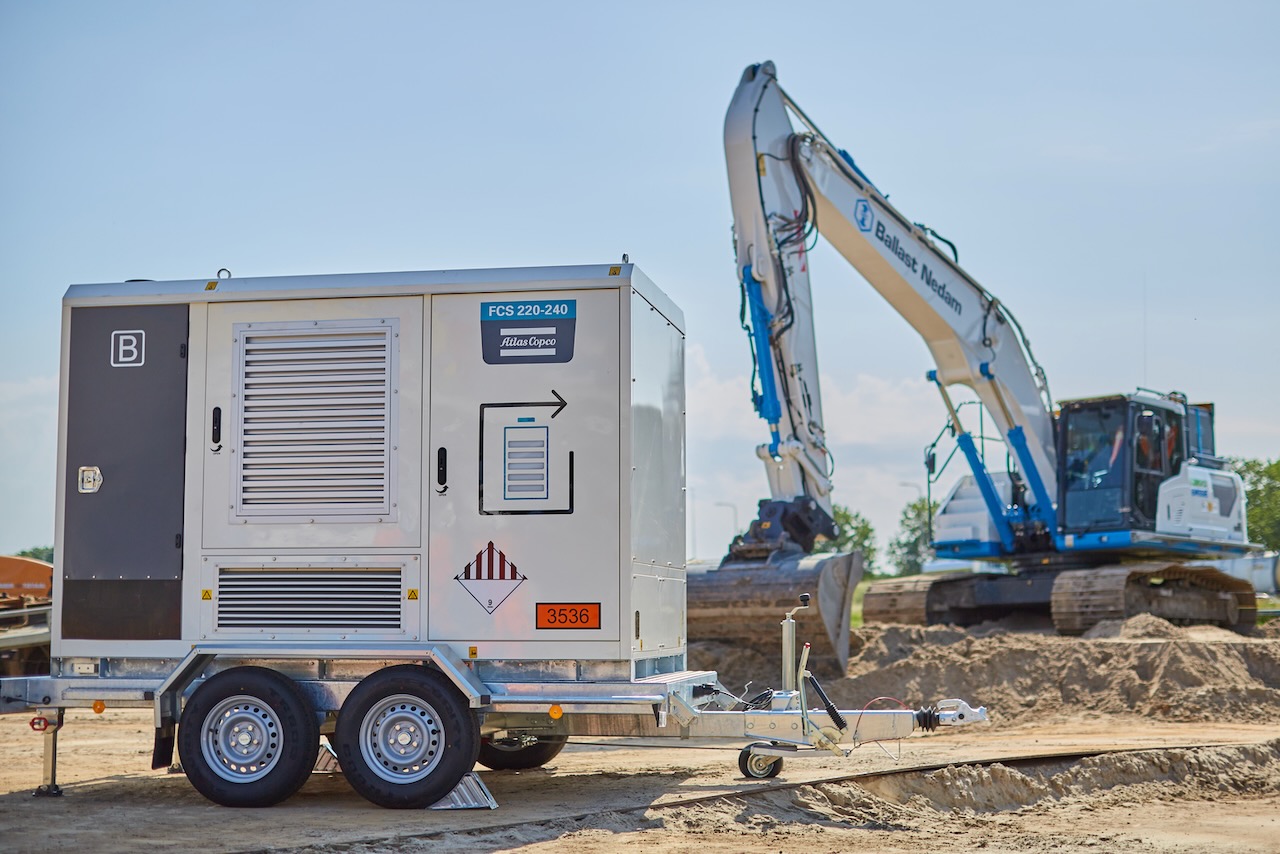
Atlas Copco has launched the towable FCS 220-240 mobile rapid charging station, delivering 232kWh with over 220 kW DC and 50 kW AC outputs in a 3.5‑tonne, IP55-rated unit for excavators, loaders, trucks and other site equipment. Customer trials report up to five extra operating hours from one hour of charging, with multiple connectors for simultaneous charging and Dynamic Load Management to balance EV demand with up to 50 kW of auxiliary site loads. Charge-to-recharge capability, RFID-based multi-level access control, OCPP support and remote monitoring target rental fleets and remote or grid-constrained worksites.
Technical Brief
- Multiple DC/AC connectors support parallel charging of mixed plant fleets without additional distribution boards.
- Charge-through capability means it can act as both buffer storage and pass-through for grid or generator power.
- Multi-level user access lets site or fleet managers lock configuration while granting basic start/stop to operators.
- RFID-based authentication enables contractor-specific usage logging, supporting cost allocation and rental billing.
Our Take
Atlas Copco’s earlier QHS integrated hybrid generators and the B-Air 185-12 compressor, both covered with theconstructionindex.co.uk, indicate a deliberate UK-facing portfolio of battery-centric site power solutions that this 232 kWh mobile charger can plug into as the high-capacity node.
With over 220 kW DC and 50 kW AC output in a 3.5 t package, the FCS 220-240 is sized to support not only individual electric machines but also auxiliary site loads, which in practice can let contractors reconfigure temporary power layouts and downsize diesel gensets on constrained urban UK sites.
Across the 987 tag-matched Product/Sustainability pieces in our database, Atlas Copco stands out for repeatedly pairing electrified equipment (e.g. B-Air 185-12, DrillAir upgrades) with enabling power infrastructure, signalling a strategy to lock in customers to a full electric ecosystem rather than one-off machines.
Prepared by collating external sources, AI-assisted tools, and Geomechanics.io’s proprietary mining database, then reviewed for technical accuracy & edited by our geotechnical team.


