Geomechanics.io

  • Free Tools
Sign UpLog In
Built byBoxcut Studio

Geomechanics.io

Geomechanics, Streamlined.

© 2026 Geomechanics.io. All rights reserved.

Geomechanics.io

CMRR-ioGEODB-ioHYDROGEO-ioQCDB-ioFree Tools & CalculatorsBlogLatest Industry News

Industries

MiningConstructionTunnelling

Company

Terms of UsePrivacy PolicyLinkedIn
    Projects
    Sustainability

    Anglo American’s desalinated water at Los Bronces: system impacts for mine planners

    September 29, 2026|

    Reviewed by Tom Sullivan

    First reported on International Mining – News

    30 Second Briefing

    Anglo American has started supplying desalinated water to its Los Bronces copper mine in Chile via the newly commissioned Quilapilún Station in Colina, where collection pools feed a dedicated pipeline into the operation. Chile’s Joint Minister of Economy, Development and Tourism, and Mining, Daniel Mas, formally opened the valve on 28 September, signalling a shift away from direct freshwater abstraction in a highly water-stressed region. For mine planners and process engineers, the move implies tighter integration of desalinated supply into plant water balances, pumping energy demand, and long-term permitting strategies.

    Technical Brief

    • Integration of the new line requires revised hydraulic control, pressure management and surge protection along the route.
    • Water quality from desalination will require process plant corrosion control and reagent adjustment versus historical sources.
    • Similar Andean copper operations using coastal desalination face comparable trade-offs in pumping energy versus water security.

    Our Take

    Among recent Chile–copper pieces in our database, most focus on smelting bottlenecks and permitting risk, so Anglo American’s Los Bronces move into desalinated supply in Colina stands out as a rare example of large-scale water-risk mitigation rather than downstream capacity issues.

    Anglo American features heavily in recent coverage for portfolio reshaping in Brazil (the proposed sale of Barro Alto and Codemin to MMG), and coupling that divestment with long-life copper assets like Los Bronces being de-risked on water suggests a clearer tilt towards capital allocation into Tier‑1 copper rather than ferronickel.

    Geotechnical Software for Modern Teams

    Centralise site data, logs, and lab results with GEODB-io, CMRR-io, and HYDROGEO-io.

    No credit card required.

    • Save and export unlimited calculations
    • Advanced data visualisation
    • Generate professional PDF reports
    • Cloud storage for all your projects

    Prepared by collating external sources, AI-assisted tools, and Geomechanics.io’s proprietary mining database, then reviewed for technical accuracy & edited by our geotechnical team.

    Related Articles
    Mining
    about 3 hours ago

    Skouries mine energisation: power, scheduling and cost implications for engineers

    Eldorado Gold has completed permanent energisation of the Skouries gold-copper project in northern Greece, connecting the site to the Greek national power grid after final inspection, testing and approval by the transmission authority. The grid tie-in replaces temporary power and enables commissioning of major process plant systems, underground infrastructure and dewatering equipment ahead of ramp-up. Reliable high-voltage supply is critical for Skouries’ planned large-scale concentrator and will influence mine scheduling, ventilation design and long-term operating costs.

    Mining
    about 3 hours ago

    Caterpillar quarrying AHS at Richards Spur: design and haulage notes for planners

    Caterpillar is extending its Command for hauling autonomous haulage system into quarry-scale operations with a new deployment at Dolese Bros’ Richards Spur quarry in Oklahoma, following its earlier rollout on Cat 777 trucks at Carmeuse’s Drummond Island quarry in Michigan supported by Fabick Cat. The Richards Spur project applies AHS to a high-production limestone operation using rigid-frame haul trucks on short, repetitive quarry cycles rather than traditional large open-pit layouts. For geotechnical and quarry planners, this signals OEM confidence that AHS can handle tighter haul roads, variable bench conditions and more constrained traffic patterns typical of aggregates sites.

    Latin America mining risks and the $54B hit: key lessons for project teams
    Mining
    about 4 hours ago

    Latin America mining risks and the $54B hit: key lessons for project teams

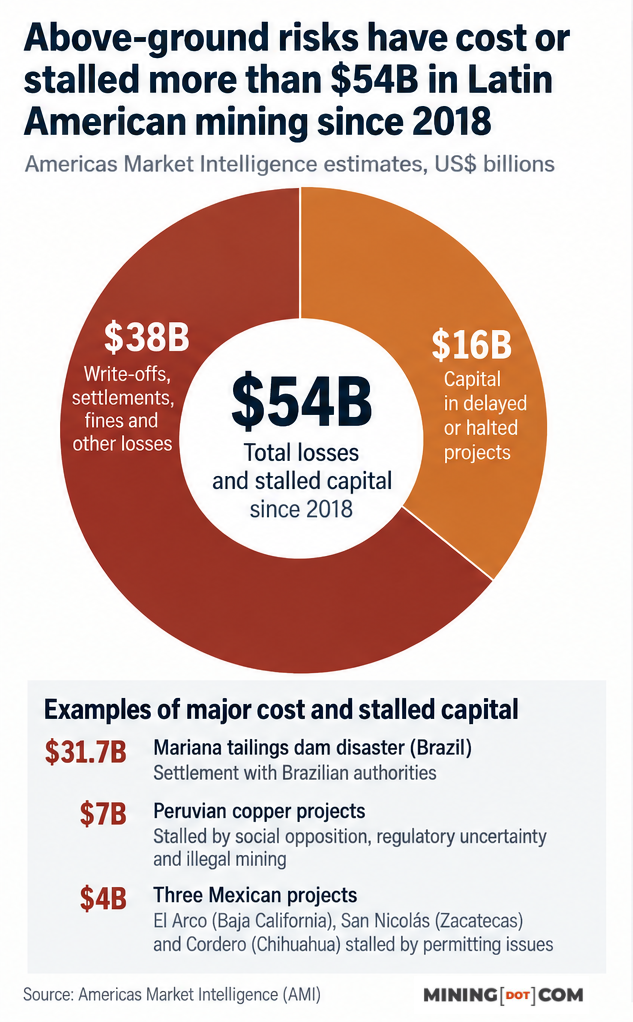
    Above-ground risks have imposed or frozen more than $54 billion in Latin American mining since 2018, including a $31.7‑billion settlement for the 2015 Mariana tailings dam failure in Brazil and roughly $7 billion in stalled Peruvian copper projects plus $4 billion tied up in Mexico’s El Arco, San Nicolás and Cordero developments. AMI also cites Panama’s $6.8‑billion Cobre Panamá copper mine closure and over 700 days of transport-corridor blockades at Peru’s Las Bambas as emblematic of execution and social risk. Consultants report investors now heavily discount projects with uncertain permitting timelines, weak institutional legitimacy or high exposure to illegal mining.

    Related Industries & Products

    Mining

    Geotechnical software solutions for mining operations including CMRR analysis, hydrogeological testing, and data management.

    CMRR-io

    Streamline coal mine roof stability assessments with our cloud-based CMRR software featuring automated calculations, multi-scenario analysis, and collaborative workflows.

    HYDROGEO-io

    Comprehensive hydrogeological testing platform for managing, analysing, and reporting on packer tests, lugeon values, and hydraulic conductivity assessments.

    GEODB-io

    Centralised geotechnical data management solution for storing, accessing, and analysing all your site investigation and material testing data.

    AllGeotechnicalInfrastructureHazardsEnvironmental