Albert Street’s 80t flood lid: design and testing insights for station engineers
Reviewed by Joe Ashwell
First reported on New Civil Engineer
30 Second Briefing
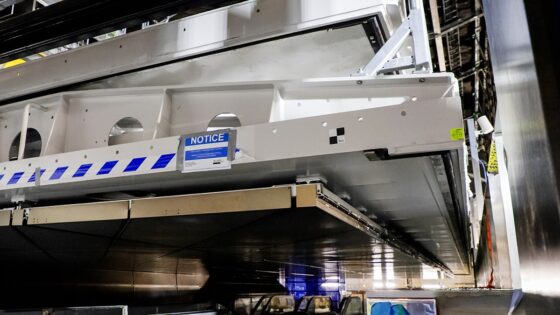
An 80t steel and concrete lid measuring 22m by 10m has been installed over Brisbane’s new Albert Street underground rail station as a flood barrier designed for a 1-in-10,000-year event. The structure is being load- and watertightness-tested in situ to confirm performance under extreme hydraulic head and debris impact conditions. For station box and tunnel designers, the project shows a move towards integrated, surface-level hard barriers rather than relying solely on internal flood doors and sump pumping capacity.
Technical Brief
- Lid mass and plan dimensions demand heavy-lift cranage and tight positional tolerances over the station box.
- Composite steel–concrete construction provides both impact resistance and stiffness against differential hydraulic loading.
- In-situ watertightness tests will likely check gasket performance, concrete cracking and steel–concrete interfaces.
- Load testing on the installed unit allows verification of support reactions into the permanent station structure.
- Locating the barrier at surface level reduces reliance on deep sump pumps and internal flood doors.
- Testing regime will inform inspection intervals and maintenance requirements for seals, coatings and drainage details.
- For other underground stations, such lids offer an alternative to raising entrances or constructing perimeter levees.
Our Take
The 80 t, 22 m by 10 m flood lid at Albert Street station implies substantial interface demands on station structural framing and lifting/actuation systems, which operators elsewhere in flood-prone Australian cities will likely study as a reference for retrofittable flood barriers.
New Civil Engineer’s wider coverage, including its webinar on BIM and asset management platforms, suggests that a bespoke asset like this flood lid will only deliver full value if Brisbane’s rail authorities integrate its inspection, actuation and resilience data into long-term digital asset registers.
Prepared by collating external sources, AI-assisted tools, and Geomechanics.io’s proprietary mining database, then reviewed for technical accuracy & edited by our geotechnical team.
Related Articles


Related Industries & Products
Construction
Quality control software for construction companies with material testing, batch tracking, and compliance management.
Tunnelling
Specialised solutions for tunnelling projects including grout mix design, hydrogeological analysis, and quality control.
QCDB-io
Comprehensive quality control database for manufacturing, tunnelling, and civil construction with UCS testing, PSD analysis, and grout mix design management.