A52 improvement package: design, phasing and safety lessons for road engineers
Reviewed by Tom Sullivan
First reported on New Civil Engineer
30 Second Briefing
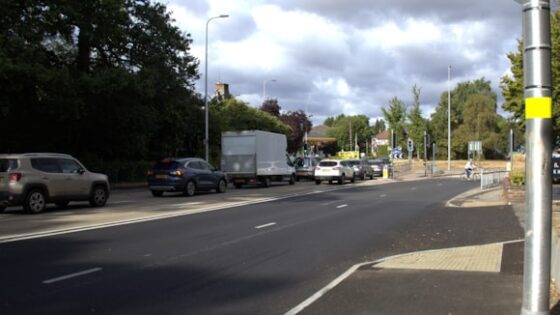
Work on a major improvement scheme along the A52, one of Nottingham’s busiest strategic routes linking the A1 and M1, is nearing completion after a multi-year programme of junction upgrades and capacity works. The package focuses on key bottlenecks between the QMC and Gamston roundabouts, adding new signalised junction layouts, extra approach and exit lanes, and revised pedestrian and cycle crossings to improve traffic flow and safety. For designers and contractors, the scheme consolidates incremental works on an existing urban dual carriageway under live traffic, with long-term implications for maintenance access and future widening.
Technical Brief
- Works delivered under live traffic on a strategic trunk road, requiring complex temporary traffic management.
- Multiple junction interventions consolidated into one package, simplifying future maintenance planning and traffic management phasing.
- Urban dual carriageway context constrained worksite widths, influencing construction sequencing and temporary safety barriers.
- Interfaces with existing pedestrian and cycle facilities demanded staged diversions and robust temporary crossing protection.
- Safety risk assessments had to account for high-speed through traffic and frequent local access movements.
- Drainage and pavement tie-ins to legacy A52 construction required careful night-time possession planning for worker safety.
- Lessons on integrating incremental upgrades into a single programme are directly transferable to other trunk-road corridors.
Our Take
New Civil Engineer’s recent webinar coverage on BIM, common data environments and digital handover suggests that A-road safety upgrades such as on the A52 are increasingly expected to deliver clean asset data at completion, not just physical works.
The prominence of New Civil Engineer in both this A52 item and the early-career bridges and Heathrow innovation competitions in our database indicates that UK practitioners are using the same media ecosystem to track both day-to-day safety schemes and emerging best practice in asset management and bridge retrofit.
Prepared by collating external sources, AI-assisted tools, and Geomechanics.io’s proprietary mining database, then reviewed for technical accuracy & edited by our geotechnical team.
Related Articles


Related Industries & Products
Construction
Quality control software for construction companies with material testing, batch tracking, and compliance management.
Mining
Geotechnical software solutions for mining operations including CMRR analysis, hydrogeological testing, and data management.
QCDB-io
Comprehensive quality control database for manufacturing, tunnelling, and civil construction with UCS testing, PSD analysis, and grout mix design management.