£53M Dover Western Docks Revival: design and capacity notes for port engineers
Reviewed by Joe Ashwell
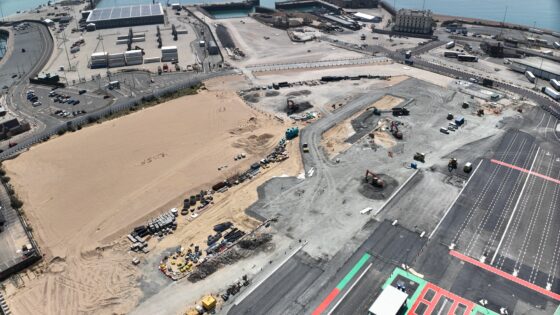
First reported on New Civil Engineer
30 Second Briefing
A joint venture between McLaughlin & Harvey and Boskalis Westminster has completed the £53M Dover Western Docks Revival (DWDR) Stage 3B works at the Port of Dover, finalising the latest phase of the port’s western expansion. The marine-focused package follows earlier DWDR stages that created new berths and quay walls to handle larger Ro-Ro and cargo vessels, reshaping the harbour basin and associated land reclamation. Completion signals full handover of upgraded dock infrastructure, with implications for future quay strengthening, pavement design and heavy freight yard layouts as traffic volumes grow.
Technical Brief
- Contract value of £53M constrains scope for heavy marine civils, ground improvement and quay works.
- Stage 3B delivery by McLaughlin & Harvey–Boskalis Westminster JV concentrates marine construction risk within a single alliance.
- Completion of this package enables subsequent quay strengthening and high-axle-load pavement design to be programmed without marine interface clashes.
- Handover timing at an operational ferry and cargo port implies complex tidal, navigation and access phasing constraints.
- Integration with earlier DWDR stages requires continuity of design assumptions for bearing capacity, settlement and quay wall performance.
- Marine works at Dover must account for chalk geology, high tidal range and wave loading on new structures.
- Upgraded western docks geometry will influence future Ro-Ro marshalling yard layouts, heavy freight turning radii and stacking densities.
Our Take
McLaughlin & Harvey’s role at Dover Western Docks Revival sits alongside a run of high-value UK work in our database, including the £100m Rolls-Royce air combat facility and MOD-backed Sheffield Forgemasters expansion, signalling that the contractor is now embedded in complex, security- and logistics-critical projects rather than just general civils.
Prepared by collating external sources, AI-assisted tools, and Geomechanics.io’s proprietary mining database, then reviewed for technical accuracy & edited by our geotechnical team.


