Geomechanics.io

  • Free Tools
Sign UpLog In

    Geomechanics.io

    Geomechanics, Streamlined.

    © 2026 Geomechanics.io. All rights reserved.

    Geomechanics.io

    CMRR-ioGEODB-ioHYDROGEO-ioQCDB-ioFree Tools & CalculatorsBlogLatest Industry News

    Industries

    MiningConstructionTunnelling

    Company

    Terms of UsePrivacy PolicyLinkedIn
    Projects

    2026 Winter Olympics medals: metals value and supply lens for mining teams

    February 3, 2026|

    Reviewed by Joe Ashwell

    2026 Winter Olympics medals: metals value and supply lens for mining teams

    First reported on MINING.com

    30 Second Briefing

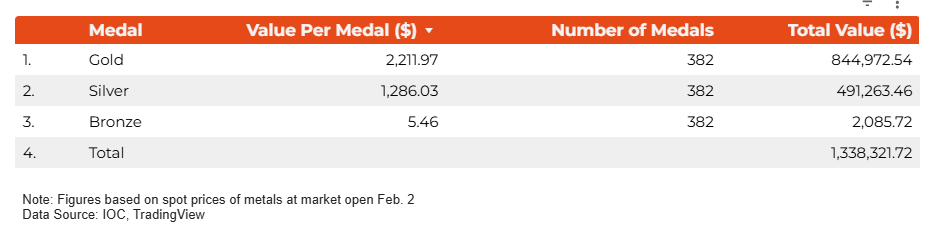
    Metals price rallies have pushed the intrinsic value of the 1,146 medals to be awarded at Milano Cortina 2026 above $1.3 million, with each gold medal now worth about $2,212 in metal content versus roughly $736 at Beijing 2022. Design specifications show each gold medal contains about 500 g of .999 silver and 6 g of .9999 gold, silver medals contain the same 500 g of silver, and bronze medals use roughly 410 g of copper. Using current prices of ~$4,800/oz gold, $80/oz silver and $13,000/t copper, a silver medal is valued at ~$1,286 and a bronze at just $5.46.

    Technical Brief

    • Medal fabrication is by the Italian State Mint using recycled feedstock and renewable power.
    • Milano Cortina 2026 medals adopt a split geometry symbolising dual host cities Milan and Cortina d’Ampezzo.
    • Fine silver in gold and silver medals is specified at .999 purity; gold at .9999.
    • Bronze medals are effectively high‑copper alloys, with c.410 g copper per unit dominating composition.
    • Total output is 735 Olympic plus 411 Paralympic medals, giving 1,146 units manufactured.
    • Design specifications are published by the International Olympic Committee, enabling precise metal mass and value calculations.
    • Metals pricing context: current gold, silver and copper levels exceed all previous Winter Games benchmarks.

    Our Take

    The same gold and silver rally that has lifted the intrinsic value of Milano Cortina medals is also underpinning record valuations in the MINING.COM Top 50 rankings, where a recent piece noted gold edging towards $5,000/oz and record copper prices driving a $2 trillion combined market cap.

    With silver now around $80/oz versus roughly $23/oz at Beijing 2022, the medal-value jump mirrors what our broader coverage has highlighted: silver-heavy producers such as Aya Gold & Silver and other precious-focused names have moved up recent Global Mining Power Rankings on the back of stronger price decks.

    Copper’s role in the bronze medals aligns with multiple recent items in our database that flag copper as a key beneficiary of the current metals rally, suggesting that even symbolic uses like Olympic medals are being repriced in line with tight physical markets and bullish long-term demand expectations.

    Geotechnical Software for Modern Teams

    Centralise site data, logs, and lab results with GEODB-io, CMRR-io, and HYDROGEO-io.

    No credit card required.

    • Save and export unlimited calculations
    • Advanced data visualisation
    • Generate professional PDF reports
    • Cloud storage for all your projects

    Prepared by collating external sources, AI-assisted tools, and Geomechanics.io’s proprietary mining database, then reviewed for technical accuracy & edited by our geotechnical team.

    Related Articles

    First Quantum’s La Granja copper giant: design and risk notes for project engineers
    Mining
    about 17 hours ago

    First Quantum’s La Granja copper giant: design and risk notes for project engineers

    First Quantum Minerals’ updated NI 43-101 for the La Granja copper project in northern Peru outlines 4.8 billion tonnes of measured and indicated resources at 0.48% Cu (23.0 Mt contained), plus 5.2 billion tonnes inferred at 0.40% Cu (20.7 Mt), based on 832 diamond holes totalling 370,000 metres. The company plans pit-side comminution and slurry transport via a 7 km tunnel to a processing and tailings complex on a flatter Pacific coastal plain ~100 km away, using desalinated seawater as primary supply. Engineering focus centres on managing arsenic as discrete, “packageable” mineral phases to maintain saleable concentrate through a conventional flowsheet under Peru’s strict ESIA regime.

    Mining
    about 21 hours ago

    Rosh Pinah Zinc water treatment plant: water balance and throughput notes for engineers

    Rosh Pinah Zinc and Appian Capital Advisory have commissioned a new process water treatment plant at the Rosh Pinah mine in Namibia as a core element of the RP2.0 expansion. The plant is engineered to retreat and recycle process water from multiple circuits across the operation, cutting freshwater draw and reducing discharge volumes to the site’s TSF and evaporation facilities. For mine planners and process engineers, the scheme tightens the site water balance and may enable higher throughput under existing abstraction permits.

    World’s 10 biggest copper mines: supply risk and price drivers for planners
    Mining
    about 21 hours ago

    World’s 10 biggest copper mines: supply risk and price drivers for planners

    Copper prices, already up 40% in 2025 and hitting a record $14,500/t in January 2026, are being driven by AI-related demand, supply disruptions and looming cost pressures from energy and sulfuric acid shortages, with the ICSG now forecasting a 150,000 t deficit for 2026. The 10 largest copper mines produced 4.9 Mt in 2025, led by Escondida at 1,347.6 kt, while major assets such as Grasberg and Kamoa-Kakula face landslide, flooding and seismic-related constraints that could remove hundreds of thousands of tonnes from the market. For planners and project developers, the rankings emphasise concentration risk in a handful of long-lived operations and the growing influence of infrastructure bottlenecks, community blockades and state renegotiations on effective supply.

    Related Industries & Products

    Mining

    Geotechnical software solutions for mining operations including CMRR analysis, hydrogeological testing, and data management.

    CMRR-io

    Streamline coal mine roof stability assessments with our cloud-based CMRR software featuring automated calculations, multi-scenario analysis, and collaborative workflows.

    HYDROGEO-io

    Comprehensive hydrogeological testing platform for managing, analysing, and reporting on packer tests, lugeon values, and hydraulic conductivity assessments.

    GEODB-io

    Centralised geotechnical data management solution for storing, accessing, and analysing all your site investigation and material testing data.

    AllGeotechnicalInfrastructureHazardsEnvironmental