£153M Thickthorn junction upgrade: bridge lift and safety lessons for engineers
Reviewed by Joe Ashwell
First reported on New Civil Engineer
30 Second Briefing
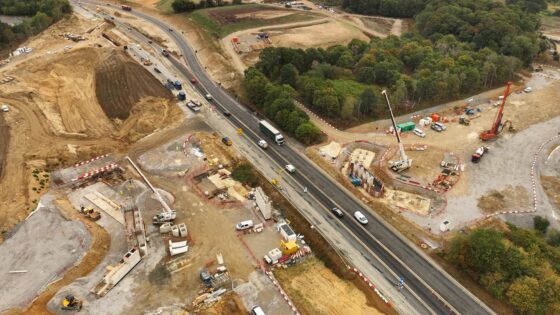
A £153M upgrade of the Thickthorn junction on the A47/A11 south of Norwich is advancing this week with a purpose-built bridge being craned into position to reconfigure one of the region’s busiest strategic road interchanges. The new structure is a key element in separating A11–A47 through traffic from local movements, reducing weaving and short merge lengths that currently constrain capacity and raise collision risk. For designers and contractors, the lift marks the critical transition from earthworks and foundations to full structural integration and subsequent tie-in works under live-traffic conditions.
Technical Brief
- Night-time or possession working windows likely used to minimise exposure of lifting operations to road users.
- Temporary traffic management, including lane closures and reduced speed limits, will control vehicle–plant interface risk.
- Crane outrigger loadings demand pre-verified hardstandings and checks against buried services and embankment stability.
- Bridge units will need pre-installed edge protection and fall-arrest anchor points before any deck access.
- Lift planning must comply with LOLER and CDM requirements, including a designated Appointed Person and exclusion zones.
- Structural tie-ins to existing earthworks will require staged construction and temporary barriers to maintain containment.
Our Take
New Civil Engineer’s recent webinar on BIM, CDEs and the ‘data handover gap’ suggests that a complex bridge lift on the A47/A11 node will be scrutinised not just for construction safety, but for how digital records of the lift and temporary works are captured for long-term asset management.
The prominence of bridges-focused content in New Civil Engineer’s related pieces (including the Bridges Awards and the Beyond Design Bridges Challenge) signals that the Thickthorn bridge operation is likely to be benchmarked against current best practice in UK bridge retrofit and replacement, especially around temporary traffic management and lifting methodologies.
Prepared by collating external sources, AI-assisted tools, and Geomechanics.io’s proprietary mining database, then reviewed for technical accuracy & edited by our geotechnical team.
Related Articles


Related Industries & Products
Construction
Quality control software for construction companies with material testing, batch tracking, and compliance management.
Mining
Geotechnical software solutions for mining operations including CMRR analysis, hydrogeological testing, and data management.
QCDB-io
Comprehensive quality control database for manufacturing, tunnelling, and civil construction with UCS testing, PSD analysis, and grout mix design management.