Volta Metals’ Springer rare earths project: resource, gallium and PEA lens for engineers
Reviewed by Tom Sullivan
First reported on MINING.com
30 Second Briefing
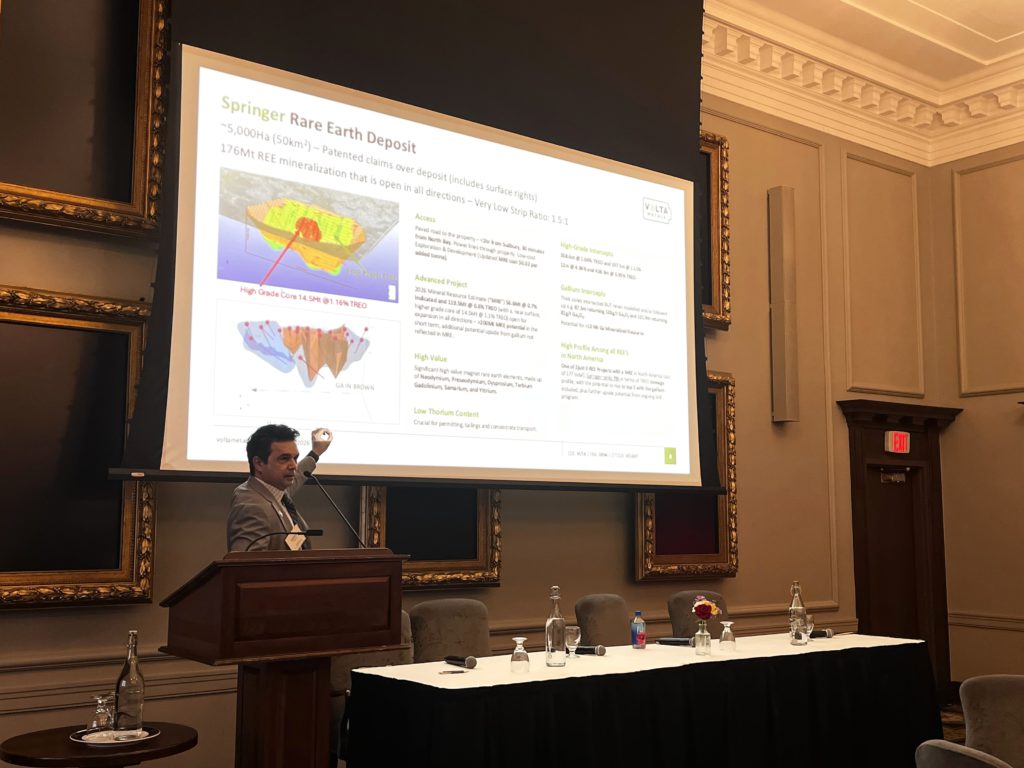
Volta Metals’ Springer rare earths project, 70 km east of Sudbury with road access and grid power on site, now hosts 56.6 million indicated tonnes at 0.7% TREO plus 119.5 million inferred tonnes at 0.58% TREO, including a near-surface high-grade core of 11.5 million tonnes at 1.1% TREO. A 1,638-metre drill campaign delivered an 11-fold resource increase over the historical estimate, with more than 5,000 metres planned to support a preliminary economic assessment by end-2026. Fall drilling also intersected 131.9 metres at 81.2 g/t Ga2O3 and 1.4% TREO from 59.6 metres, positioning Springer as a potential primary gallium resource pending recovery testwork.
Technical Brief
- Classification uplift is from a historical 17 Mt estimate, implying substantial reinterpretation of geometry and continuity.
- Springer sits 70 km east of Sudbury and 310 km northeast of Toronto, with all-season road access.
- Grid power is already on site, materially reducing future CAPEX for powerline construction and camp infrastructure.
- Mineralisation includes both light REEs (Nd, Pr, Sm) and heavy REEs (Dy, Tb, Gd, Y), favouring diversified concentrate value.
- Gallium is currently not in the April resource statement, with inclusion contingent on forthcoming metallurgical recovery testwork.
- Springer is ranked seventh-largest North American REE deposit by S&P Global, between Ashram (Quebec) and Nechalacho (NWT).
- In a Canadian context where most large REE deposits are remote, Springer’s brownfield-style access materially de-risks logistics and opex.
Our Take
Within our 113 rare-earths pieces, most Canadian stories centre on remote Quebec and Northwest Territories assets, so Springer’s 70 km distance from Sudbury marks it out as one of the few large-scale REE resources in an established mining and processing hub with existing labour and power infrastructure.
The 11-fold increase over the historical 17 Mt resource, combined with a defined near-surface high‑grade core at Springer, suggests this deposit could be engineered first as a smaller, higher-margin starter pit before scaling up, which is a pattern seen in other capital‑constrained critical-mineral juniors in our database.
Gallium credits at the grades reported for Springer are relatively uncommon in our recent rare-earth coverage and, if metallurgically recoverable, could materially influence project economics at a time when Western supply of gallium is under scrutiny following Chinese export controls.
Prepared by collating external sources, AI-assisted tools, and Geomechanics.io’s proprietary mining database, then reviewed for technical accuracy & edited by our geotechnical team.
Related Articles

Related Industries & Products
Mining
Geotechnical software solutions for mining operations including CMRR analysis, hydrogeological testing, and data management.
Construction
Quality control software for construction companies with material testing, batch tracking, and compliance management.
CMRR-io
Streamline coal mine roof stability assessments with our cloud-based CMRR software featuring automated calculations, multi-scenario analysis, and collaborative workflows.
HYDROGEO-io
Comprehensive hydrogeological testing platform for managing, analysing, and reporting on packer tests, lugeon values, and hydraulic conductivity assessments.
GEODB-io
Centralised geotechnical data management solution for storing, accessing, and analysing all your site investigation and material testing data.