Geomechanics.io

  • Free Tools
Sign UpLog In

Geomechanics.io

Geomechanics, Streamlined.

© 2026 Geomechanics.io. All rights reserved.

Geomechanics.io

CMRR-ioGEODB-ioHYDROGEO-ioQCDB-ioFree Tools & CalculatorsBlogLatest Industry News

Industries

MiningConstructionTunnelling

Company

Terms of UsePrivacy PolicyLinkedIn
    Projects

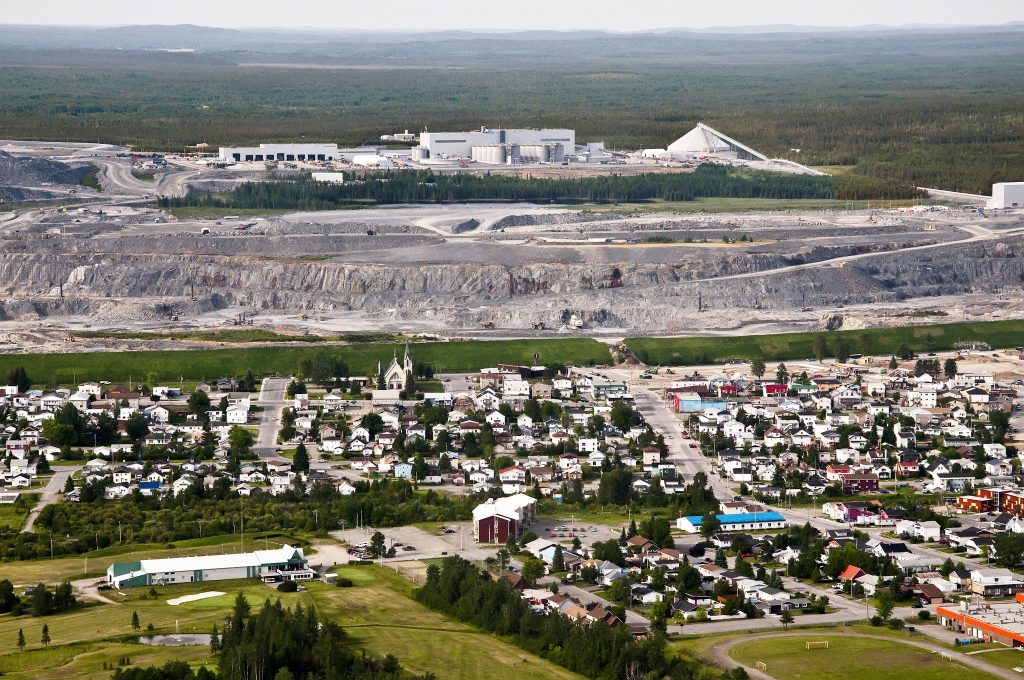
    Val-d’Or gold camp: long-term mine planning lessons for engineers and geologists

    April 30, 2026|

    Reviewed by Joe Ashwell

    Val-d’Or gold camp: long-term mine planning lessons for engineers and geologists

    First reported on MINING.com

    30 Second Briefing

    Val-d’Or’s evolution from a 1930s bush camp around early high-grade discoveries at Sullivan Consolidated, Lamaque and Sigma into a hard-rock gold city shows how rapid underground development, deeper shafts and mechanised mining turned a remote Abitibi Greenstone Belt outpost into a durable production hub. Successive waves of operators, culminating in Agnico Eagle’s Goldex, LaRonde and Canadian Malartic mines, have kept the district active on the same structures for nearly a century. For engineers and geologists, Val-d’Or now functions as both a live training ground and a case study in long-term camp-scale mine planning and infrastructure build-out.

    Technical Brief

    • Early Lamaque and Sigma development relied on hand-steel drilling and mule-drawn ore haulage before mechanisation.
    • Supply logistics initially depended on rough bush roads linking the camp to the Senneterre railhead.
    • Rapid underground expansion at Lamaque targeted high-grade veins, justifying shaft sinking in remote Abitibi conditions.
    • At Sigma, engineers progressively deepened shafts and refined underground methods to chase structurally controlled veins.
    • Transition from lanterns to electric lighting paralleled installation of town power infrastructure driven by mine demand.
    • Camp build-out included schools and hospitals, embedding social infrastructure directly tied to mining payroll stability.
    • Modern operations at historic Lamaque and Sigma work the same mapped structures identified in the early 1930s.
    • Val-d’Or’s evolution illustrates how early bush-camp logistics and workforce training can seed long-lived hard-rock hubs.

    Our Take

    The 60-tonne yttrium oxide shipment into the US positions this Canadian rare earth flow alongside Australian supply from Northern Minerals’ Browns Range project, which our coverage shows is one of the few other heavy rare earth sources actively scaling up outside China.

    Within our 486 keyword-matched pieces on gold and rare earths, there are only a handful that link Canadian rare earth exports directly to US aerospace demand, suggesting this Val-d’Or–centred story is part of a relatively small but strategically important subset of supply-chain articles rather than routine project news.

    Geotechnical Software for Modern Teams

    Centralise site data, logs, and lab results with GEODB-io, CMRR-io, and HYDROGEO-io.

    No credit card required.

    • Save and export unlimited calculations
    • Advanced data visualisation
    • Generate professional PDF reports
    • Cloud storage for all your projects

    Prepared by collating external sources, AI-assisted tools, and Geomechanics.io’s proprietary mining database, then reviewed for technical accuracy & edited by our geotechnical team.

    Related Articles
    Trump-linked $1.1B Kazakhstan tungsten project: key metrics for mine planners
    Mining
    about 6 hours ago

    Trump-linked $1.1B Kazakhstan tungsten project: key metrics for mine planners

    A $1.1 billion tungsten project in Kazakhstan’s Karaganda district is being advanced by newly formed Kaz Resources, created via the merger of US construction group Skyline Builders (Nasdaq: SKBL) and Cove Kaz Capital, with Skyline having paid $20 million for a 20% stake. The project covers the Northern Katpar and Upper Kairakty deposits, holds a 2023 JORC resource of 1.4 million tonnes WO₃, and targets output equivalent to about 15% of global tungsten production within three years. Cove/Kaz Resources will own 70% alongside Kazakh state miner Tau-Ken Samruk (30%), with potential debt support of up to $900 million from US Ex-Im Bank and $700 million from the US International Development Finance Corporation.

    Arizona Metals’ negative-value Kay mine PEA: project economics lens for engineers
    Mining
    about 10 hours ago

    Arizona Metals’ negative-value Kay mine PEA: project economics lens for engineers

    Arizona Metals’ Kay polymetallic project in Arizona has delivered a rare negative-value PEA, with a post-tax NPV5 of -$6 million, IRR of 4.9% and upfront capital of $731 million for a 1,918 t/d underground operation, triggering a 46% share price drop to C$0.29. Even a spot-price case at $6.05/lb copper and $4,745/oz gold only lifts the post-tax NPV to $445 million with a modest 14.9% IRR, constrained by limited initial tonnage. The PEA uses just 71% of the 9.28 Mt indicated resource, with no inferred material, so future economics hinge on adding tonnes, higher mining rates and alternative processing routes.

    Royal Canadian Mint cartel-linked gold: due diligence lessons for mine teams
    Mining
    about 10 hours ago

    Royal Canadian Mint cartel-linked gold: due diligence lessons for mine teams

    Gold refined by the Royal Canadian Mint may include material from Colombian mines linked to the Clan del Golfo cartel, after an unidentified Texas supplier mixed Antioquia-sourced gold with US metal that the Mint then classified as “North American”, a New York Times investigation found. About 5% of the Mint’s 2024 feedstock came from this US supplier, which held a valid audit naming Colombia as a source, while the Mint relied on supplier due diligence and said “it’s not our responsibility” to probe further. The Mint has now halted Colombian gold intake, launched an “incident review”, and plans to start disclosing source countries despite already deploying Bullion Genesis traceability software and LBMA-aligned KYC and AML controls.

    Related Industries & Products

    Mining

    Geotechnical software solutions for mining operations including CMRR analysis, hydrogeological testing, and data management.

    Construction

    Quality control software for construction companies with material testing, batch tracking, and compliance management.

    CMRR-io

    Streamline coal mine roof stability assessments with our cloud-based CMRR software featuring automated calculations, multi-scenario analysis, and collaborative workflows.

    HYDROGEO-io

    Comprehensive hydrogeological testing platform for managing, analysing, and reporting on packer tests, lugeon values, and hydraulic conductivity assessments.

    GEODB-io

    Centralised geotechnical data management solution for storing, accessing, and analysing all your site investigation and material testing data.

    AllGeotechnicalInfrastructureHazardsEnvironmental