Uranium shares slide: supply, cost and project risks unpacked for mine planners
Reviewed by Joe Ashwell
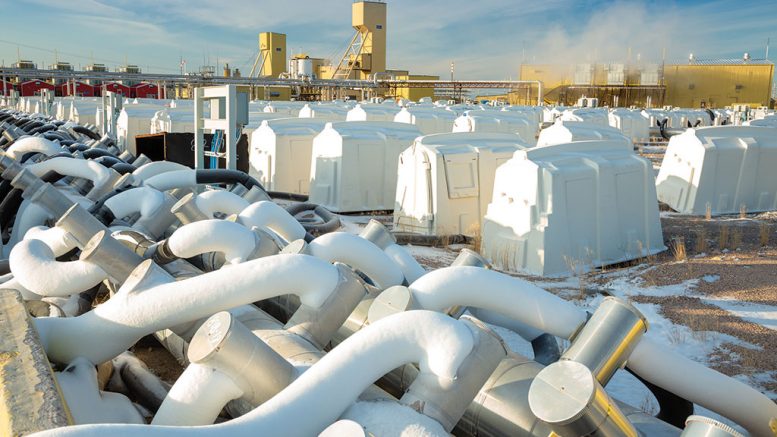
First reported on MINING.com
30 Second Briefing
Uranium mining equities fell sharply in September, with the VettaFi Global Uranium Mining Index down 16% and the Nasdaq Sprott Junior Uranium Miners Index off 22%, even as TradeTech’s long-term price indicator held near an 18‑year high at US$97/lb and BMI forecasts an average US$95/lb spot price in 2027. Supply risks centre on Kazakhstan’s in‑situ leach operations, where Kazatomprom’s sulphuric acid plant commissioning has slipped to 3Q 2027–1Q 2028, and on Western project execution, including NexGen’s Rook I (first ore targeted 3Q 2030) and Anfield’s Shootaring Canyon mill restart (mid‑2028). Cameco’s 3Q EBITDA of C$267 million came in 44% below BMO’s forecast, with attributable production 19% under expectations and cost-of-sales guidance raised to C$67–70/lb, reinforcing investor focus on cost inflation and operational reliability.
Technical Brief
- Kazakhstan’s in-situ leach output is constrained by sulphuric acid supply, with a new plant delayed by palaeontological finds.
- BMI now models lower Kazakh production next year, assuming acid bottlenecks and Kazatomprom prioritising value over volume.
- Global mine output is forecast to rise 7.8% this year, still yielding only a modest near-term surplus once secondary supplies and financial buying are included.
- TradeTech reports utilities contracting for deliveries from 2027 into the late 2030s, extending coverage well beyond current cycles.
- BMI projects reactor uranium requirements to grow 4.1% annually over 2026–35 versus 3.3% annual mine supply growth, driven mainly by Chinese reactor build-out.
- Cameco’s Key Lake maintenance shutdown has slipped into Q4, leaving restart timing a key production risk flag.
- NexGen’s Rook I schedule hinges on ground freezing in early 2027 and shaft sinking into basement rock during 2028, both identified as critical execution milestones.
- Anfield’s Shootaring Canyon mill restart depends on licence renewal targeted for Q2 2027 plus roughly one year of refurbishment construction and securing about US$117 million in initial capital.
Our Take
Cameco’s recent operational disruptions at Cigar Lake, highlighted in our July 2026 coverage, underline how single‑point processing bottlenecks in northern Saskatchewan can quickly tighten physical uranium availability even when long‑term demand growth (4.1% vs 3.3% mine output) already implies structural undersupply.
The long lead times at NexGen’s Rook I project, with ground freezing only starting in 2027 and first ore targeted for 2030, mean that high‑grade Canadian supply cannot materially relieve the 2026–35 gap between reactor requirements and mine production identified in this piece.
Prepared by collating external sources, AI-assisted tools, and Geomechanics.io’s proprietary mining database, then reviewed for technical accuracy & edited by our geotechnical team.
Related Articles


Related Industries & Products
Mining
Geotechnical software solutions for mining operations including CMRR analysis, hydrogeological testing, and data management.
Construction
Quality control software for construction companies with material testing, batch tracking, and compliance management.
CMRR-io
Streamline coal mine roof stability assessments with our cloud-based CMRR software featuring automated calculations, multi-scenario analysis, and collaborative workflows.
HYDROGEO-io
Comprehensive hydrogeological testing platform for managing, analysing, and reporting on packer tests, lugeon values, and hydraulic conductivity assessments.
GEODB-io
Centralised geotechnical data management solution for storing, accessing, and analysing all your site investigation and material testing data.