Geomechanics.io

  • Free Tools
Sign UpLog In
Built byBoxcut Studio

Geomechanics.io

Geomechanics, Streamlined.

© 2026 Geomechanics.io. All rights reserved.

Geomechanics.io

CMRR-ioGEODB-ioHYDROGEO-ioQCDB-ioFree Tools & CalculatorsBlogLatest Industry News

Industries

MiningConstructionTunnelling

Company

Terms of UsePrivacy PolicyLinkedIn
    Standard/Guideline
    Projects

    UK rail construction cost review: procurement and risk lessons for engineers

    November 10, 2026|

    Reviewed by Joe Ashwell

    UK rail construction cost review: procurement and risk lessons for engineers

    First reported on New Civil Engineer

    30 Second Briefing

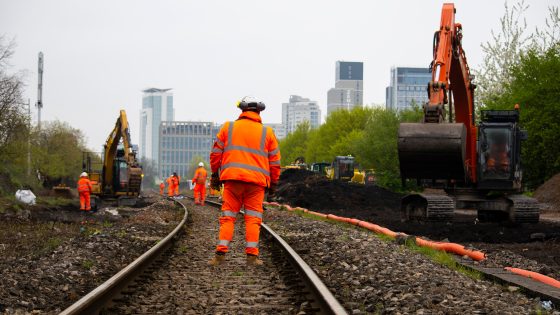
    Government has launched a six‑month review into why UK rail infrastructure schemes, such as electrification, new stations and major renewals, are significantly more expensive to deliver than comparable projects in Europe. The review will examine cost drivers across design standards, procurement models, possession regimes and risk allocation on projects delivered by Network Rail and Great British Railways Transition Team. Outcomes could influence future business cases, value‑for‑money tests and funding approvals for large schemes including HS2 extensions and Northern Powerhouse Rail.

    Technical Brief

    • Cost drivers to be interrogated include design standards, procurement models, possession regimes and contractual risk allocation.
    • Possession regime scrutiny is likely to examine night‑time and weekend access constraints on intensively used main lines.
    • Procurement review is expected to compare alliancing, target‑cost and traditional NEC forms used on recent routes.
    • Findings could be benchmarked against continental electrification and upgrade programmes, using scheme‑level £/track‑km comparisons.
    • Outcome is likely to influence geotechnical, civils and systems design optimisation, particularly around over‑specification and redundancy.

    Our Take

    With 114 Policy stories in our database, UK infrastructure pieces like this sit in a dense cluster of standard- and guideline-focused coverage, signalling that any rail cost review is likely to feed quickly into updated procurement and design norms rather than remain a one-off announcement.

    New Civil Engineer’s recent webinar on BIM, common data environments and asset management platforms suggests that any UK-wide rail cost review may look closely at digital delivery and data handover practices as levers for reducing lifecycle, not just upfront, construction costs.

    Geotechnical Software for Modern Teams

    Centralise site data, logs, and lab results with GEODB-io, CMRR-io, and HYDROGEO-io.

    No credit card required.

    • Save and export unlimited calculations
    • Advanced data visualisation
    • Generate professional PDF reports
    • Cloud storage for all your projects

    Prepared by collating external sources, AI-assisted tools, and Geomechanics.io’s proprietary mining database, then reviewed for technical accuracy & edited by our geotechnical team.

    Related Articles
    PAS 4010 infrastructure standard: productivity and workflow lens for project teams
    Policy
    about 2 hours ago

    PAS 4010 infrastructure standard: productivity and workflow lens for project teams

    PAS 4010, a new BSI Publicly Available Specification for UK infrastructure, will require major project teams to measure and manage productivity systematically across the full project lifecycle. The standard mandates structured assessment of workflows, interfaces and decision-making, pushing clients, designers and contractors to collect consistent performance data and act on identified bottlenecks rather than relying on ad hoc improvement initiatives. For engineers, this signals more formalised productivity baselining, clearer process metrics and closer scrutiny of how design, procurement and construction sequencing affect delivery efficiency.

    Brazil’s 27 critical minerals list: funding signals for mine project teams
    Policy
    1 day ago

    Brazil’s 27 critical minerals list: funding signals for mine project teams

    Brazil has approved a 27‑mineral critical list, with nine high‑priority commodities – including rare earths, graphite, lithium, nickel, cobalt, copper, manganese, silicon and uranium – guiding which projects qualify for federal backing. A new risk‑reduction fund, FGAM, can receive up to R$2 billion, while the Federal Program for Critical and Strategic Minerals will provide up to R$1 billion per year from 2030–2034 for mining development and transformation. Only listed minerals in nationally registered projects will be eligible, with classifications reviewed every four years.

    Australian miners rail against looming tax changes: capital risk lens for project teams
    Policy
    1 day ago

    Australian miners rail against looming tax changes: capital risk lens for project teams

    Australian mining leaders are warning that federal plans to replace the 50% capital gains tax discount with cost base indexation and a 30% minimum tax on gains from 1 July 2027 will choke risk capital for greenfields exploration. Evolution Mining founder Jake Klein and Westgold Resources managing director Wayne Bramwell told IMARC the exclusion of explorers from exemptions granted to tech start-ups is already drying up funding in Western Australia, Australia’s largest exploration jurisdiction. The Minerals Council of Australia and AMEC argue the policy conflicts with Canberra’s stated critical minerals ambitions and could damage the exploration ecosystem for years.

    Related Industries & Products

    Construction

    Quality control software for construction companies with material testing, batch tracking, and compliance management.

    Mining

    Geotechnical software solutions for mining operations including CMRR analysis, hydrogeological testing, and data management.

    QCDB-io

    Comprehensive quality control database for manufacturing, tunnelling, and civil construction with UCS testing, PSD analysis, and grout mix design management.

    AllGeotechnicalInfrastructureHazardsEnvironmental