Thames power tunnel TBM start: design and mixed-ground notes for tunnel engineers
Reviewed by Tom Sullivan
First reported on The Construction Index
30 Second Briefing
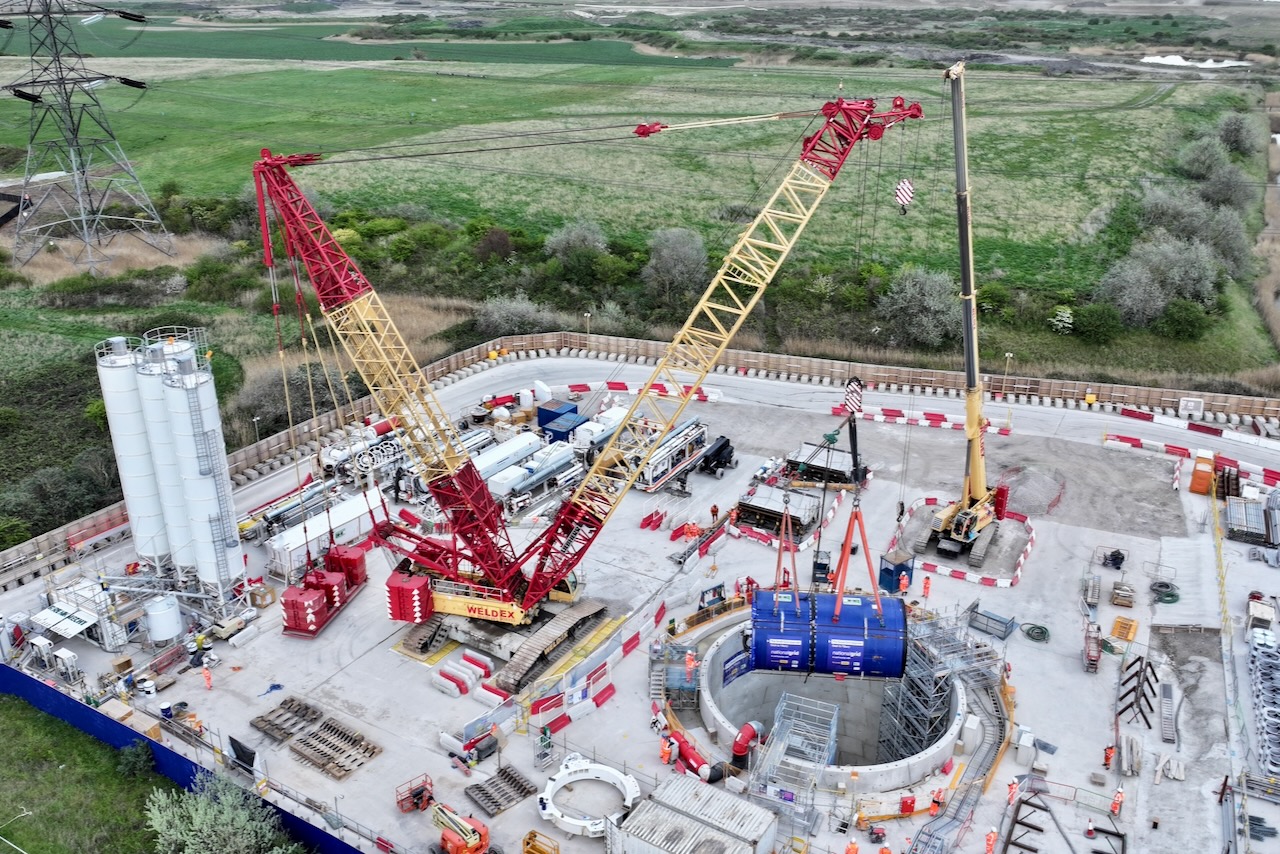
A Herrenknecht Mixshield TBM has begun driving a 2,200m National Grid cable tunnel under the Thames between Gravesend and Tilbury for the Ferrovial Bemo JV, following excavation of the launch shaft with a Herrenknecht Vertical Shaft Sinking Machine. The 4,730mm diameter, 108m-long, 464t machine is designed for mixed chalk–flint ground with compressive strengths up to 1,000MPa and water pressures up to 4.5 bar at 41m depth, using multiple sealing systems and a personnel airlock for hyperbaric interventions. The TBM installs 4.0m ID / 4.5m OD precast segmental lining on a 350m radius alignment, with hydraulic overcutter, mini gripper, anti-roll fins, face drilling rig, telescopic camera, VMT navigation and a dedicated separation plant and multi-service vehicles.
Technical Brief
- Launch and reception shafts are being sunk with Europe’s largest Herrenknecht shaft sinking system for access.
- TBM drive forms part of National Grid’s “Great Grid Upgrade” between Gravesend and Tilbury.
- Same supplier, Herrenknecht, also provided machinery for the related Grain–Tilbury grid reinforcement works.
- Tunnel alignment lies near the Thames estuary mouth, so tidal head drives up design water pressures.
- Personnel airlock enables hyperbaric tool changes while maintaining atmospheric pressure in the TBM backup.
- Telescopic camera and face drilling rig reduce the frequency of manned hyperbaric interventions for obstruction management.
Our Take
Herrenknecht’s role on National Grid’s Grain to Tilbury tunnel adds to a cluster of recent UK and international references in our database (HS2 Euston, Panama Canal undercrossing, Tung Chung West), signalling that National Grid is buying into a well‑proven Mixshield and control ecosystem rather than taking on a one‑off machine risk.
The predicted 1,000MPa compressive strength in the chalk–flint mix and 4.5bar design water pressure put this Thames crossing at the more demanding end of utility tunnels in our Infrastructure coverage, which typically deal with softer ground or lower heads, so contractors will likely lean heavily on VMT guidance and Herrenknecht’s segment design experience to manage wear and alignment on the 350m‑radius curve.
Prepared by collating external sources, AI-assisted tools, and Geomechanics.io’s proprietary mining database, then reviewed for technical accuracy & edited by our geotechnical team.
Related Articles


Related Industries & Products
Tunnelling
Specialised solutions for tunnelling projects including grout mix design, hydrogeological analysis, and quality control.
Mining
Geotechnical software solutions for mining operations including CMRR analysis, hydrogeological testing, and data management.
CMRR-io
Streamline coal mine roof stability assessments with our cloud-based CMRR software featuring automated calculations, multi-scenario analysis, and collaborative workflows.
HYDROGEO-io
Comprehensive hydrogeological testing platform for managing, analysing, and reporting on packer tests, lugeon values, and hydraulic conductivity assessments.
GEODB-io
Centralised geotechnical data management solution for storing, accessing, and analysing all your site investigation and material testing data.