TD sees rhodium surplus: supply, price and PGM mine planning takeaways
Reviewed by Joe Ashwell
First reported on MINING.com
30 Second Briefing
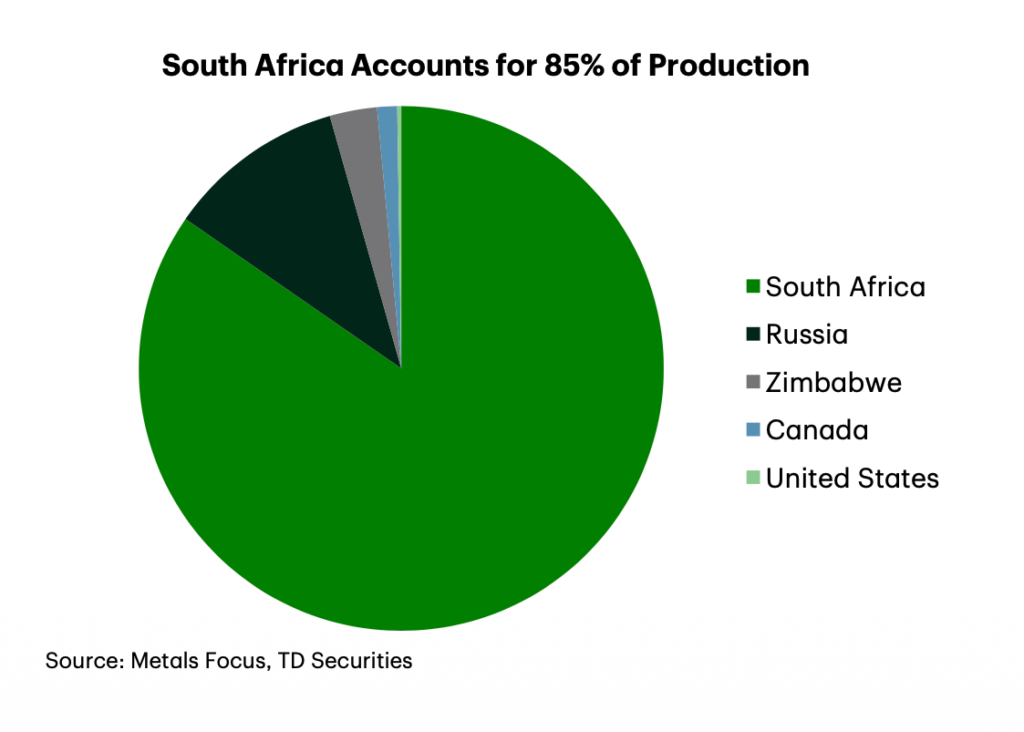
Rhodium is forecast by TD Commodity Strategy to swing to a 20,000‑oz surplus in 2027 after four years of deficits, pushing prices down from about $9,000/oz to $7,600 in 2027 and $6,500 in 2028 as mine and recycled supply rise against flat or falling autocatalyst demand. Above‑ground stocks are seen shrinking to just over three months of consumption, with South Africa’s highly concentrated output (about 85% of primary supply, half from five PGM mines) and a >3‑month refining cycle leaving prices prone to sharp spikes on any disruption. Autocatalyst demand is being eroded by EV uptake, while substitution into palladium can require 18–24 months and five to eight times the metal, and recycling growth is constrained by recovery rates and limited processing capacity.
Technical Brief
- Rhodium’s mine-to-refined processing chain exceeds three months, versus just over one month for platinum and palladium.
- Above-ground rhodium inventories are projected to shrink to a little over three months of demand cover.
- South Africa provides ~85% of primary rhodium; only five South African PGM mines supply ~50% of global output.
- Remaining primary supply comes mainly from smaller South African operations plus Russian and Zimbabwean PGM mines.
- Rhodium contributes only about 25% of mined PGM revenue, so mine plans track overall PGM basket economics, not rhodium alone.
- Around 80% of rhodium production feeds autocatalyst manufacture, tightly coupling demand to ICE vehicle output.
- Longer ICE vehicle lifespans delay scrap availability, slowing the return of rhodium to secondary supply streams.
- Substituting palladium into catalyst formulations typically needs 18–24 months and uses 5–8× the displaced rhodium mass.
- Recycling growth is constrained by sub‑100% recovery rates and limited processing equipment in key vehicle-retirement markets.
- Rhodium ETFs have seen first net inflows in over a decade, reintroducing investor-driven physical offtake volatility.
Our Take
With South Africa providing about 85% of primary rhodium supply and just five PGM mines accounting for roughly half of global output, any operational or power-disruption issues at those assets could rapidly flip a forecast surplus back towards tightness given above‑ground coverage of only a little over three months.
The 18–24 month lead time to substitute palladium for rhodium in autocatalysts, combined with the need for 5–8 times more palladium per unit of rhodium displaced, implies that any sustained rhodium surplus into 2027–2028 could materially tighten the palladium balance, which aligns with several palladium‑tagged pieces in our database highlighting concerns over medium‑term availability.
Rhodium making up about a quarter of mined PGM revenue means that price swings driven by this projected surplus will disproportionately affect the economics of South African PGM complexes such as Amandelbult, potentially accelerating decisions on shaft closures or mine-life optimisation even if platinum and palladium prices remain relatively stable.
Prepared by collating external sources, AI-assisted tools, and Geomechanics.io’s proprietary mining database, then reviewed for technical accuracy & edited by our geotechnical team.
Related Articles



Related Industries & Products
Mining
Geotechnical software solutions for mining operations including CMRR analysis, hydrogeological testing, and data management.
CMRR-io
Streamline coal mine roof stability assessments with our cloud-based CMRR software featuring automated calculations, multi-scenario analysis, and collaborative workflows.
HYDROGEO-io
Comprehensive hydrogeological testing platform for managing, analysing, and reporting on packer tests, lugeon values, and hydraulic conductivity assessments.
GEODB-io
Centralised geotechnical data management solution for storing, accessing, and analysing all your site investigation and material testing data.